

 How far are you willing to go to maintain anti-public peeing social conventions?
This is a question that plagues me at night, when I’m camping, and the bathroom is on the other end of the campground. On the one hand, watering a bush seems better than flushing a toilet, but sends untreated pollutants, which will eventually land up in a stream or a river, into the ground.
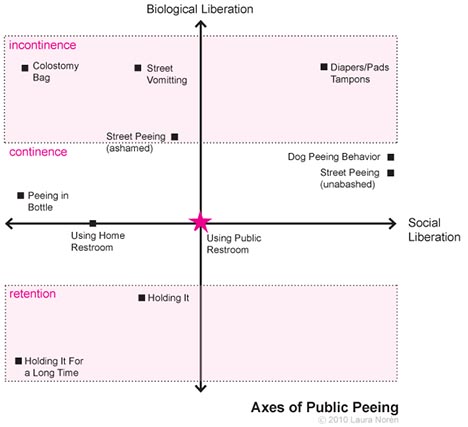
Treehugger posted an axes that weighs the argument differently, in terms of biological and social liberation. The graphic suggests that dogs and shameless public pee-ers, who both have their favorite walls judging by the stench, are the most biologically and socially liberated of them all.
Most interesting to me is the degree to which the axes suggests we will subdue our biological comfort to assuage social norms, which in most places discourages public territorial markings. But then, I’ve been places where no such norm exists.
In Israel, I regularly saw people (men especially – it is slightly more discreet) happily watering sidewalks in broad daylight, making virtually no effort to disguise themselves. The same is true in Africa. Not so long ago, I saw a man stark naked, taking a bath in the river beside a busy highway.
According to The Axes of Public Peeing designed by Laura Norén, incontinent people would rather stuff pads in their pants or hold their urine to its bursting point than transgress. Which means that social norms differ, but we already knew that. In New York, even dogs are discouraged from urinating on trees, which are said to die from excessive leg-lifts.
A quick wikipedia search reveals that urine is not toxic, and that until it reaches the urethra, it is absolutely sterile. There, the liquid waste is invaded by the epithelial cells’ colony of bacteria. This bacteria produces a foul odor, which is better or worse depending on each person’s diet.
Imagine walking down a busy street where men who eat a lot of asparagus relieve themselves on a daily basis. Sounds like an interesting olfactory education.
It is also true that modern wastewater treatment plants fail to manage our waste properly anyway. So, apart from smelling up a street, peeing in public won’t create much more of a hazard than already exists. Because of the new motley of drugs we use to treat every tiny ailment, a pernicious cocktail of pharmaceuticals bypasses conventional treatment processes and wreaks havoc on the reproductive systems of certain fish, for example.
I guess what is boils down to is a) we need better (and more) public facilities that address all of these problems, b) we need more efficient wastewater treatment systems, and c) if we gotta go, we gotta go:- liberate yourself!
:: Treehugger
More on peeing and pooing:



The (disturbing) issue of public peeing had driven me to design a green (concept) solution, you can see it on my web site under “concept”.www.aya-kaya.com
looking at it from a practical point of view:
people need to pee while in public places + the urban environment lacks green areas = why not solve both problem with one solution?
The design is a small installation (2metersX5meters), for peeing only, uses no water or grid electricity.
The urine is used to water the plants growing around the installation – the pee is being recycled.
I once heard a lecture about lichens. Apparently there are certain lichens that thrive at “male-pee” height on alley walls.
I was 6 months pregnant and at the central bus station in Tel Aviv – 6:30 am on my way to Jordan. I know why Israel is a nation of public pee-ers – there are no public restrooms available when you need them. And when you find them they are tragically filthy. The public restrooms that you have to pay for were locked. At the bus station – I found a dark alcove and … peed.
Truth is, when I am travelling by car in a well-wooded area, like in Canada or the US, I much prefer outdoor peeing. As long as I have privacy of course. It’s much more hygienic than touching a filthy public toilet.
Switzerland has an amazing public toilet system in its cities. You have to pay a lot to use them but it’s worth it. I was in Helsinki recently and theirs were paid also, but decent.
A pee in public is not anti-ecological for most humans. [If the human in question is extremely dehydrated and their urine is super-concentrated, that could threaten plant life.] Dogs’ urine tends to have higher concentrations of nitrogen than human urine and can cause plant death, especially if the dog is small. Small dog’s urine is more concentrated than big dogs urine. This concentrated dog urine can cause dead spots in the lawn or degrade tree bark and leave trees susceptible to disease, particularly when lots of dogs choose to pee on the same tree or lawn. The same could be true of human urine, but only if humans are choosing to pee on the same plants. High concentrations of nitrogen are bad for plants. But low concentrations provide utilizable fertilizer.
Pee is sterile, so tree and plant health is just about the only kind of ‘public’ health one needs to worry about. Infectious diseases generally don’t live in pee.
In Ho Chi Minh City, walking home from a night out, down a darkish alley. And bear country in the US.
Where is the craziest place you’ve peed in public? Anyone care to divulge?