Passive cooling for Syria’s beehive houses

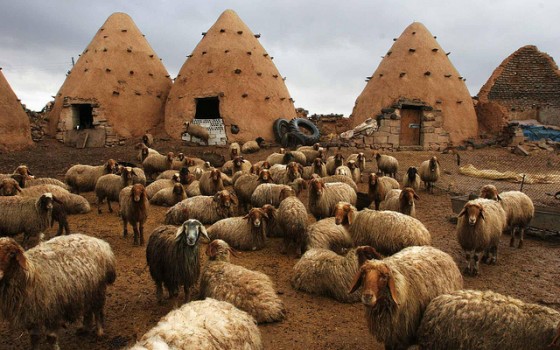
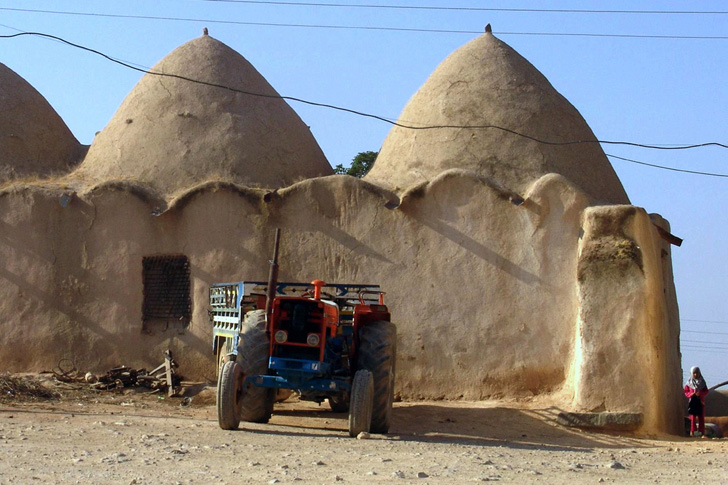
beehive house, syria, made from mud, sheep grazing in foreground

With the unbearable heat of a Middle Eastern July upon us, many of us try to find ways to stay cool.  Though regular energy-guzzling air conditioning is tempting, some of us will try to relieve our consciences with more energy effecient cooling methods, such as using the cross breeze or a solar powered air conditioner.

beehive house, syria, made from mud

But way before there were electronic ways to condition our temperatures, cooling methods were built into the architecture of traditional Middle Eastern homes.  Such as the beehive homes found in Syria.
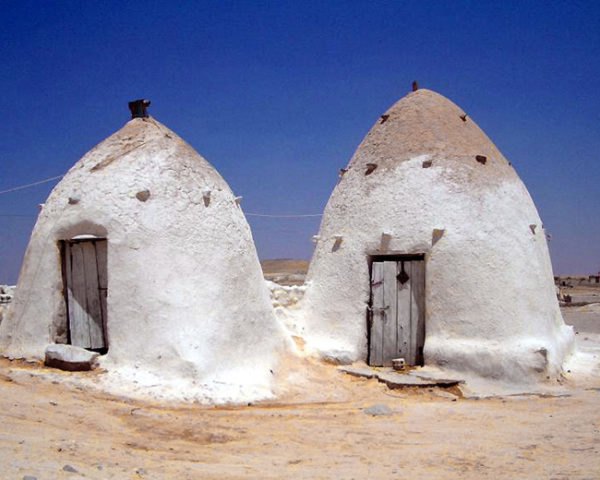
beehive house, syria, made from mud, keep storage cool

Remaining beehive homes (nicknamed “beehive” because of their conical, tapered shapes) are located mainly in northern Syria – west and east of the Aleppo and along the Euphrates River.  Two towns that still have a number of these traditional beehive homes in good shape are Sarouj and Twalid Dabaghein.

beehive homes syria ,roof looking up to sun

The beehive homes keep the heat out in a few ways.  Their thick mud brick walls trap in the cool and keep the sun out as well (beehive homes have very few, if any, windows).  The high domes of the beehive houses also collect the hot air, moving it away from the residents sleeping at the bottom of the house.Combining natural elegance with architectural functionality, the shapes of the beehive homes keep interior temperatures between 75-85 degrees Fahrenheit.
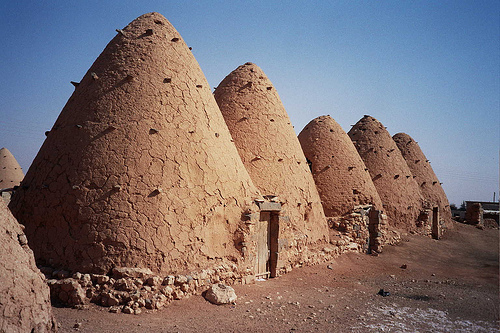
beehive house, syria, made from mud

The beehive homes also protect their residents from cold temperatures, serving as a strong guard against powerful desert winds and maintaining a comfortable temperature.
beehive house, syria, made from mud

Karen Chernick
Karen Chernickhttps://www.greenprophet.com/
Much to the disappointment of her Moroccan grandmother, Karen became a vegetarian at the age of seven because of a heartfelt respect for other forms of life. She also began her journey to understand her surroundings and her impact on the environment. She even starting an elementary school Ecology Club and an environmental newsletter in the 3rd grade. (The proceeds of the newsletter went to non-profit environmental organizations, of course.) She now studies in New York. Karen can be reached at karen (at) greenprophet (dot) com.
4 COMMENTS
  1. Syrian Beehive Houses…

    Designed for the desert climate, the beehive homes keep the heat out in a few ways. Their thick mud brick walls trap in the cool and keep the sun out as well (beehive homes have very few, if any, windows). The high domes of the beehive houses als…

Comments are closed.

TRENDING

Iran’s water mafia and thirst for war leaves the country on brink of being dry

Iran’s Lake Urmia, once the Middle East’s largest saltwater lake, has shrunk by 90 percent due to mismanagement, dams, and drought. As Tehran pours billions into foreign conflicts, water activists face repression at home. The crisis mirrors Syria’s drought-driven unrest, showing how water scarcity can destabilize entire regions.

A guide to rewilding your cities

Tel Aviv has started giving away free fruit trees in a bid to re-wild its city and make it greener. They are calling it an urban food forest. Researchers from Berlin come up with a blueprint on how to green and re-wild your city. You could use this with new greening AI research from MIT to make your city remarkably green.

Creamy Eggplant Soup Recipe

Eggplant seems an unlikely soup ingredient. But blended with vegetable stock, herbs, and cream, the shiny purple vegetable makes a creamy soup full of Middle-Eastern flavors.

Six “Green” Reasons To Drink Camel’s Milk

With 5 times the amount of Vitamin C in camel's milk, and full of iron, camel's milk needs no nutritional help. It has a shelf life of 5 days before pasteurization, after which it will survive for up to 3 weeks. Camel's milk is just as versatile as other milk, used as it is to produce low-fat varieties of cheese, chocolate, and a fermented delicacy that is used in areas that lack refrigeration.

The Kibbutz Movement from Israel Revival

Want to learn about organic agriculture and how it's...

Turning Your Energy Consultancy into an LLC: 4 Legal Steps for Founders in Texas

If you are starting a renewable energy business in Texas, learn how to start an LLC by the books.

Tracking the Impacts of a Hydroelectric Dam Along the Tigris River

For the next two months, I'll be taking a break from my usual Green Prophet posts to report on a transnational environmental issue: the Ilısu Dam currently under construction in Turkey, and the ways it will transform life along the Tigris River.

6 Payment Processors With the Fastest Onboarding for SMBs

Get your SMB up and running fast with these 6 payment processors. Compare the quickest onboarding options to start accepting customer payments without delay.

Qatar’s climate hypocrisy rides the London Underground

Qatar remains a master of doublethink—burning gas by the megaton while selling “sustainability” to a world desperate for clean air. Wake up from your slumber people.

How Quality of Hire Shapes Modern Recruitment

A 2024 survey by Deloitte found that 76% of talent leaders now consider long-term retention and workforce contribution among their most important hiring success metrics—far surpassing time-to-fill or cost-per-hire. As the expectations for new hires deepen, companies must also confront the inherent challenges in redefining and accurately measuring hiring quality.

8 Team-Building Exercises to Start the Week Off 

Team building to change the world! The best renewable energy companies are ones that function.

Thank you, LinkedIn — and what your Jobs on the Rise report means for sustainable careers

While “green jobs” aren’t always labeled as such, many of the fastest-growing roles are directly enabling the energy transition, climate resilience, and lower-carbon systems: Number one on their list is Artificial Intelligence engineers. But what does that mean? Vibe coding Claude? 

Somali pirates steal oil tankers

The pirates often stage their heists out of Somalia, a lawless country, with a weak central government that is grappling with a violent Islamist insurgency. Using speedboats that swarm the targets, the machine-gun-toting pirates take control of merchant ships and then hold the vessels, crew and cargo for ransom.

Related Articles

Popular Categories