Slow Food has been garnering lots of attention lately, with an international convention in San Francisco in September and another in Italy just this week. It seems like the perfect time to pull out the Slow Food anthology, this week’s entry in our eco-reads review series.
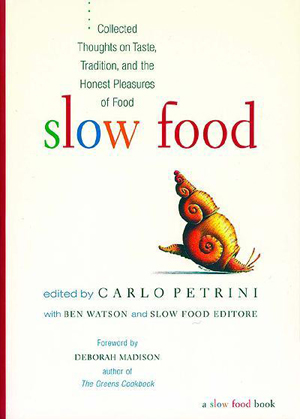
‘Slow Food’ is one of those elusive yet still useful terms: we’re able to grasp what it’s gesturing at even though we can’t define it precisely. Most of us recognize slow food experiences when we have them and feel, moreover that they are genuinely special and distinctive – this is proof enough that term, and the movement which gave rise to it, are onto something important.
Slow Food was founded by Carlo Petrini in Italy about twenty years ago; its membership now numbers tens of thousands and spans over more than 100 countries, including a chapter in northern Israel. The Slow Food collection, first published in 2001, gathers together some of the best writing from the movement’s quarterly journal, and includes short pieces on everything from wine to cheese-making to biotechnology. Taken together, these stories and articles offer something more complex and ambitious than a mere definition, an accounting of what slow food is through a cataloguing of its principles (though the principles are included as well): they are rhetorical, aiming to inspire by painting pictures so lush we cannot help but be drawn in.
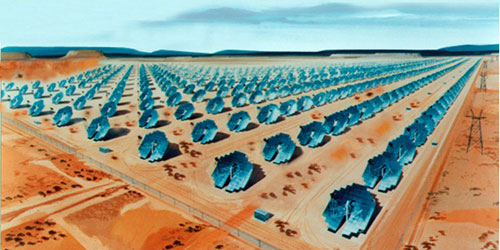

 You first heard it here on Green Prophet a few months ago – the
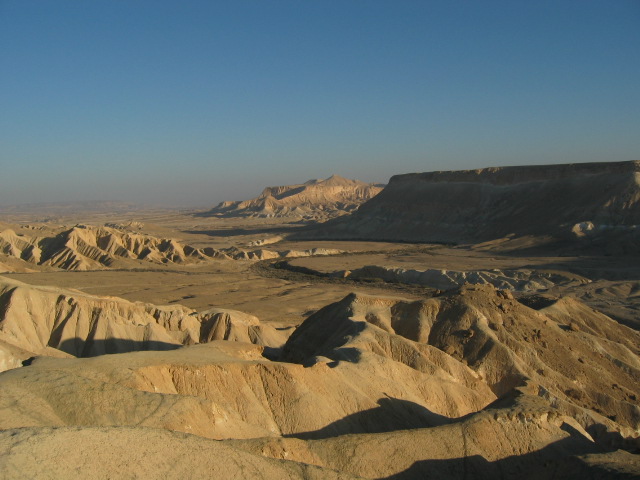
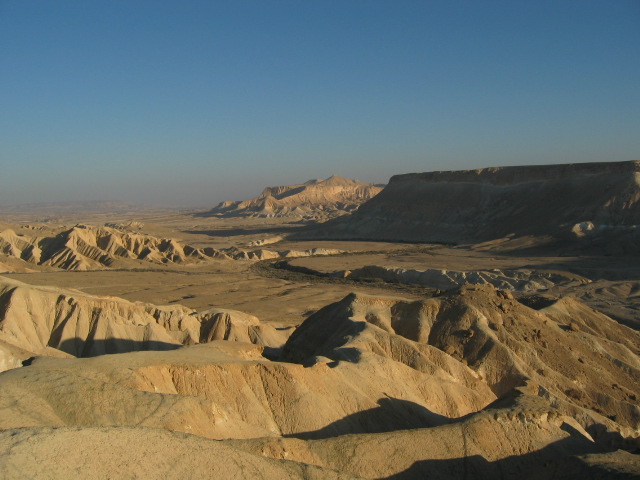 When thinking about the Israeli army (or any other army, for that matter) becoming more “green” or environmentally conscious, skepticism is unfortunately the first thing that comes to mind. Military activity is nasty business, leaving detrimental traces on human relationships, governmental spending, and the environment – to name a few.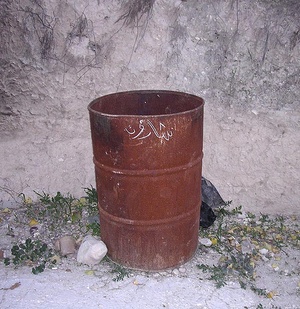
 For Palestinians in the West Bank and Gaza, lack of infrastructure is a big obstacle for protecting the environment.
 Businesses play a huge role in our everyday impact on the environment. The way that businesses conduct themselves – ranging from what services or products they provide, to what means they use to provide them, and what kind of energy consumption habits they have – all effect their carbon footprint. And since we live in a society where businesses are greatly relied upon to do things for us – our carbon footprint is directly related to what businesses we choose to support.


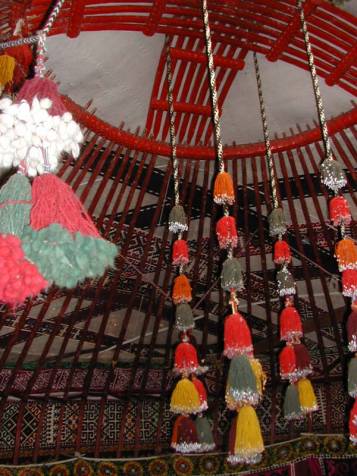
 A little out of place, a yurt in the Israeli desert offers a neat eco-treat.
 Winter is on its way, and with it the bone-chilling cold that penetrates every poorly insulated apartment in Israeli cities. Now is the perfect time to stop contemplating