The company's Next Generation Process (NGP) Pilot Plant in London, Ontario, has officially moved into initial operating campaigns, generating the kind of structured, repeatable data that separates laboratory promise from commercial viability.
In the modern nutrition universe, that level of commitment deserves an applause. But for those who don’t live in a Nordic fishing village, the nutrition company Zinzino has built its omega-3 research and formulations around these principles, combining biomarker testing, antioxidant protection and traceable sourcing across both sustainably harvested small-fish oils and a vegan marine-microalgae alternative.
Dubai Municipality has set up 12 AI-powered "Ehsan Stations" to safely and officially feed strays. The city also officially supports Trap-Neuter-Return (TNR) programs.
A new project in Spain shows how digital twins, which are virtual replicas of real environments, are becoming powerful tools for protecting ecosystems.
The company's Next Generation Process (NGP) Pilot Plant in London, Ontario, has officially moved into initial operating campaigns, generating the kind of structured, repeatable data that separates laboratory promise from commercial viability.
In the modern nutrition universe, that level of commitment deserves an applause. But for those who don’t live in a Nordic fishing village, the nutrition company Zinzino has built its omega-3 research and formulations around these principles, combining biomarker testing, antioxidant protection and traceable sourcing across both sustainably harvested small-fish oils and a vegan marine-microalgae alternative.
Dubai Municipality has set up 12 AI-powered "Ehsan Stations" to safely and officially feed strays. The city also officially supports Trap-Neuter-Return (TNR) programs.
A new project in Spain shows how digital twins, which are virtual replicas of real environments, are becoming powerful tools for protecting ecosystems.
The company's Next Generation Process (NGP) Pilot Plant in London, Ontario, has officially moved into initial operating campaigns, generating the kind of structured, repeatable data that separates laboratory promise from commercial viability.
In the modern nutrition universe, that level of commitment deserves an applause. But for those who don’t live in a Nordic fishing village, the nutrition company Zinzino has built its omega-3 research and formulations around these principles, combining biomarker testing, antioxidant protection and traceable sourcing across both sustainably harvested small-fish oils and a vegan marine-microalgae alternative.
Dubai Municipality has set up 12 AI-powered "Ehsan Stations" to safely and officially feed strays. The city also officially supports Trap-Neuter-Return (TNR) programs.
A new project in Spain shows how digital twins, which are virtual replicas of real environments, are becoming powerful tools for protecting ecosystems.
The company's Next Generation Process (NGP) Pilot Plant in London, Ontario, has officially moved into initial operating campaigns, generating the kind of structured, repeatable data that separates laboratory promise from commercial viability.
In the modern nutrition universe, that level of commitment deserves an applause. But for those who don’t live in a Nordic fishing village, the nutrition company Zinzino has built its omega-3 research and formulations around these principles, combining biomarker testing, antioxidant protection and traceable sourcing across both sustainably harvested small-fish oils and a vegan marine-microalgae alternative.
Dubai Municipality has set up 12 AI-powered "Ehsan Stations" to safely and officially feed strays. The city also officially supports Trap-Neuter-Return (TNR) programs.
A new project in Spain shows how digital twins, which are virtual replicas of real environments, are becoming powerful tools for protecting ecosystems.
The company's Next Generation Process (NGP) Pilot Plant in London, Ontario, has officially moved into initial operating campaigns, generating the kind of structured, repeatable data that separates laboratory promise from commercial viability.
In the modern nutrition universe, that level of commitment deserves an applause. But for those who don’t live in a Nordic fishing village, the nutrition company Zinzino has built its omega-3 research and formulations around these principles, combining biomarker testing, antioxidant protection and traceable sourcing across both sustainably harvested small-fish oils and a vegan marine-microalgae alternative.
Dubai Municipality has set up 12 AI-powered "Ehsan Stations" to safely and officially feed strays. The city also officially supports Trap-Neuter-Return (TNR) programs.
A new project in Spain shows how digital twins, which are virtual replicas of real environments, are becoming powerful tools for protecting ecosystems.
The company's Next Generation Process (NGP) Pilot Plant in London, Ontario, has officially moved into initial operating campaigns, generating the kind of structured, repeatable data that separates laboratory promise from commercial viability.
In the modern nutrition universe, that level of commitment deserves an applause. But for those who don’t live in a Nordic fishing village, the nutrition company Zinzino has built its omega-3 research and formulations around these principles, combining biomarker testing, antioxidant protection and traceable sourcing across both sustainably harvested small-fish oils and a vegan marine-microalgae alternative.
Dubai Municipality has set up 12 AI-powered "Ehsan Stations" to safely and officially feed strays. The city also officially supports Trap-Neuter-Return (TNR) programs.
A new project in Spain shows how digital twins, which are virtual replicas of real environments, are becoming powerful tools for protecting ecosystems.
The company's Next Generation Process (NGP) Pilot Plant in London, Ontario, has officially moved into initial operating campaigns, generating the kind of structured, repeatable data that separates laboratory promise from commercial viability.
In the modern nutrition universe, that level of commitment deserves an applause. But for those who don’t live in a Nordic fishing village, the nutrition company Zinzino has built its omega-3 research and formulations around these principles, combining biomarker testing, antioxidant protection and traceable sourcing across both sustainably harvested small-fish oils and a vegan marine-microalgae alternative.
Dubai Municipality has set up 12 AI-powered "Ehsan Stations" to safely and officially feed strays. The city also officially supports Trap-Neuter-Return (TNR) programs.
A new project in Spain shows how digital twins, which are virtual replicas of real environments, are becoming powerful tools for protecting ecosystems.
The company's Next Generation Process (NGP) Pilot Plant in London, Ontario, has officially moved into initial operating campaigns, generating the kind of structured, repeatable data that separates laboratory promise from commercial viability.
In the modern nutrition universe, that level of commitment deserves an applause. But for those who don’t live in a Nordic fishing village, the nutrition company Zinzino has built its omega-3 research and formulations around these principles, combining biomarker testing, antioxidant protection and traceable sourcing across both sustainably harvested small-fish oils and a vegan marine-microalgae alternative.
Dubai Municipality has set up 12 AI-powered "Ehsan Stations" to safely and officially feed strays. The city also officially supports Trap-Neuter-Return (TNR) programs.
A new project in Spain shows how digital twins, which are virtual replicas of real environments, are becoming powerful tools for protecting ecosystems.
I love to cook with my microwave. Sure, it’s possible to manage without it, and there are better ways to defrost food.
However, there are environmentally sound reasons for preferring it to conventional cooking: It only heats the moisture in food, so more energy is retained. Microwave cooking preserves nutrients in vegetables. And since many microwave utensils can go straight to the table and they scorch less, less water and detergent are needed for washing up.
Because microwaves cook food using electromagnetic radiation, many people are afraid to use them. The FDA discusses the issue here. I’m not here to convince anyone to buy an electrical appliance they don’t feel comfortable with.
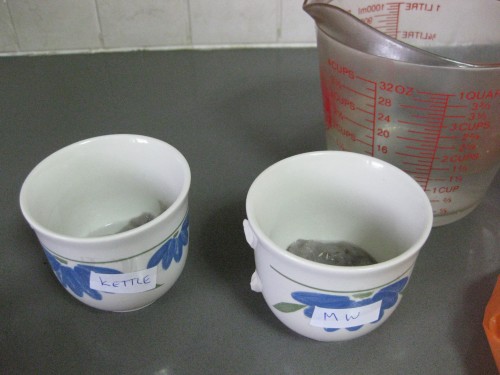
But when a post on Green Prophet made questionable claims about microwaved foods, I spoke up in the comments and offered to debunk the claim that seeds watered with microwave-boiled water won’t sprout.
Snow is a serious matter for Lebanon. So serious, in fact, that the white part of the Lebanese flag represents the country’s snowy mountains. Snow also plays an important economic role, since Lebanon’s six ski resorts draw tourists from nearby countries. Most significant of all, however, is the fact that the mountain soil absorbs the slowly melting snow, replenishing Lebanon’s mountain aquifers. Especially considering the highly alarming drought conditions throughout the region, snow is “crucial for the survival of Lebanese.”
So it’s not surprising that over 95 activists gathered in Faraya, Lebanon on Sunday to take a stand against climate change (although it is certainly exciting!). Participants, organized by the Leage of Independent Activists (IndyACT), drew a symbolic line across the snow to demand goverments “draw the line” on snow cover loss, a major consequence of climate change.
In an official statement issued yesterday, Executive Director of IndyACT and Arab Climate Alliance coordinator Wael Hmaidan said, “If we do not take climate change seriously enough, we will reach a point where we will need to remove the white color from our flag, and start importing water for our survival.”
Somewhere between juggling appointments with potential Prime Ministers in-waiting, Israeli President Shimon Peres (pictured with shovel) found time to get his hands dirty in Kfar Saba recently, which has been awarded the title of Israel’s first “green city.”
During the visit to the town 15km north east of Tel Aviv, Peres received a gift himself, a home composter to recycle organic waste at the President’s official residence in Jerusalem.
(In 1922 Jerusalem gets its first sewage system. YNet)
Jerusalem is a holy city which houses the country’s holiest people. Now their excrement will continue doing good work:
In the first deal of its kind for the country, the Israel Electric Company (IEC) signed an agreement on Sunday with Gihon, Jerusalem’s water and sewage firm, to purchase electricity generated from bio-gas resulting from the treatment of solid waste, reports the Jerusalem Post.
“It will produce enough electricity to light between 1,000 and 1,500 homes,” said Yisrael Bar-Gil, the CEO of Mabti, a Gihon subsidiary said. “We can eventually produce up to 50 percent more.”
Eitan Parnass, who head of the Association of Renewable Energy Companies in Israel, told the Jerusalem Post that “unlike wind or solar [energy], where storage is a problem, the gas can be stored for electricity production whenever needed.”
Plans call for collecting hydro-electric type energy from the sewage pipes as well.
Jokes, however crass, most welcome in the comments section.
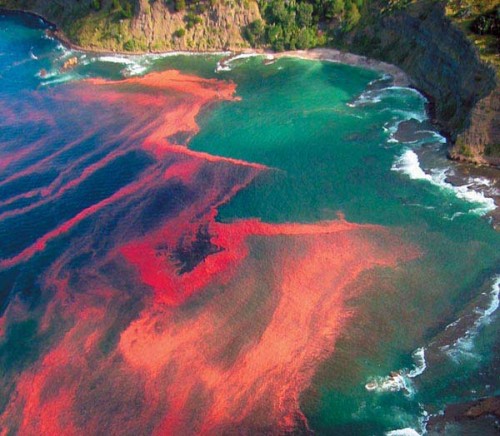
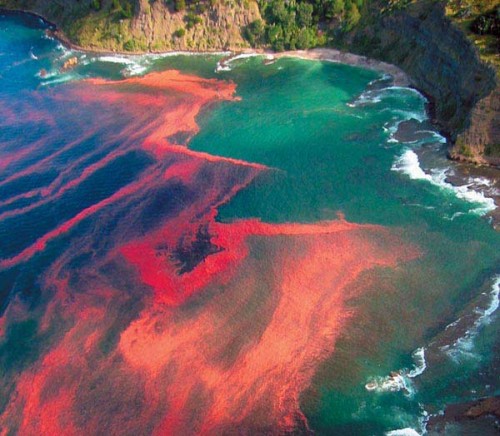
In summer, Israelis battle jellyfish, an introduced species that came to the Mediterranean Sea via the Suez Canal. But that’s nothing compared to what Iran’s battling right now: A weird and wacky red, soap-like super foam is taking over the Persian Gulf in Iran.
Known as the “red tide,” it’s the result of an excessive algal bloom caused when marine or freshwater algae accumulate repdily in the water.
Researchers in the region estimate that the damage cost the red tide is causing amounts to about $500 million dollars. Posing a danger to wildlife such as fish, the red foam clogs their gills cutting off the air supply.
Green Prophet’s Ilana Teitelbaum recently wrote an article about Israel’s water crisis at the Huffington Post.
Rainstorms have been raging throughout Israel in the past week, after a warm and bone-dry winter. Winter, which is the only rainy season in the Middle East. There is no such thing as spring or summer rain, and in autumn it is rare. There is only harsh winter rain, borne by violent winds. Umbrellas are next to useless: a flimsy one will be blown inside-out in no time, while a strong one will try to carry you away like you’re Mary Poppins. The sidewalks after a rainstorm in Jerusalem are littered with the spiky remains of broken umbrellas.
Yet in spite of the inconvenience of the winter rain, it is always a celebrated occurrence. And it is an increasingly sporadic occurrence, as Israel faces the most serious drought in its history.
Imagine being able to place an entire farm, complete with crops and livestock, in the same space as is required for one of today’s modern urban skyscrapers. A Columbia University professor, Dickson Despommier, has been involved in such a project that could turn a 30 story glass faced building into a vertical agricultural enterprise capable of feeding 50,000 the year round.
While such an idea may seem a bit far-fetched to some people, to others who live in densely populated areas such as Tokyo, Hong Kong and New York City, see this idea as having great benefit, as well as being much more environmental friendly than standard agricultural practices which contribute greatly to greenhouse gases, and global warming.
Using scientifically developed growing techniques developed by NASA and other bio-technical laboratories, Despommier believes these “green towers” could help solve the world’s food and water shortage problems by growing both food and livestock in controlled environments where the temperature remains a constant 22 to 24 degrees Celsius year round with controlled humidity according to desired needs.
Recycled sewage and other waste water, such as run-off from air conditioning systems, can be used to irrigate crops in these “vertical greenhouses” as well as provide drinking water for both humans and livestock, augmented by recycled carbon dioxide gases which can be turned into water.
The buildings for these projects can be constructed according to need and available space, and will almost eliminate greenhouse gases; weather caused crop failures, diseases from untreated biological wastes, and without the use of pesticides and herbicides. In other words, the growing environment can be completely organic, and scientifically controlled.
It’s been in the works for a while. Finally, the new US-Israel agreement of cooperation in renewable energy was announced at the opening of the 2nd Eilat-Eilot International Renewable Energy Conference last week.
The US-Israel Energy Cooperation Act is an international collaboration aimed at creating a renewable energy storage initiative to reduce the world’s oil dependence.
The year 2020 onwards will be the decade of action for renewable energy. This is a solar energy field in Israel’s Negev Desert.
The Cooperation Act will fund eligible joint ventures between US and Israeli businesses. Two million dollars, or $1 million from each country, has already been allocated for this year with a significant increase expected in future years.
At the opening, Jonathan Shrier (pictured above), acting assistant secretary at the Office of Policy and International Affairs of the US Department of Energy, told the conference plenum that the agreement had the support of Dr. Steven Chu, the new US Secretary of Energy.
“The secretary sees the power of international arrangements,” such as those brokered by the Binational US-Israel R&D Foundation (BIRD), the US-Israel Binational Science Foundation and others. “These various parties are involved because we need to push R&D of already available technologies and not neglect the cutting edge research at the basic science level.”
Shrier told me that, while the US has similar agreements with countries such as Japan and the EU, “This one is special because we have a partner who brings a lot to the table. Israel is world-renowned in the field and we meet as equals,” he said.
US-Israel already in cooperation
Seambiotic algae pools
Examples of US-Israel cooperation in renewable energy are already underway, noted Shrier. Seambiotic and Better Place, have already received approval. Seambiotic is the first company in the world utilizing flue gas from coal burning power stations for algae cultivation. The company aims to grow and process marine microalgae using an ecologically based environmental system to reduce air pollution and global warming. Better Place is a venture-backed company aiming to reduce global dependency on oil through the creation of an electric car network with a swappable battery.
The US Department of Energy and Israel’s Ministry of National Infrastructures agreed that the exchange researchers and conferences are two important elements of the collaboration. Two conferences in the US and two in Israel will take place annually. The annual conference in Sde Boker, Israel, will focus on the technological advancements in the Renewable Energy industry while the annual Eilat-Eilot conference will serve as a platform for industry-ready technologies to exhibit and market their offerings. In addition, Israeli researchers will spend significant time working in the US market and Israeli researchers will do the same in Israel.
The three-day conference focused on the latest innovations in renewable energy, with the participation of internationally-recognized alternative energy companies such as SCHOTT Solar of Germany, SunPower of the UK and Concentrix of the US, and speakers from around the world, as well as leading Israeli firms and start-up companies in the field. Close to 1,000 people attended the event and exhibition at Eilat’s Herod’s Palace conference center.
At the opening, keynote speaker, Israel’s Minister of National Infrastructure Binyamin “Fouad” Ben Eliezer, said his office was concentrating on two areas, that of assuring energy sources, primarily natural gas; and developing alternative energy sources, “primarily solar, given Israel’s optimal climate conditions,” and others, such as oil shale, as well.
The Silicon Valley of renewable energy
By 2020, 10 to 20 percent of Israel’s energy production will be solar, Ben-Eliezer told delegates, adding that he had full confidence that the energy economy division would be 20% solar, 40% natural gas and 40% coal-based. Energy would be generated at solar power projects at Ashalim, a 250MW BOT project whose tender will be offered shortly; Timna, a 250MW project whose bid for tender will be announced this coming summer; and Tel Arad, which is in the planning stages.
Ben-Eliezer called for the government to implement the decision to declare the Negev and Arava national priority regions. Also in attendance were MKs Avishay Braverman and Ophir Pines-Paz and Minister of Environmental Protection Gideon Ezra.
Noam Ilan, director of business development for the Eilat Eilot region said: “We truly believe that this event will place us firmly on the international map as a true world leader in the renewable energy and solar industries and the participation of Ministers Ben Eliezer and Ezra underscores that belief.”
His sentiments were echoed by Meir Yitzhak-HaLevy, Mayor of Eilat, who said he intended to make Eilat, “the world’s first solar city,” and Udi Gat, chairman of the Hevel Eilot Regional Council, who said: “We want to be the Silicon Valley of renewable energy.”
Other announcements made at the conference include the Timna Renewable Energy Park, which will be a center for R&D, and the AORA Solar Thermal Module at Kibbutz Samar, the world’s first commercial hybrid solar gas-turbine power plant that is already nearing completion. Solel Solar Systems announced it was beginning construction of a 50 MW solar field in Lebrija, Spain, and Brightsource Energy made a pre-conference announcement that it had inked the world’s largest solar deal to date with Southern California Edison (SCE).
(Yuli Ziv, founder of MyItThings, cofounder of the Style Coalition)
I first talked to Yuli Ziv when she was in the middle of a paparazzi storm. It was Fashion Week in New York and she was just about to enter the Justin Timberlake show. Walking over to her website MyItThings, the Tel Aviv native, now in New York, I saw Ziv had established a green category on her fashion website. I wanted to know more about that, and also “green” fashion trends for the future. It can’t hurt to ask, right? Here’s our interview:
How does a girl from Israel find herself in the middle of the fashion world in New York?
Yuli Ziv: Personal style expression has always interested me – from watching Sex & The City on a TV screen from my home in Israel to walking on NYC streets later on and watching these women in real life – I’m fascinated by the people that tell a story with their look. It took me few years to find my own story and what clothes really meant to me, and then I wanted to give a chance to other people to share their story as well – that’s how I founded MyItThings.com.
Is there any green fashion from Israel or the Middle East making its way to America?
Yuli Ziv: If so, let us know what. Or what you like. I’ve heard about Neutra – the accessories made of recycled tires, and B Nature – the organic baby clothes, which seem to be the biggest trend now. I wish more of the Isreali green designers targeted online fashion outlets like ours to share their vision, as I don’t hear these much often.
The rest of this report, was penned by conference organizers at the GDN Network: This 10th annual conference on ‘Natural Resources and Development’ ended on February 5 in Kuwait with about 450 researchers and policy-makers agreeing that policy steps can be taken to turn resources into a blessing.
(A photograph of the female C. echinata coral, expelling its eggs into the water around it.)
Research from TAU unlocks the secret of coral survival during global warming
Trees do it. Bees do it. Even environmentally stressed fish do it. But Prof. Yossi Loya from Tel Aviv University’s Department of Zoology is the first in the world to discover that Japanese sea corals engage in “sex switching” too.
His research may provide the key to the survival of fragile sea corals — essential to all life in the ocean — currently threatened by global warming.
In times of stress like extreme hot spells, the female mushroom coral (known as a fungiid coral) switches its sex so that most of the population becomes male. The advantage of doing so, says the world-renowned coral reef researcher, is that male corals can more readily cope with stress when resources are limited. Apparently, when times get tough, nature sends in the boys.
For centuries, animals have been our first line of defense against toxins. A canary in a coalmine served as a living monitor for poisonous gases. Scientists used fish to test for contaminants in our water. Even with modern advances, though, it can take days to detect a fatal chemical or organism.
Until now. Working in the miniaturized world of nanotechnology, Tel Aviv University researchers have made an enormous — and humane — leap forward in the detection of pollutants. This is good news for environmental health.
A team led by Prof. Yosi Shacham-Diamand, vice-dean of TAU’s Faculty of Engineering, has developed a nano-sized laboratory, complete with a microscopic workbench, to measure water quality in real time. Their “lab on a chip” is a breakthrough in the effort to keep water safe from pollution and bioterrorist threats, pairing biology with the cutting-edge capabilities of nanotechnology. The research is being commercialized into a company called Canarius.
“We’ve developed a platform — essentially a micro-sized, quarter-inch square ‘lab’ — employing genetically engineered bacteria that light up when presented with a stressor in water,” says Prof. Shacham-Diamand. Equipment on the little chip can work to help detect very tiny light levels produced by the bacteria.
Each week Orthodox Jews read one segment of the Five Books of Moses so that they can complete the entire Five Books within the course of a year. In last week’s Eco-Rabbi post I discussed free trade and the commandments, this week I write about how to create room for God to live within us.
God asks Moses to request from the Jewish People that each person give a donation. Each according to the generosity of his heart. From those donations God commands that they make a sanctified place, Mikdash, in their camp. God promises that if they do so, He will live inside them.
God, who created the heavens and the Earth, the One who took His people out of Egypt cannot just make a home in the midst of the camp Himself?
Why did God, the one who arranged for a cloud of protection for His people in the desert for the day and a pillar of fire for night, the one who made food rain down on the People of Israel every morning, need for the people to donate their recently acquired riches to Him so that they could make Him a home in their camp?
This is about the time of year where we are all just about fed up. The weather is by turns glum, stormy, angry, and generally ill-tempered, there’s little of the new season‘s growth to enjoy yet, and reserves of patience are at their annual low.
A freshly baked batch of muffins may not dispel all these woes, but they can certainly take the edge off.
These, we are very happy to say, are a one-bowl, mixer-free, dead easy way to brighten up your weekday afternoons or weekend mornings. The batter comes together in ten minutes and the muffins bake up in twenty more. They are loaded with healthy ingredients like applesauce and whole wheat flour, and have warm brown-sugar-and-spice undertones for a bit of comfort on a cold day. The muffins call for mixing in, well, whatever strikes your fancy or you happen to have around: for this batch we used a handful of walnuts and chopped up the one lone pear aging un-gracefully on the counter. The point is to play a bit, and use whatever’s in sight, which is convenient when you didn’t feel like going out anyway.