Home Blog Page 714

Jews Celebrate "Solar Seder" in the Arava Desert at Kibbutz Lotan

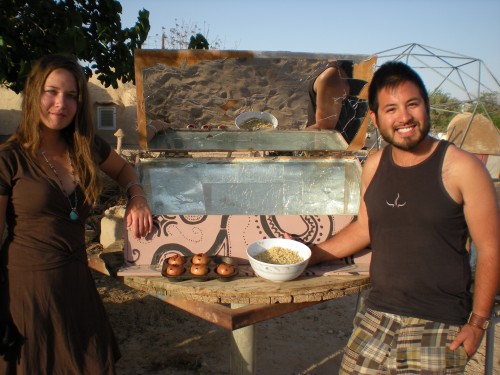
lotan-solar-seder-jews-photo-passover

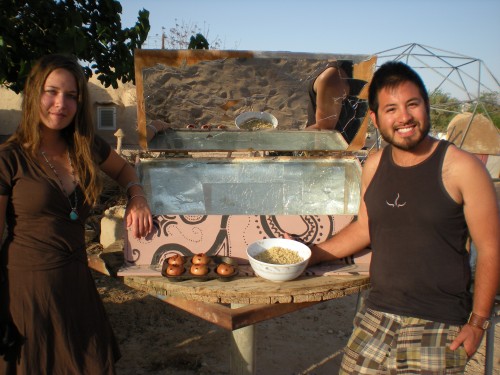
Just a few hours after Jews of all stripes gathered at the Western Wall in Jerusalem to celebrate “Birkat haChama” – the blessing of the sun – Aria Penkava slid a tray of kosher-for-Passover cookies into a solar oven to slow-cook using focused heat energy from the sun.

“The sunrise was glorious this morning,” said Penkava, “but we wanted to not only bless the sun but actually use its energy to do something constructive and creative.”

Penkava, 20, is a recent graduate of Kibbutz Lotan’s 6-week “Green Apprenticeship” program, which combines coursework in permaculture design, organic farming and ecovillage design. To her, the timing of Birkat haChama coincided perfectly with the seder for the first night of Passover.

Along with several other Green Apprentices who are

Council for a Beautiful Israel Trains Palestinian Teachers on Environmental Education

1

As we’ve mentioned often here at Green Prophet, nature knows no boundaries.  The environment, therefore, can provide a powerful incentive for collaboration amidst conflict.

Last week, in yet another example of cross-border environmental cooperation, the Council for a Beautiful Israel brought 25 Palestinian teachers and educators to their educational center in Tel Aviv for special training in environmental education.

The training was modeled after previous cooperation between the Council for a Beautiful Israel and the Towns Association for Environmental Quality, Agan Beit Natufa, a leading environmental organization among Israel’s minority Palestinian (Arab-Israeli) sector.

Increasing Khamsini or Sharav Heat Waves Could Signal Global Warming in the Middle East

11

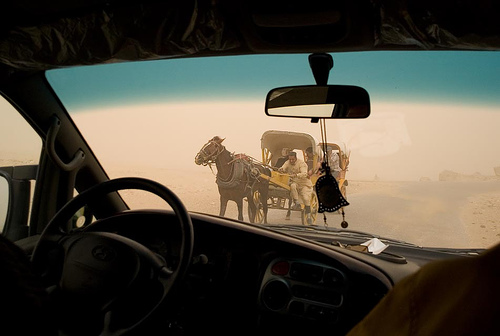
sand-storm cairo photo

For those of us who live in the Middle East, those hot dry heat waves known as khamsini (in Arabic) or sharav (the Hebrew term) appear to be becoming more frequent, as well as more intense.

They also seem to be occurring during times of the year when they ordinarily are not supposed to – such as in what should be the winter rainy season.

A khamsini heat wave or dust storm as often occurs along with the heat wave, is usually characterized by intense dry heat, often accompanied by high winds. Temperatures can rise into the 40 degree celsius range and can be so intense that it can be actually dangerous to venture out of doors due to the intense heat and large amounts of dust the often come along with it.

A recent article in the Jordan Times mentioned that dust and sand storms caused by khamsini conditions were so bad that a number of roads were considered to be dangerous

Second International Conference on Water to Commence in Ramallah, Palestinian Authority

2

With the regional water crisis weighing so heavily on everyone’s minds, it’s no wonder that the Palestine Academy for Science and Technology and the Palestinian Water Authoirty have teamed up to host the 2nd International Conference on Water: Values and Rights.

The conference, to be held in Ramallah from April 13-15, will bring together academics, scientists, decision-makers, and more from a variety of sectors, and will feature prominent speakers from the Palestinian Territories, the United States, and the United Kingdom.

The conference will also address a variety of themes related to water management, water rights, and other aspects of water politics, as well as special themes including:

  • The “Palestinian-Israeli Water Dispute,”
  • “Cooperative Water Projects between Israel and Palestine: Pitfalls, Successes, and Lessons Learned,”
  • “The Impact of Climate Change on Water Resources Management,”
  • the “Red Sea-Dead Sea Conveyance Project.”

For more information, visit the conference website: http://www.waterrightsconference.org.

More water and the Palestinian Authority:
Water Relationship Possibilities Between Israel and Gazans In Better Days
FoEME to Hold Conference on Shared Mountain Aquifer
A Green Prophet Finds West Bank In Water Crisis Too!

Shut Down the New Coal-Fired Power Plants, Says Israel's New Environment Minister

2

ashkelon-coal-power-plant beach israel photo

Israel has a new government, and this also means a new environment minister. The new one, Gilad Erdan actually sounds like he’s learned something about the environment before taking on the post. The hot news is that he has applied to Israel’s Acting Government Secretary to convene an emergency government session to discuss his demand for freezing plans for a coal fired power plant in Ashkelon, reports the Ministry.

In parallel, he’s called on the Minister of National Infrastructure to submit an updated plan for electricity production based on recent changes in the economy and on similar plans worldwide.

In his request, Minister Erdan notes that the plan for a coal-fired power station in Ashkelon calls for two new coal fired units,

Could Urban Beekeeping Renegades Buffer Bees From Colony Collapse Disorder?

13

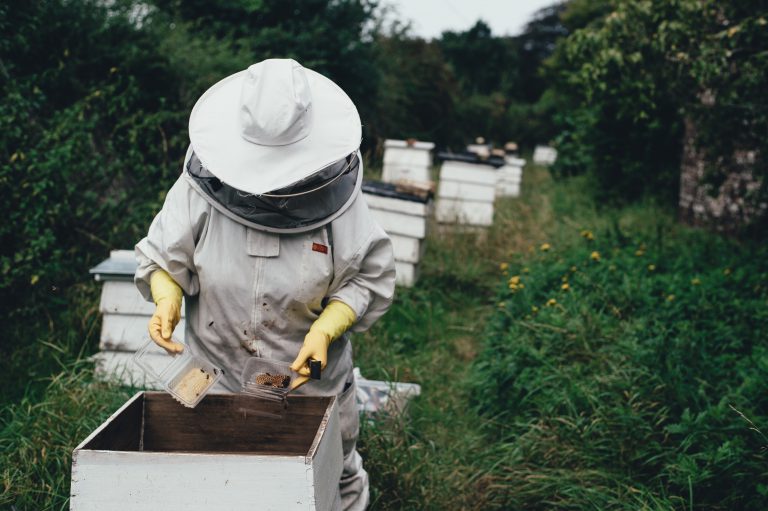
apiary beehives

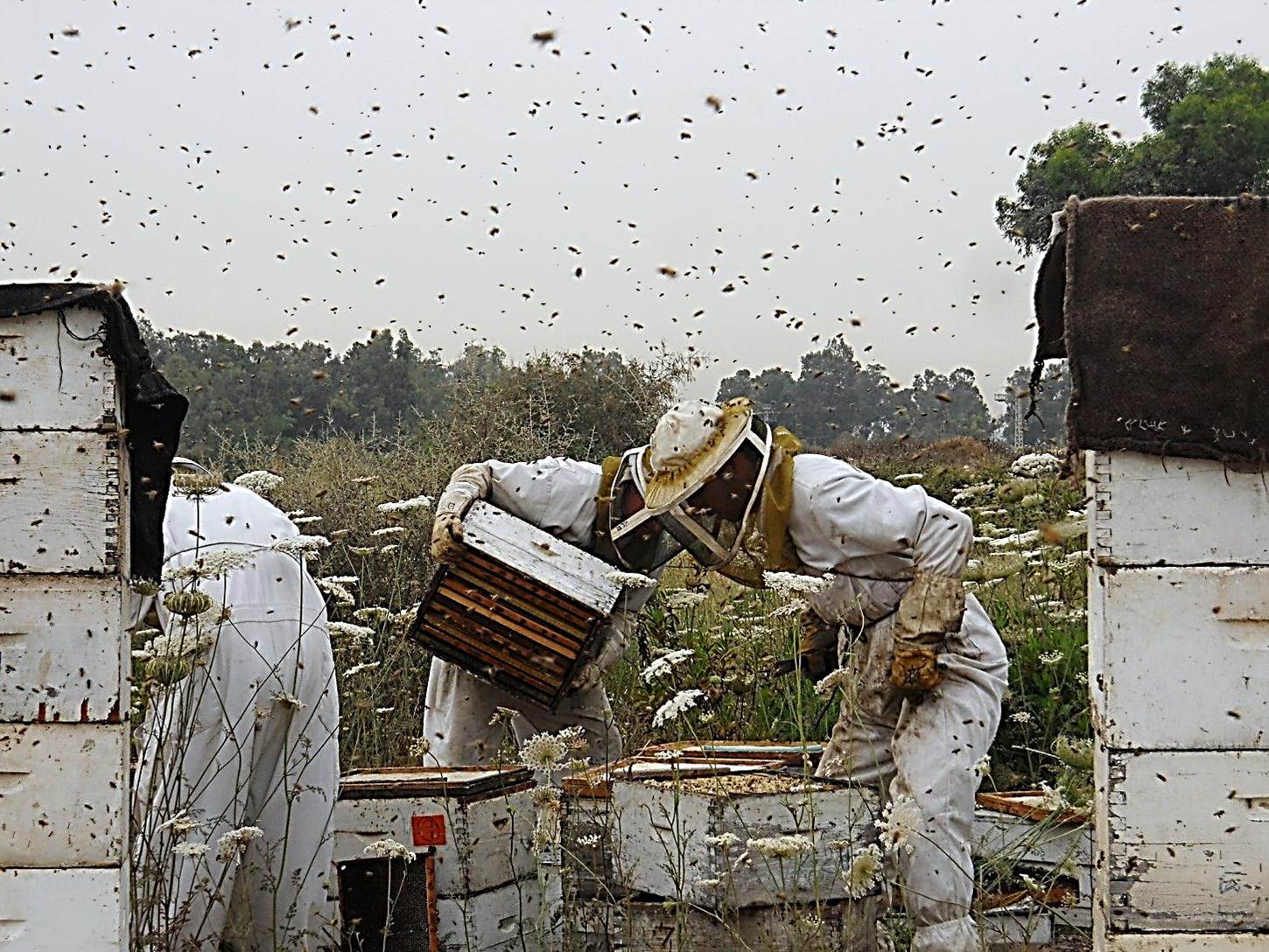
On a sunny Saturday afternoon in mid-February, a small group of New Yorkers—beekeepers, environmentalists, and a handful of honey aficionados—huddled together in an empty SoHo office building for a local honey-tasting session.

If this had been Portland or San Francisco, it wouldn’t have been a notable event—just a harmless gathering of honey connoisseurs. But in New York, where they may be hydroponics, bees are classified under section 161.01 of the health code as “wild animals,” and are just as illegal to own in the city as lions, cougars, alligators, or polar bears. So a local honey-tasting event is, in many ways, an act of political defiance.

True, there aren’t squad cars going around inspecting buildings for beehives on any given day, but the law can be invoked by a frightened neighbor who calls “311” to report a neighbor keeping buzzing colonies on the roof.

Even so, the threat of a $2,000 fine certainly hasn’t deterred New York’s underground enclave of beekeepers.

At the SOHO tasting, some 30 people were huddled around a large table, holding tongue depressors to dip into an assortment of honey containers. While some of the honey had come from Europe and New Zealand, the true stars of the tasting were local keepers from the West Village, the Bronx, and Brooklyn.

Some of the big, established local beekeepers were at the center of the room, sharing years of wisdom—how to get hold of a swarm of one’s own, how to keep bees on rooftops—and relishing their minor celebrity. Local beekeeping, after all, has become a bold new frontier in the overlapping worlds of environmentalism and food activism.

In the United States, nearly one-third of the country’s crops depend on bees for pollination, yet nearly one-quarter of the country’s honeybees have vanished in recent years, due to Colony Collapse Disorder (CCD) and other factors that are still unclear. The dearth of bees has quickly become alarming—according to a recent piece in the magazine Edible Manhattan, one urban farmer recently had to hand-pollinate his crops due to a lack of bees.

Saskia Cornes, an author who has written about New York City’s beekeepers, tells me that beekeeping has gained traction in recent years because of “a nice confluence of sorts between Colony Collapse Disorder and a renaissance of local foods.”

For one, New York City’s bees are mostly free of disease, which makes them invaluable in countering the outbreak of CCD. What’s more, beekeeping has become a popular way for New Yorkers to support local agriculture even if they don’t have much green space for a garden.

“Beekeeping suits New York because we don’t have yards,” Cornes explains. Recently, a variety of urban-beekeeping courses have sprouted up, like those offered by the The New York City Beekeepers Association. A beekeeping “meetup” group was launched in 2006 and according to the Gotham City Honey Coop, has been growing rapidly since.

The honey itself, meanwhile, is becoming wildly popular. Many beekeepers, honey advocates, and holistic healers believe eating local honey is the best remedy for allergies, since it provides a low-level (and delicious) exposure to local pollens. And there’s the fun of identifying local flavors: Honeybees usually travel two or three miles each day pollinating rooftop gardens and plants before returning home to make honey with the flavors of the flora they’ve visisted. A few honey tasters at the SoHo tasting swore they could detect the Bronx in the South Bronx honey, and one claimed to have tasted a hint of Tenth Street in a Manhattan variety.

All of this enthusiasm has spurred organizations such as Just Food, as well as other bee activists from various organizations, to work with city council member David Yassky to introduce legislation that would license residents as beekeepers, so that they could nurture and grow the local bee population, as well as assist nearby farms in dire need of pollinators. Back at the SoHo honey tasting, anticipation hung in the air as attendees discussed the future legalization of beekeeping.

Esther M., one of the SoHo honey-tasters, said the whole thing was like being “part of a secret society.” She insisted that she felt a strong connection to bees, and saw their vitality and health as the future to a healthy New York.

On the other hand, she added, she couldn’t help but think that the South Bronx variety “tasted like pollution—like buildings, concrete and dirt.” She preferred the honey from Fort Greene.

Jordan's Environment Society A Middle East Model for Environmental Protection

jordan guard petra environment photoCountries in the Middle East should take notice that the Hashemite Kingdom of Jordan is making great efforts to improve Jordan’s environment as well as that in the region.

One of the foremost environmental societies in the Kingdom is the Jordan Environmental Society, which was established in 1988, during the reign of King Ab dullah’s father, King Hussein.

Like the SPNI in neighboring Israel, the Society is a non-governmental and non-profit organization whose propose is to improve the environment and improve its basic elements.

These elements not only include ones like air, water, soil and animal life, but human beings too.

Lebanon Pours the Country's Sewage to the Sea Costing Millions and Harming the Environment

3

swim-beirut-photo

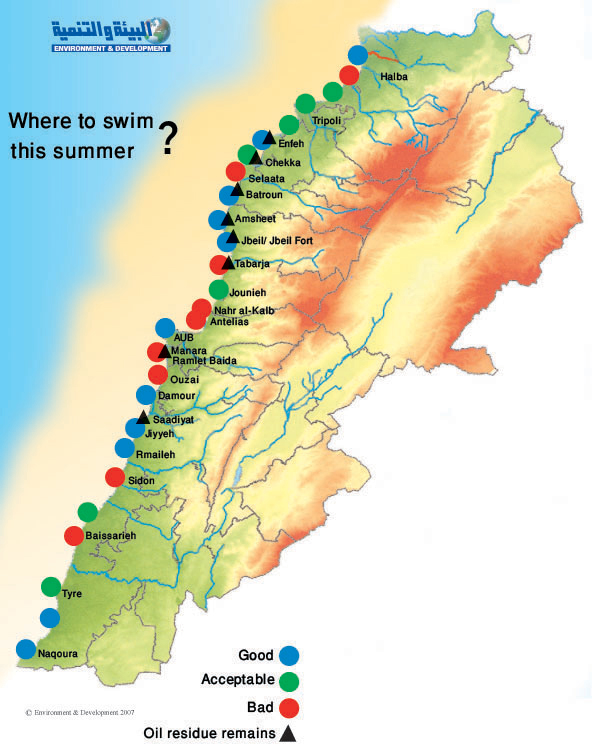
If those of us living in Israel think we have a problem with pollution and beach closures in the Mediterranean Sea, we should take a look on what’s happening north in Lebanon.

A recent article in Beirut’s English language newspaper, the Lebanese Star, noted that pollution caused by both the public and private sectors is reaching dire proportions.

According to the article, the problem seems largely ignored by much of the Lebanese public, and at least 200,000 cubic meters of untreated sewage water pours into the sea daily.

The situation is so bad, that Mr. Ali Darwhish Secretary of the Lebanese environmental organization, Greenline, said that “Lebanon is one of a few countries where nearly all sewage goes into the sea.”

Iran's New Year "Nowruz" An Ecological Bridge To Connect The Middle East?

2

persian-spring-new-year-photo

Eco-Jews are busy now celebrating Passover, while Christians in the Holy Land and the world over ready themselves for Easter. Iranians, we learn had their own celebrations this time of the year, coinciding with the vernal equinox on March 21. 

Iran’s political makeup and leadership may not be making many friends these days, but one of Iran’s annual festivals, one called Nowruz or Persian New Year festival is being celebrated in a number of countries, and by several different religions as well. 

Nowruz or Nowrouz, which means “New Day” in Persian, officially marks the first day of Spring in the Persian calendar and corresponds to the Spring Equinox which is marked on Western calendars as March 21.

The holiday is not only celebrated by the Iranians, but also by countries in Central Asia, South Asia, Western China, The Crimea, and by a number of ethnic groups in Balkan countries such as Albania, Kosovo, and Macedonia. The holiday marks the period when the sun crosses the celestial equator and creates equal day and night. 

The sun and fire are important elements in the ancient Persian religion of Zoroaster and the festival is observed by this ancient monotheistic faith.

Algae-For-Biofuel Isaac Berzin's New Advert Touting the Importance of this Alternative Energy Source

3

“We call it pollution, they call it gourmet food,” so says algae-for-fuel missionary Isaac Berzin, who sent Green Prophet a new video, an advertisement touting the benefits of this alternative energy source for our planet.

Berzin, a Ben-Gurion University and MIT-trained chemical engineer, and Boston-based Greenfuel Technologies have developed a revolutionary technology to produce biofuels from algae that are bred on gases emitted by power plants.

Time Magazine included Berzin in its list of the 100 most influential people in the world in 2008, and Fortune Magazine also published a flattering article about the company, which has raised tens of millions of dollars in venture capital.

Rabbi Sinclair Reviews "Nature's Due" And Its Complicated Biology

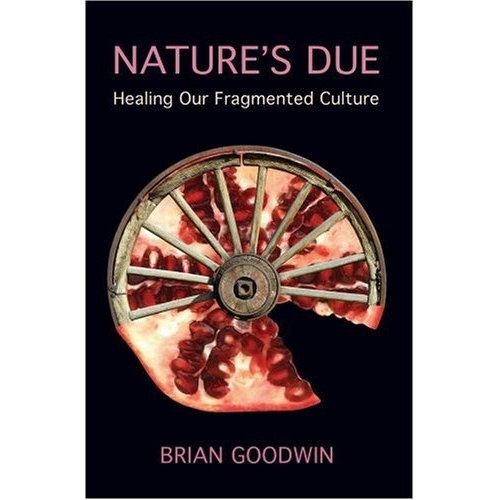
natures-due-cover-large

I am really not the right person to be reviewing “Nature’s Due” by Professor Brian Goodwin from Shumacher College in the UK. It is based on some quite complicated biology, a subject that I haven’t studied formally since I was 14. James sent me the book in September, and I’ve only just finished it now, after several tactful reminders from James. As you can infer from that, it’s been a bit of a struggle.

However, I’m really glad that James stayed on my case about this, because “Nature’s Due” is a fascinating and important book. It’s one of those books that can furnish you with a couple of serviceable building blocks for a worldview.

Goodwin’s guiding question is: what would it take for our culture to interact with the world in a mode of engaged, evolutionary participation rather than in a mode of dominance and control?

He lists the familiar litany of environmental failures engendered by the dominance and control model (GM crops, degraded food supply, ugly, dysfunctional cites etc.) and asserts that the root cause of this cultural attitude is dualism: our predilection for seeing nature as inert stuff to be acted on and transformed for our benefit through the agency of human will and subjectivity.

Sometime shortly after the Renaissance, claims Goodwin, we disenchanted the world. Consciousness, intelligence and freedom were arrogated to the human realm, while the physical world was conceived as a mere machine.

Israel's Sovna Provides Wind Energy In the Urban Environment Where It's Needed

Here’s a video produced by my pal Nitsana, on a new wind power company, Sovna, working to collect the wind blowing between and around skyscrapers:

Matteo's Vegan Dinner in Brooklyn is Animal-Friendly but People-phobic

180-chefmatteo
Chef Matteo. Photo from VegCooking.com

While in Israel, I often read about the hip food scene in Brooklyn, New York. From home picklers to small-scale cheese artisans and onto creative butchers, the borough seems to be bursting with local and environmentally friendly food innovators. So on a visit home in mid-March, I sampled the scene by paying $40 for a four-course meal in the home-cum-underground restaurant of vegan chef Matteo Silverman.

Two friends and I got to his spacious loft, where Matteo, young, smiling, and quiet in a white chef coat, greeted us and led us to one of two dining tables set up in view of his small but meticulously organized home kitchen. In action since 2003, Matteo has received high accolades including this review.

Syria and Jordan's Wihdeh Dam Will Cut Israel's Water Needs Out of the Picture

0

yarmouk-river

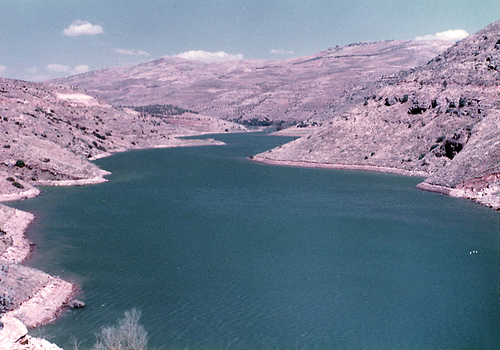
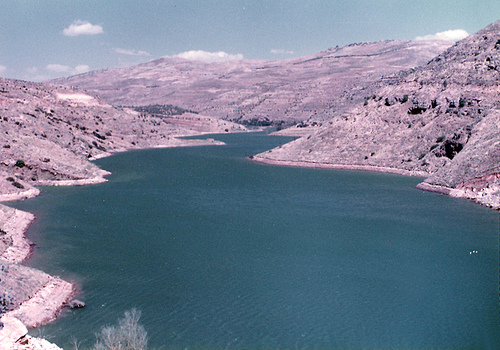
Little publicity appears to have been made in Israel regarding a proposed joint project between Jordan and Syria to construct a dam across the Yarmouk River.

The dam, known as the Wihdeh Dam, will be built on that part of the Yarmouk that is shared by the two countries before it reaches an area now under Israeli sovereignty.

One of the Jordan river’s main tributaries, the Yarmouk’s waters are shared by Syria and Jordan for a 40 km stretch which is also part of the boundary between the two countries, before it reaches the part of Golan Heights which is now under Israeli sovereignty where it then forms the boundary between Israel and Jordan. It is a tributary of the Jordan River.

The river at present provides Jordan with an annual water supply of 135,000 cm. Upon completion, a reservoir created by damming the river will result in a storage capacity of 220,000 cm.

The project was originally planned back in the spring of 1999 and is said to have connection with the 1994 peace agreement with Israel, when Jordan was allotted an annual amount of water as part of the peace agreement between the two countries.

It has been refuted by the Jordanian government that Israel objects to this plan, which will curtail the Yarmuk’s flow and deprive Israel of much of the Yarmuk’s flow

NewDealDesign’s Gadi Amit Designs Charge Spots For Better Place Electric Cars

newdealdesign-gadi-amit-electric-cars-photoA little industrial design can make a product go a long way. Take the design of Apple computers, iPhones and accessories. Discriminating consumers often purchase these products for the “look and feel” and not necessarily the technology that makes them tick.

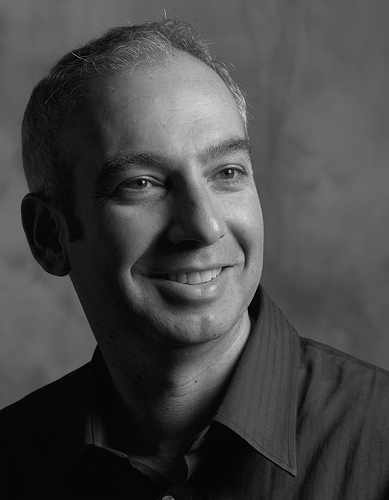
With experience working for the US-based frogdesign firm, and now major clients, some looking to go green, from the computer industry, such as Dell, HP, and Samsung, the Israeli industrial designer Gadi Amit, 46, is running a tight and successful ship at the American design firm he founded: NewDealDesign, based in the San Francisco Bay Area.

Fast Company and BusinessWeek consider Amit’s industrial design firm to be a top 10 in America, and in consumer electronics, he’s an easy top five.

Recently partnered with Shai Agassi, the founder of the electric car company Better Place, Amit took on the role of designing Better Place’s electric car charging ports. San Francisco and Hawaii have already committed to test-driving the project, and in Israel says Amit, who is an old friend of Agassi, the NewDealDesign recharge stations are already on the streets.

gado-amit-charge-spots

The first ones were inaugurated last December. “We’re moving forward – moving very fast and the project is very tangible. It’s real and it’s happening,” Amit tells ISRAEL21c.

“My contribution is to make sure the product is cost-effective, user-friendly and has a significant signature, one that’s playing well with the urban setting.”