Home Blog Page 693

Voltaire's Switching Computers Onto Green Power

1

computer-heap-old-green

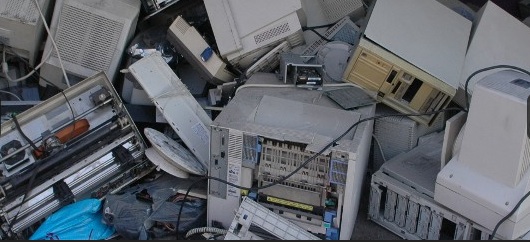
Computers need resources. Whether it’s logging on at work, sending Tweets from the train station or powering big laboratory ideas, firing up all those communications devices requires juice. In the language of “green,” energy savings equal increased efficiency, and efficiency means less carbon-based pollution.

Israel’s Voltaire works with the top companies in the business, such as Oracle, Sun and IBM, to make servers and super-computers more energy efficient. Some 1,100 clients around the world use InfiniBand, Voltaire’s “switching” product that lets them connect together small servers so that they can scale up in accordance with their business and computing power needs.

Globe Ecological Hub Recently Proposed for Israeli City of Modiin

5

eco hub modiin tamariIsraeli architect Zvika Tamari (of TeaM Architects) recently proposed a conceptual plan for a Globe Ecological Hub in Modiin, a city in the center of Israel between Tel Aviv and Jerusalem.

What is a Globe Ecological Hub?

In Tamari’s conception, it is an organically shaped, grass-roofed eco-dome located in the center of the city and surrounded by green spaces.  If completed, the hub would function as a museum and multifunctional urban center that promotes sustainable living.

Many green building strategies would be used in the construction of the hub, such as natural ventilation, daylighting, water reuse, and active solar systems.

Sewage Pipes and 8 Israel-related Cleantech Headlines, Week of August 2, 2009

0

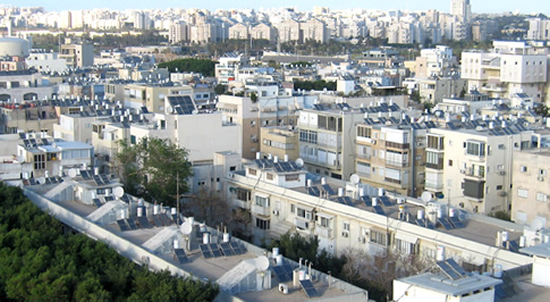
solar-hot-water-heater-rooftops-israel2_UMvkj_5784[1]

The Dead Sea on Israel’s side is drying up. The path to peace might be in the sewage. An Australian-Israeli team is working together to try to rescue rainwater runoff. For these stories and the rest of this week’s 8 Israel-related cleantech headlines, check below.

Solar
eSolar Shows Off Its Solar Thermal Tower

Arison unit to install solar panels on new projects

Investment
MoneyTree: VC investment lowest in decade

In Israel
5 Must-See Green & Tech Travel Stops at Israeli Kibbutzes

Smoking the Sewage Pipe

Water
Dry land of the Dead

Australian-Israeli team hoping to rescue rainwater runoff

Miscellaneous
The ‘other Israel’

Israel's Army Makes Advances In Green, But Victory Comes First

4

israel army goes greenDoes the Israeli Army read Green Prophet?

Following our recent May 26 article , Israel’s Ministry of Environmental Protection: IDF Bases Pollute Land and Water, it now appears that the Israel Defense Forces, otherwise known as the IDF, may now be trying to “clean up their act” in regards to protecting the environment.

Is this another case of greenwash or something that’s true? 

An article on August 4 in the Jerusalem Post, IDF joins environmental revolution, notes a number of  things being done by the IDF to prevent damage done to the environment by various military related activities, including the use of electric powered vehicles on military bases for moving army personnel and supplies around. The article also points out cleaning septic tanks and other sewage storage and treatment facilities on army bases (until now a big cause of ground water pollution), and even introducing special bacteria that consume the explosive material from disused bombs and other explosives.

The efforts are being made to help reduce the IDF’s carbon and ecological “footprint” on Israel’s environment, often said to be one of the biggest contributors to environmental damage. It’s a contentious issue. 

Sweetened Soda and Natural Juice Causes Long-Term Liver Damage

17

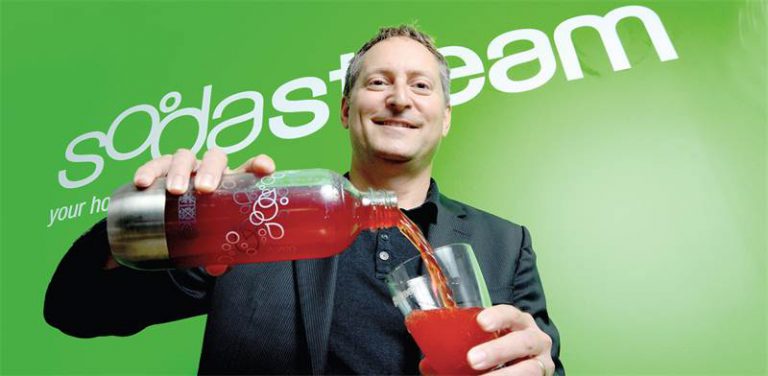
Daniel Birnbaum, invests in Seedo, Cannbit, was former CEO of SodastreamEating healthy, we already know is part of maintaining a green lifestyle.

If you haven’t by now stopped buying high in sugar colas, soft drinks and fruit juices, here is some news that might want you limiting your consumption, and drinking water instead:

A new study reveals that too much sweetened soda and fruit juice may cause long-term liver damage. Switching to water is the best preventive measure to contribute to long-term health.

It may be a good idea to replace the juice in your kid’s lunch box with a bottle of water. A health conscious physician has bad news for the beverage industry. According to Dr. Nimer Assy, people who drink more than one liter (about four cups) of sweetened beverages a day have a five times greater risk of developing fatty liver.

“In the long term, this contributes to more diabetes and heart disease,” warns the doctor from the Ziv Medical Center in Haifa, Israel.

While known culprits like sweetened carbonated soda are on the list of “no-nos,” natural and freshly squeezed fruit juices appear there, too. His findings are reported in the Journal of Hepatology, where Assy, a specialist in internal medicine, liver disease and liver transplantation and director of the Liver Unit at Ziv, warns that the beverages cited can cause long-term damage.

In his study, Assy followed 90 healthy patients with no perceived risk for fatty liver. He discovered that about 80 percent of the people in the study who were diagnosed with fatty liver drank more than half a liter (about two cups) of sweetened soft drinks (carbonated beverages and sweetened juices) every day, whereas only 17% of those in the control group had the condition.

Don’t squeeze, chew your fruit!

The ingredient in the sodas and juices that causes the damage is a fruit sugar called fructose, which is highly absorbable in the liver. It does not affect insulin production and goes straight to the liver where it is converted to fat. Fructose ups the chances that you will suffer from a fatty liver, which can lead to cirrhosis of the liver and liver cancer, Assy says.

The father of five, who lives in the Christian Arab village of Fassuta in the Galilee region of Israel, confesses that his own kids drink Coke. However, his advice to other parents is to limit their offsprings’ intake of soda or any sweetened beverage – natural or artificial – to not more than about one cup, juice box, or can, a day.

Red Bull and high energy drinks are a big problem in the Middle East, where kids drink cans of these high-fructose beverages instead of water.

To reap optimal benefits from fruit and avoid the liver damage possibility, Assy suggests eating the fruit whole. “The natural orange has fibers and prevents fructose from being absorbed [in the liver],” he explains. If that’s not possible, he recommends drinking fruit juice that has extra pulp in it.

Assy’s study was spurred by what he saw at his in-patient clinic. “We have noticed recently that there are many patients coming to the clinic with fatty infiltration of the liver,” he says. “Usually the risk factor is for people with obesity, diabetes and alcohol [abuse, but] we noticed some people without these pre-conditions could have fatty liver.”

Diet drinks are suspect as well

He started the study by asking his patients to take a questionnaire. As the group of 90 people (with a 50:50 ratio of women to men, ages 40 to 50) filled in the blanks, an explanation began to emerge. They were asked about their level of physical activity, caloric intake on a daily basis and the amount of soft drinks they consume.

“We found people who drink more than two cans of Coke a day have increased their chances for a fatty liver, and if left untreated their chances for heart disease and cirrhosis of the liver also increase,” Assy says.

When Assy refers to soft drinks, he’s including diet soft drinks in the mix. With inconclusive data on diet drinks, he believes that those containing artificial sweeteners may have a similar effect. While diet drinks do not contain fructose, they do have aspartame and caramel colorants: “Both these can increase insulin resistance and may induce fatty liver,” says the doctor.

Assy plans to conduct a more extensive study of the health effects of artificially sweetened drinks and he suspects that his findings may not be to the taste of the world’s beverage industry.

Upcoming Giftec Exhibition in Tel Aviv to Feature Local Palestinian Handicrafts

4

giftec exhibition israelGiftec, an industry show featuring various types of gifts and housewares that achieved great success in Tel Aviv this past February, is having another show starting today (August 10) and running through Wednesday (August 12).  The items in the show will include textiles, dishes, kitchenware, art, souveneirs, Judaica, and more.

This time, however, Giftec will be hosting Artesana: Authentic Handicrafts – a display of 16 Palestinian handicrafts companies in a move that supports Israeli-Palestinian business cooperation and also encourages the promotion of local handicrafts.  And as we’ve noted many times before here on Green Prophet, local is almost always greener.

Local products require less fossil fuels to transport, and handicrafts are also greener since they rely on human power instead of mechanical (and electrical) power.

Maccabi Health Fund Undermines Babies' Health By Distributing Free Formula to New Moms

2

Distributing samples of infant formula and marketing breastmilk substitutes to new mothers is in direct violation of the World Health Organization’s International Code of Marketing of Breast-Milk Substitutes. Israel is a signatory to the Code and the Israeli Health Ministry recommends exclusive breastfeeding for at least six months to prevent illness and health problems in both mothers and babies.

Israeli government hospitals have been accepting money from formula companies for years. Hospitals agree to use only one brand of formula in their newborn ward, with the expectation that parents will be influenced by  the  unspoken endorsement once they are home.

A New New Central Bus Station for Tel Aviv?

4

old-tel-aviv-bus-station-demolished

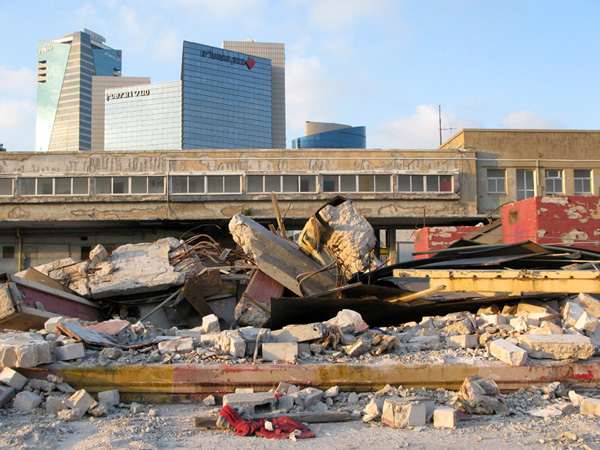
“I used to get off at the old bus station, and to me it was like another country…” goes the Tipex song (free translation mine). Above: Tel Aviv’s Old Central Bus Station demolished. Photo by Moran Beth Halachmi, via Flickr.

This week, Tel Aviv’s unused Old Central Bus Station became history. The much-maligned New Central Bus Station may soon follow suit, while a New New Central Bus Station is still in the planning stages.

It sometimes seems to me that there must be some kind of curse on all things transportation in Tel Aviv. The traffic jams are unbearable, the drivers obnoxious, the buses lousy and the bus station even lousier. And who even knows if the light rail/subway project will ever actually happen

The Elders and Eco Minded Businessmen to Visit Israel, West Bank, and Gaza

5

the elders middle eastThe Elders, a group of independent and eminent global leaders originally brought together by Nelson Mandela, have announced their plans to visit Israel, the West Bank, and Gaza at the end of August.    The delegation will be led by former Brazilian President Fernando Henrique Cardoso, and will include Ela Bhatt (India), Gro Brundtland (Norway), Jimmy Carter (former US President), Mary Robinson (Ireland), and Desmond Tutu (South Africa).

The delegation will also be joined by two eco minded businessmen who have already been environmentally active – Richard Branson and Jeff Skoll.

Skoll in particular has already been active in promoting a greener Middle East.  This year the Skoll Foundation awarded a $750,000 grant to EcoPeace/Friends of the Earth Middle East (FoEME) in order to expand its cross border community based activities and deepen its organizational capacity to advance water and peace issues in the Middle East.

Israel's Clean Tech Industry: A Broad Brush Overview

15

tal-ya-water-israel-dew-collectorsWater technology, solar innovation, Israel’s electric cars: I’d originally written this story for ISRAEL21c a few months ago when we were planning on launching its new Environment channel. The new channel was finally up this week. Consider it a good starting point if you’d like to know more about Israeli technology and investment opportunities and what the future may hold:

When green evangelist Al Gore visited Israel last year (and Green Prophet was there) he gave a clear message. “The people of Israel can lead the way to renewable energy,” he told audiences. With its unique geographical position, and clean tech know how, he announced, Israel is a natural leader in the field.

It’s a view that is echoed by many. Ian Thomson, the Californian co-founder of CleanTechies, a web site launched for clean technology professionals, agrees. “Israel has a natural incentive towards clean tech because of its political and natural geography,” he tells ISRAEL21c. The innovations that “make natural sense in Israel, are often good for the rest of the world.”

“Israeli innovators have proven themselves in high -tech, communications, Internet, biotech, medical devices and more,” says Mike Granoff, a general partner at Israel Cleantech Ventures, and the head of oil independence policies at electric car company Better Place.

“The same drive, talent and creativity will serve them well in the next great business frontier, technologies around sustainability,” he says.

The field of clean technology emerged about 10 years ago. It’s a natural space for Israelis, who for more than 60 years have been looking for ways to grow crops on barren wasteland, to re-use scarce water resources creatively, and to lower their reliance on oil from enemy states.

Gazans Smoke Sewage Peace Pipe With Israel

5

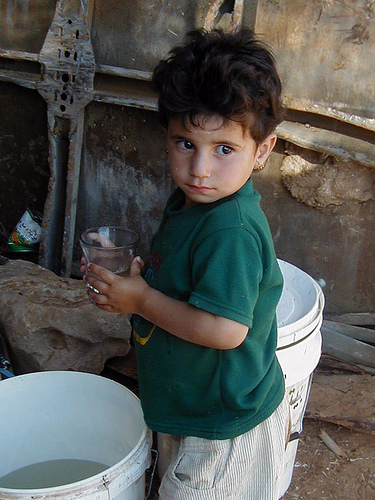
palestinian-child-drinking-water-green-prophetThe concept of achieving peace through pipes may have originated with Native Americans, but today, unbeknownst to most of us, Israelis and Gazans are seeking peace through sewage pipes.

It was a wild idea back in 1997, and perhaps it is even more unrealistic today. However, against the odds – and working around their governments – the mayors of the Israeli city of Ashkelon and the Palestinian Authority’s Gaza City have taken it upon themselves to try to cooperate with each other.

Ten years ago the vehicle was an educational project in high-tech. Today, they’re coming together over waste water, a major problem in Gaza City right now.

By car, the two cities are only about a 20-minute drive away from each other. But in fact, they are worlds apart. Most people in both cities have never met one another.

The only thing they can be sure that they have in common is a beautiful coastline that follows the Mediterranean Sea from Lebanon all the way down to Egypt. But that shining sea is heavily polluted, since Gaza has no water infrastructure and its raw sewage pours directly into the sea, as Green Prophet’s Rami reports here.

Thanks to one man’s vision, the two cities will soon be working together. Ilan Juran, an American-Israeli specialist in urban infrastructure, is seeing to it that the residents of Gaza will be equipped with the same sanitation and sewage systems that are enjoyed by their neighbors in their sister city on the coast.

Jewish National Fund Sponsors North America's Green Israel Program

The Jewish National Fund says it is proud to sponsor the Habonim Dror North America (HDNA) Green Israel Program.

The program brings together the values of Judaism, Zionism and social justice through a Zionist-based, environmentally friendly gardening project at HDNA’s seven summer camps located in California, Maryland, Michigan, New York, Pennsylvania, Toronto, and Vancouver. Its goal is to foster campers’ connections to Judaism and Israel while teaching them to live more environmentally conscious lives.  

Israel Railways Teams Up With Better Place To Refuel Electric Car Commuters

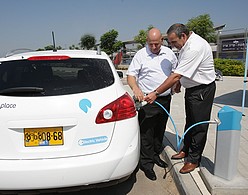
Satellite[5] Refueling newly developed electric cars in Israel may be one step closer to being commonplace with an agreement reached between Israel Railways and the Better Place electric car and energy terminal company.  

Better Place, which we’ve covered in depth currently in the process of developing practical electric powered cars, as well as recharging stations for them, has agreed to install up to 220 charging terminals in railway parking lots in a number of stations. They are Bat Galim, Central Haifa, Acre, Beit Yehoshua, Herzliya, Hod Hasharon, Rosh Ha’ayin, Petah Tikva Segula, Kiryat Arie Petah Tikva, Bnei Brak, and Pe’atei Modi’in.

Get your electric engines roaring? The agreement was reached by Yitzhak Harel, director -general of Israel Railways,  and Moshe Kaplinsky, CEO of Better Place. The terms of the agreement will mean that Better Place will construct the “charging posts” in designated sections of the train station parking areas, so railway commuters can charge up their electric powered vehicles while they are traveling to and from various locations by train.

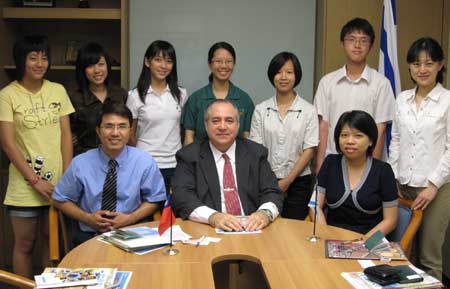
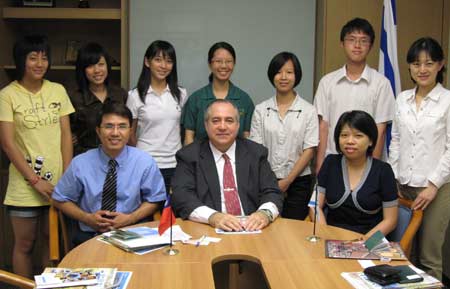
"Green" Taiwanese Visiting "Green Village" in Israel

taiwan-israel-green-village-exchange-photoFive young people from Taiwan are visiting Israel this month and will
spend most of their time at Hakefar-Hayarok (Green Village),
according to government officials.

Take Chang Hsin-yu, Cheng Yu-shun, Lin Yun, Chen Wan-shiuan, and Hsieh Feng-ho, and send them off to far away Israel, at the invitation of the Israeli Youth Council, and a good summer adventure is in the works.

It’s a cultural exchange, a youth exchange, and a scientific exchange.

Jordan, Israel and Palestinian Reps Meet to Jumpstart Controversial Red-Dead Canal

2

Dead Sea-dying-israel-jordan-world-bank-photoRepresentatives of Jordan, Israel and the Palestinian Authority met last week to study ways to undertake a project known as the “Red Sea-Dead Sea Water Conveyance Study Program, according to Globes.

The meeting, hosted by Jordan, was headed by representatives of the World Bank, with the purpose of forming a committee to study ways in which the project of constructing a canal from the Red Sea to the Dead Sea in order to supply much needed fresh water from desalination as well as replenish the rapidly diminishing  Dead Sea water levels.

The Technical Steering Committee will study the options for undertaking the construction project, which would be done in stages.

The feasibility of mixing Red Sea and Dead Sea water will also be studied, as this issue has been one of the problems of such a project which some environmentalists fear will damage the sensitive regional environment.

Financing of such a project that would be handled through the World Bank, will depend on the outcome of these studies, and the total commitment that everyone will have to undertake such a project.

But isn’t this the same old song and dance we’ve been hearing about in the last 5 or 6 years? Earlier this year Jordan, we reported earlier, said they’d go it alone; later Israel said the World Bank had given them clearance and didn’t mention the Jordan partner. Isn’t this story becoming a bit like kids in a sandbox?