Home Blog Page 683

Google "Sees the Light" by Investing in More Israeli Renewable Energy Projects

11

google-green logo invest sola energy israelAmerican search engine giant Google is now becoming involved in renewable energy projects, including electrical power generated by solar energy. One such project in which Google is a known investor is the Israeli solar energy company, BrightSource Energy,  whose specially-designed collection mirrors and energy generating tower are one of the most  advanced and successful in the solar energy field.

We also reported last year, that Google was eying geothermal energy company Ormat (NYSE:ORA))

BrightSource, which has a contract with PG&E, is currently  involved in a number of solar energy projects in Israel, California, and Nevada , and will eventually be supplying more than 4 Gigawatts of  electricity to homes, commercial and business properties in both countries.

It recently received investor capital in the amount of $115 million, a part of which was invested by Google. Google’s president, Bill Wheil, spoke at a recent global energy summit held in San Francisco about his company’s interest in innovations which will provide large amounts of clean, renewable energy at much lower costs. Wheil told the audience about the unique mirrors used by BrightSource which are not only very efficient, but much lower in cost than those used by other companies.

Transform junk mail into beautiful envelopes

13

junk mail envelope

Whether we like it or not, many of us get bombarded with junk mail.  And try as we might to remove ourselves from junk mail lists, unsubscribe, plead with the postman… somehow it just keeps trickling in.  This project will give some of the paper in your junk mail pile one more use before it heads into the recycling bin.

With all of the colorful designs on a lot of junk mail catalogs and solicitations, many of them can make unique envelopes. They are extremely easy to make, and these one-of-a-kind, funky envelopes are sure to put a smile on your addressee’s (and maybe even your postman’s) face.

junk mail envelope tutorialFor this project you will need:

1 sheet of junk mail paper or 1 sheet out of a junk mail catalog

Scissors (If you need them, you can get lefty scissors on this website)

Glue

Card/Letter you want to put in the envelope

1. Place the item you want to mail (the card or letter) on the center of your junk mail sheet.  Make sure that the side of the paper you want to appear as the outside of the envelope is facing down.recycled paper envelope

2. Fold the sides of the sheet in around the card or letter – fold straight creases along the top, bottom, left, and right.  This should create a grid-like pattern of folds on the sheet.  (See the picture on the right.)

recycled paper envelope tutorial3. Use your scissors to cut out the four corners that were created by the folds.  This should leave you with a cross-like shaped paper that has a center for the card or letter you want to mail and 4 flaps surrounding it.  (Check out the picture on the left.)

4. Glue one of the larger flaps to the two side flaps to create a pocket for the item you want to mail.  Once the glue has dried, place your letter in and seal the envelope by gluing the remaining flap closed.reused paper envelope tutorial

If you are hand-delivering this envelope, then you don’t have to worry how sturdy your paper is.  But if you plan on mailing the envelope (especially if it’s to an international location), then you may want to line the inside of the envelope with some additional junk mail paper.  Magazine or catalog papers can be beautiful, but they can also be thin so before gluing the flaps closed in step 4, glue a cut out piece of paper that is slightly smaller than the main section of the envelope to the inside.

Read about other upcycled projects:

Think Again: Make a Last Minute Gift Bow with Reused Paper

Think Again: Strike Up a Matchbox Inspired Recycled Notebook

Think Again: Turn Old T-Shirts Into Drawstring Bags

Jewish Clean Tech Conference in San Francisco to Feature Israeli Companies and "Green" US Superstars

13

 wind-turbine[1]With an eye to the Middle East, hundreds of Jewish professionals will meet November 8 in San Francisco to share ideas and experiences dealing with clean energy projects in both the US and in Israel.

The conference Jewish Response to the Energy Challenge (JREC) will feature some of the top Jewish “players” in the clean tech and environmental fields.

Among these are Alan Salzman, CEO of Vantage Point Venture Partners, a company  which specializes in raising venture capital for clean tech and bio-tech projects in various parts of world;  Jason Wolf, of Better Place California, which is involved in the production of both electric-powered cars and service stations for them; and Joel Makower, Executive Director of Greenbiz.com,  a news site dedicated to informing readers about  environmentally friendly enterprises and projects all over the globe. 

Keynote speakers include Adam Werbach (link to his book blog and site), who is regarded as one of the world’s premier experts in sustainability. At age 23, Werbach was elected as the youngest president ever of the Sierra Club, the oldest and largest environmental organization in the United States. In 1998, Werbach founded sustainability agency, Act Now, to engage the corporate and media world in social, environmental, cultural and economic change.

After ten successful years, Act Now merged with global ideas company Saatchi & Saatchi to form Saatchi & Saatchi S, the world’s largest sustainability agency.

Among the topics to be covered in the one day agenda includes Jewish involvement in promoting environmental sustainability, clean tech and the economy, and the creation of more employment opportunities in these fields.

Kuwait Marine Life Degrading to Alarming Levels

5

kuwait-oil-drill-1950-photo
(Bechtel International, Persian Gulf (Arabian Gulf), Oil Drill-head; about 1950. Kuwait or Saudi Arabia.)

They say the world is a global village. If so, and if the environment is a global concern, more emphasis needs to be put on helping countries like Kuwait where their marine life, its atmosphere and soil levels, according to the Kuwait Times, is degrading at an alarming rate.

Considered one of the most polluted among all the Gulf countries, a lack of government policy coupled with the pollution after-effects of the Iraq invasion of 1991 has kept Kuwait in a poor state of repair. Dr Hamad Al-Mutar, Head of Kuwait’s Greenpeace Organization and a Chemistry professor at the Kuwait University is asking the United Nations help Kuwait clean up lingering hydrocarbons via less impacting biological methods. 

Israeli Presidential Conference Includes Environmental Content This Week

10

Shimon_PeresIsraeli President Shimon Peres has been keeping busy lately with all of his environmental advocacy.  Last year he launched Tel Aviv’s Earth Hour by powering down the lights in the Tel Aviv City Hall and Azrieli towers, then he inaugurated Israel’s first “green city” – Kfar Saba, this year he unplugged Jerusalem for Earth Day 2009, and just last month he launched an Israeli Clean Energy Forum.  And he’s not tired yet.

In his Presidential Conference taking place this week in Jerusalem (October 20-22), a portion of the discussions will be devoted to various aspects of the global environmental crisis.

The environmental section of the conference will take place on Wednesday, October 21st and address several ecological concerns and issues.  The various environmental sessions will include:

Saudi Arabia's KAUST University Is Eco-friendly Environment For Fueling Academic Progress

18

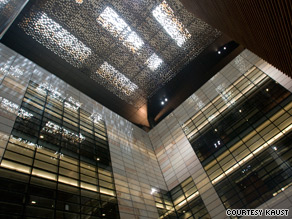
art.spinewalk.kaust[1] The Kingdom of Saudi Arabia may still be considered as one of the most conservative from a religious standpoint. But with the opening of the new King Abdullah University of Science and Technology, otherwise known as KAUST, a new era in academic learning, combined with new innovations in ecological architecture and design, has begun in which both men and women students will benefit jointly.

 The new campus opened its doors in September, in the Red Sea city of Thuwal,  80 km north of Jeddah. It is considered to be  the most environmentally innovative  campus of its kind in the Kingdom. Constructed in a manner to utilize the maximum benefit of sea breezes for cooling, the buildings themselves have been constructed in order to screen out a good deal of the heat that is generated by the hot Arabian sun; making the internal environment  more sustainable for the students.

Built close together, the buildings themselves are designed to shade each other, making the internal temperatures much cooler.

 From an academic standpoint, the university will offer degrees in 11 fields of study, including Environmental Science and Energy Development, Biosciences and Bioengineering, Industrial and Chemical Engineering, Applied Mathematics, and Computer Science. One of the most innovative aspects to the new KAUST campus, for Saudi Arabia anyway, is that both male and female students will study together in the same classrooms; something that has not been common in other Saudi campuses.

Siemens Buys Israel's Solel for $418 Million

16

solel solar energy siemensIt’s getting really hot over here in the Middle East – at least when it comes to solar energy investing and buying. Siemens, reports Haaretz today, just bought Israel’s solar energy company Solel yesterday for a scorching hot price tag of $418 million USD.

The news between Siemens and Solel was already bubbling back in July, Green Prophet reports. And just this week General Electric (GE) announced its B round financing of SolarEdge, another Israeli solar energy company.

The Solel purchase will expand Siemens’ business with solar thermal power plants, according to the paper:

“We aim to be the global market leader in the solar thermal sector,” Siemens Chief Executive Peter Loescher said during a conference call. It was broadcast live and available through the Siemens’ website.

The company’s name will most likely be changed to Siemens-Solel, and Siemens is willing to continue using the manufacturing plant here in Bet Shemesh, for five years. However, after this period, the Israeli office is expected to concentrate mostly on research and development. 

Solel has 400 employees in Israel and 100 in Spain. 

Read more on Solel here, and link to the Haaretz article. Or at the Financial Times.

The Financial Times says:

Siemens is part of a consortium – called Desertec – that aims to supply up to 15 per cent of Europe’s energy needs by 2050 through thermal and other renewable energy plants in the deserts of North Africa and the Middle East.

SDE Energy and India Make Waves With Tidal Power

20

energy from waves SDE desalination

The idea of producing electricity from ocean currents and waves has been talked about for several years (see our story on Leviathan and India and a $50 million wave energy deal in the works then). But now, the idea is becoming more serious as countries are joining forces to harness the great energy potential that is being produced continuously by the world’s seas and oceans.

Two countries getting serious about these kinds of projects are Israel and India. Israel’s SDE Energy and India’s Om Se Mantra Powergen made an agreement with the government of the Indian state of Gujarat to build a 5 megawatt electric power plant that will be powered exclusively by the power of ocean waves.

Gaza Zoo Paints Donkeys To Look Like Zebras

13

Donkey painted like a zebra

Zoos in many parts of the world have often been in dire straits due to budget problems and other factors. But when a zoo happens to be located in a place like Gaza City, the situation can become even more dire, as well as “interesting”.

Take the case of the Mara (Happy) Land Zoo, in which its only two zebras starved to death during the January war with Israel.

The zoo’s owner, Mohammed Bargouthi, didn’t have the money to replace the zebras ($40,000), and even if he did, there simply wasn’t any way to bring them into Gaza, which is still under blockade by both Israel and Egypt. They’ve been known to pull lions through the underground tunnels, but animals with longer legs like zebras probably wouldn’t work.

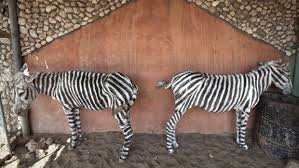
So, what to do, as far as offering Gaza children something to see at the zoo, which still has a couple of  baboons, an aging leopard, and a number of  cats, birds, and other small animals. Bargouthi found the solution by painting a couple of white donkeys, known as “hamor” in Arabic, with black stripes made from women’s hair coloring, which from a distance made the two donkeys resemble a couple of emaciated zebras.

The kids, many of whom had never seen a live zebra, didn’t know the difference, and since the domesticated donkeys allow the kids to ride on their backs, something a live zebra would never done, the “zemors” (a cross between hamor and zebra) have become an instant hit with the kids. Bargouthi has even accommodated the kids by allowing whole bus loads of them to visit the zoo at special group prices.

Zoo in line of fire

The little Gazan zoo has definitely had its ups and downs – mostly downs. During the January war, Palestinian militants planted booby traps in both the zoo and other places, including schools, with the hope of blowing up Israeli soldiers who may have felt sorry for the animals kept there and try to save them.  This may be one of the reasons why the zoo owners weren’t able to feed them.

There may be a happier ending to this story, since the Mayor of the Israeli city of Ramat Gan, Zvi Bar, is trying to arrange the transport of two zebras from his city’s Safari Park Zoo as a good-will gesture to the children of Gaza. Israel has several zoos, the Safari Park being the largest and most affluent one.

Zoos in general have had both good and bad reviews, depending on whether one is in favor of complete freedom for wild creatures in their native habitat. Whether one’s opinion toward zoos is favorable or not, it must be noted that many animal species have become either extinct or nearly so in the wild, with only those kept alive in zoos being able to carry on the species – providing they reproduce, that is.

Domesticated animals such as donkeys are often severely mistreated and some have been saved in special “donkey farms” that take in these poor abused creatures and nurse them back to health.

In the case of the Mira or Happy Land Zoo in Gaza, it appears that all of the animals there, including the two “zemors”,  are not in the best of  shape, which  also goes for a good part of Gaza’s population. The eventual future of this little zoo, and the creatures kept in it, is in the hands of the Gaza authorities themselves. Blaming Israel for it’s restrictions on Gaza won’t help; since the Hamas controlled government there is largely responsible.

One might wonder what Mr. Bargouthi will need to do, if he has to use some other kind of animal to replace one of the two remaining baboons or the old leopard still there in his zoo. One Israeli TV commentator challenged them to create a giraffe…

More on Gaza:
Gaza Heaven Zoo Is Hell For Animals
Environment Impact of Gaza War
Gaza’s DIY Solar Oven


GE Joins $23 Million Financing Round In Israel's SolarEdge

12

There had been rumors about it earlier this weeks on Globes, Israel’s financial newspaper. But the story was took down, I guess because of a leak before the deal was sealed.

Now General Electric (GE) has unveiled its good news finally, according to ABC News, that it is investing in the Israeli solar technology company SolarEdge. The company allows photovoltaic panels, which convert sunlight into power, to operate up to 25% more efficiently.

The announcement was made officially today, as part of GE’s strategy to focus on creating energy efficiency ventures. GE is the largest U.S. conglomerate (remember the old ad: GE – Your Bring Good Things To Life) and its Energy Financial Services arm, which made the investment is one of a few others investors in the $23 million round of series B financing for SolarEdge.

According to Earth2Tech:

“GE’s SolarEdge investment was part of a $23 million round that the 3-year-old Herzliya, Israel-based startup plans to use to grow its business in residential and large-scale projects. Other investors, who hail from the United States, Israel and Singapore, include Opus Capital, Walden International, Genesis Partners, Vertex Venture Capital and JP Capital Asia. SolarEdge had raised $34.8 million in venture capital before this latest round.”

Guess SolarEdge will be hiring!

Now the world’s largest maker of electricity-producing turbines, also financed the US clean tech company Tendril, which allows electricity consumers to communicate with utility companies. This tech known as “smart grid” can let customers know peak hours of power usage to run dishwashers and other non-essentials when the power needs are low.

Want to know more about solar energy efficiency? Read:
BP and SolarEdge Develop Power Harvesting Systems
Tigo Energy Squeezes More Power From The Sun

"Turd Timber" By Qteros Makes Biofuel from Human and Animal Excrement

11

mn_technology_q[1]
An Israeli-American team develops sludge to ethanol technology

The stuff may stink to high heaven, and is very unpleasant to work with; but “manure in the sewer”, or just plain “poop” is fast on its way to becoming a viable biofuel. Thanks to a venture involving an American bio-fuel company, Qteros, and an Israeli clean tech firm, Applied Clean Tech, the new start-up may be a leader for converting human and animal waste into high grade fuel for cars and other vehicles.

The process these two companies are working on, involves using a microbe called a Q Microbe to break down the cellulose and other organic content of the “water bio-mass” or poop into simple sugars that can then be fermented and processed into a similar biofuel as is now being made from raw sugar, corn, and other materials. After all, what is this stinking mass anyway but the residue of plant and animal matter that has been digested and fermented in the gut of a cow, other animal, or even humans.Dried animal dung has been used for fuel in more primitive parts of the world virtually since humans discovered the use of fire itself.  So in a way, this waste material has been used by Mankind as an energy source for thousands of years.

While Qteros is specializing primarily in this section of the process, their Israeli partner, Applied Clean  Tech, is involved in a number of clean tech projects including producing animal feedstock from recycled waste products, producing electricity, water recycling from sewage processing plants, and even recycling paper. The idea of making energy from sewage and waste products has been around for a while, and decomposing sewage produces quantities of methane gas which  is highly flammable in itself and may soon be used as a fuel not only for vehicles (as bottled LP gas  is today).  It may also be used one day in our homes and for industrial uses too.

While the use of these waste products to produce energy may sound like a great idea, as it not only produces fuel but is in itself a solution for disposing  of substances that could wind up finding their way into our water supplies (which unfortunately often happens); the “by-product” of both bio-fuels and methane gas is none other than the very greenhouses gas that contribute to global warming.

Despite this reality however, finding a better way to dispose of our manure, other than down the sewer, may far outweigh the problem of greenhouse gases. After all, the decomposing  poop in it’s natural state will result in producing these gases anyway.  So why not produce something useful from this bio-mass, that otherwise  is simply flushed down the toilet  or shoveled out from a cow pen or stable?

As of 2025 the site Qteros was no longer working. Another dream flushed down the toilet.

Comet-ME, Solar for Palestinians is a Finalist in the BBC World Challenge

3

comet brings solar power to palestinian villages west bank israel
Israeli-run NGO gives solar power to off-grid West Bank Palestinian villagers

Comet-ME (Community, Energy, and Technology in the Middle East) is one of those visionary non-profit organizations that recognizes the fact that environmental concerns span the Middle East’s borders, cultures, religions, and histories.  At the end of the day, all the residents of the Middle East want an environmentally sustainable and fruitful future for themselves and their children.
elad orian comet ME

A joint initiative of both Israelis and Palestinians, Comet-ME believes that “barriers of hostility can be overcome by joint, concrete, work aimed at felling down the walls of segregation and racism.”  The work that they choose to focus their combined efforts on is the provision of sustainable wind and solar energy generating infrastructures in the poorest and most marginalized areas of the Palestinian territories.

We are so happy that the BBC World Challenge 2009 Competition has taken notice of this incredible organization.  Comet-ME is one of 12 finalists is this global competition that seeks to find projects or small businesses from around the world that have shown enterprise and innovation at a grass roots level.

Public voting is now open on the competition’s website until November 13th, and we encourage you to cast your vote of support for Comet-ME and also check out some of the other great finalists from Afghanistan, Democratic Republic of Congo, Namibia, Kenya, Sri Lanka, India, Thailand, Indonesia, Haiti, United Kingdom, and the United States.  Our small region is in good company in this competition.

To keep updated about Comet-ME, check out their facebook page.

:: Comet-ME

Read more about Comet-ME:
Israeli Activists Build Wind, Solar Energy Systems for Palestinian Villages: An Interview with COMET’s Elad Orian
A Solar-Powered Comet Lights Palestinian Villages

West Bank Village of Yaabad Deals with Industrial Pollution

6

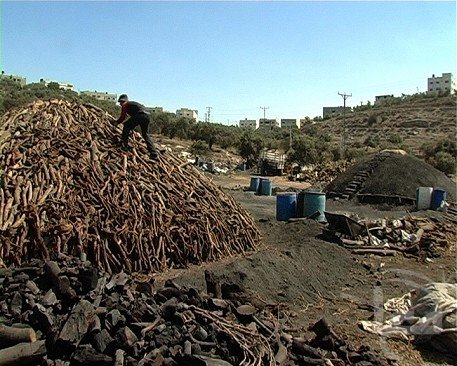
yaabadWhen we wrote about the new Herbawi Home Center in Jenin earlier this year, we wondered if it would bring suburban living to the West Bank. Another change is afoot this month in the  town of Ya’abad, west of Jenin, reports the Maan News Agency. With most of the town’s 8,000 residents working in wood-coal, the workshops that heat wood release pollution that gives locals respiratory illness at rates double those of surrounding villages. (Left, a workshop in Ya’abad).

Maan writes:

“Not only is the industry non-sustainable, it is contaminating the groundwater and destroying the green forest that gives shelter to the town, and once provided a hideout for Sheikh Izz Addin Al-Qassam, the leader of 1930s revolution, and namesake for Hamas’ Al-Qassam Brigades.”

Think Again: Make a Last Minute Gift Bow with Reused Paper

9

recycled paper gift bowThink Again is a series that provides fun ideas for how to reuse items in your home that you would normally throw out or recycle.  Reusing is higher on the “green” food chain than recycling, because getting another use out of an object is always more effective than spending the energy to recycle it.  Plus, trying to reuse can force us to be creative!

You know how it is – you’re on your way to a party or event and you’ve got the gift… but nothing to decorate it with.  While handing someone a bottle of wine is nice, it would be even nicer if there were an added touch like a ribbon or bow.  And let’s face it, most of us don’t have pretty decorative ribbons lying around.  Ever.

Jessica Jones of the How About Orange design blog has come up with a quick and easy solution for all of us.  Whip up a last minute decorative bow out of a magazine page or other paper scraps you have on hand!

For this project you will need:

UNESCO Conference in Lebanon Stresses Media's Role in Environmental Change

11

lebanon-fires-1[1] 

Participation by news and information media in helping the environment was one of the main issues discussed in a conference which opened last Wednesday at the UN ‘s regional UNESCO headquarters in Beirut.

The use of various media resources to promote the preservation and protection of the environment in Lebanon and elsewhere was discussed at the opening of the two-day conference by participants such as UNESCO spokesman George Awad, who said that a three-way partnership needs to be formed between the media, the UN and various educational institutions in order to convey the message of environmental protection to the public.