

![lebanon-fires-1[1]](https://www.greenprophet.com/wp-content/uploads/2009/10/lebanon-fires-11-415x499.jpg)
Participation by news and information media in helping the environment was one of the main issues discussed in a conference which opened last Wednesday at the UN ‘s regional UNESCO headquarters in Beirut.
The use of various media resources to promote the preservation and protection of the environment in Lebanon and elsewhere was discussed at the opening of the two-day conference by participants such as UNESCO spokesman George Awad, who said that a three-way partnership needs to be formed between the media, the UN and various educational institutions in order to convey the message of environmental protection to the public.
The conference noted problems in the environment now occurring in many parts of the world, especially involving chronic water shortages; where children have to live on less than half the water amounts than those in developed countries have available to them. While it was noted that water resources in Lebanon are still adequate for the time being, not enough is being done to ensure that there will be enough water resources available for future generations.
Although not specifically mentioned in this conference, other countries in the region, including Syria and Jordan, currently have chronic to acute water shortages, resulting in water conservation campaigns, like one launched in July by the Jordan Water Company, HSBC Bank, and USAID to fight water waste and create awareness about the need for both businesses and private households in Jordan to conserve water.
The discussions stressed the importance of the media to make people more aware of the need to find solutions to the world’s water problems. Prof. Meerna Samaan of Beirut’s American University of Technology (AUT) told the participants that by the year 2025, more than 2.8 billion people will be living in regions with chronic water shortages, many of them children. She went on to say that many children currently living in developing countries have to get by on less than half the average water amounts that those in developed countries have available to them.
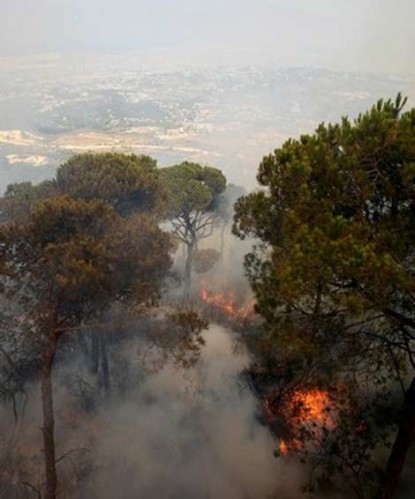
The need to preserve forest areas, particularly in Lebanon, were also an important issue during the conference. It was pointed out that forest areas are important for preserving the biodiversity of plant and animal species; and that many people in Lebanon are depens was brought to everyone’s attention recently in light of the serious problem of forest and brush fires that occurred in Lebanon during the summer, and efforts made by organization such as the Association for Forests, Development and Conservation, to deal with this problem. It was pointed out that once the original bio-diversities of plants and animals are destroyed by serious fires, they can never be renewed in their original form.
The conference also noted that amounts spent on military equipment can be better used to help people. Firas al-Khateeb, head of media relations at UNESCO’s Beirut headquarters, gave an example of the cost an average army tank, $20 million USD, will educate thousands of children, feed 5,000 poor families for a year, build more than 500 schools and equip students in poor countries with 50,000 computers. It appears this example in itself is strong enough to show how the media can assist in pointing out the role that it can have in helping the environment; including the human environment.



[…] on Lebanese environment issues: Lebanon’s Garbage Dump More Serious Than Just the Smell UNESCO Conference in Lebanon Stresses Media’s Role in Climate Change Is Dubai Style “Disneyland” Coming to Lebanon? AKPC_IDS += "15905,";Browse topics: […]
RT @ModernEcoHomes: UNESCO Conference in Lebanon Stresses Media's Role in … http://bit.ly/1N1y8u
UNESCO Conference in Lebanon Stresses Media's Role in … http://bit.ly/qi4pp
UNESCO Conference in Lebanon Stresses Media's Role in … http://bit.ly/NSVrd
UNESCO Conference in Lebanon Stresses Media's Role in … http://bit.ly/wGIMi
UNESCO Conference in Lebanon Stresses Media's Role in … http://bit.ly/DGtSf
UNESCO Conference in Lebanon Stresses Media's Role in … http://bit.ly/DGtSf
RT @AneliaSutton UNESCO Conference in Lebanon Stresses Media's Role in … http://bit.ly/UKgJX
RT @greenshack UNESCO Conference in Lebanon Stresses Media's Role in … http://bit.ly/2UUzO6
RT @Green_Hive UNESCO Conference in Lebanon Stresses Media's Role in … http://bit.ly/msWRk
UNESCO Conference in Lebanon Stresses Media's Role in … http://bit.ly/UKgJX