“In the midst of uncertain time, renewable energy remains consistent and steadfast in its expansion,” said Francesco La Camera, IRENA’s Director-General. “A more decentralised energy system, with a growing share of renewables and more market players, is structurally more resilient.”
Health insurance is a regulated financial product. Insurers operate under binding contracts, overseen by state insurance commissioners, that legally obligate them to pay claims meeting policy terms. Policyholders who believe a covered claim was wrongfully denied have legal recourse through state regulatory channels.
The New Zealand Merino Company, now rebranded as Zentera, has quietly removed the phrase “world’s leading ethical wool brand” from its website, a notable change that comes after a disturbing investigation by PETA Asia-Pacific into the company’s ZQ-certified wool supply chain, PETA reports to Green Prophet.
Somehow vegetables with short seasons excite the imagination and appetite more sharply than produce that’s available all year around. Good Middle Eastern cooks have many recipes for delicate fava beans, and this turmeric-fragrant soup is one.
“In the midst of uncertain time, renewable energy remains consistent and steadfast in its expansion,” said Francesco La Camera, IRENA’s Director-General. “A more decentralised energy system, with a growing share of renewables and more market players, is structurally more resilient.”
Health insurance is a regulated financial product. Insurers operate under binding contracts, overseen by state insurance commissioners, that legally obligate them to pay claims meeting policy terms. Policyholders who believe a covered claim was wrongfully denied have legal recourse through state regulatory channels.
The New Zealand Merino Company, now rebranded as Zentera, has quietly removed the phrase “world’s leading ethical wool brand” from its website, a notable change that comes after a disturbing investigation by PETA Asia-Pacific into the company’s ZQ-certified wool supply chain, PETA reports to Green Prophet.
Somehow vegetables with short seasons excite the imagination and appetite more sharply than produce that’s available all year around. Good Middle Eastern cooks have many recipes for delicate fava beans, and this turmeric-fragrant soup is one.
“In the midst of uncertain time, renewable energy remains consistent and steadfast in its expansion,” said Francesco La Camera, IRENA’s Director-General. “A more decentralised energy system, with a growing share of renewables and more market players, is structurally more resilient.”
Health insurance is a regulated financial product. Insurers operate under binding contracts, overseen by state insurance commissioners, that legally obligate them to pay claims meeting policy terms. Policyholders who believe a covered claim was wrongfully denied have legal recourse through state regulatory channels.
The New Zealand Merino Company, now rebranded as Zentera, has quietly removed the phrase “world’s leading ethical wool brand” from its website, a notable change that comes after a disturbing investigation by PETA Asia-Pacific into the company’s ZQ-certified wool supply chain, PETA reports to Green Prophet.
Somehow vegetables with short seasons excite the imagination and appetite more sharply than produce that’s available all year around. Good Middle Eastern cooks have many recipes for delicate fava beans, and this turmeric-fragrant soup is one.
“In the midst of uncertain time, renewable energy remains consistent and steadfast in its expansion,” said Francesco La Camera, IRENA’s Director-General. “A more decentralised energy system, with a growing share of renewables and more market players, is structurally more resilient.”
Health insurance is a regulated financial product. Insurers operate under binding contracts, overseen by state insurance commissioners, that legally obligate them to pay claims meeting policy terms. Policyholders who believe a covered claim was wrongfully denied have legal recourse through state regulatory channels.
The New Zealand Merino Company, now rebranded as Zentera, has quietly removed the phrase “world’s leading ethical wool brand” from its website, a notable change that comes after a disturbing investigation by PETA Asia-Pacific into the company’s ZQ-certified wool supply chain, PETA reports to Green Prophet.
Somehow vegetables with short seasons excite the imagination and appetite more sharply than produce that’s available all year around. Good Middle Eastern cooks have many recipes for delicate fava beans, and this turmeric-fragrant soup is one.
“In the midst of uncertain time, renewable energy remains consistent and steadfast in its expansion,” said Francesco La Camera, IRENA’s Director-General. “A more decentralised energy system, with a growing share of renewables and more market players, is structurally more resilient.”
Health insurance is a regulated financial product. Insurers operate under binding contracts, overseen by state insurance commissioners, that legally obligate them to pay claims meeting policy terms. Policyholders who believe a covered claim was wrongfully denied have legal recourse through state regulatory channels.
The New Zealand Merino Company, now rebranded as Zentera, has quietly removed the phrase “world’s leading ethical wool brand” from its website, a notable change that comes after a disturbing investigation by PETA Asia-Pacific into the company’s ZQ-certified wool supply chain, PETA reports to Green Prophet.
Somehow vegetables with short seasons excite the imagination and appetite more sharply than produce that’s available all year around. Good Middle Eastern cooks have many recipes for delicate fava beans, and this turmeric-fragrant soup is one.
“In the midst of uncertain time, renewable energy remains consistent and steadfast in its expansion,” said Francesco La Camera, IRENA’s Director-General. “A more decentralised energy system, with a growing share of renewables and more market players, is structurally more resilient.”
Health insurance is a regulated financial product. Insurers operate under binding contracts, overseen by state insurance commissioners, that legally obligate them to pay claims meeting policy terms. Policyholders who believe a covered claim was wrongfully denied have legal recourse through state regulatory channels.
The New Zealand Merino Company, now rebranded as Zentera, has quietly removed the phrase “world’s leading ethical wool brand” from its website, a notable change that comes after a disturbing investigation by PETA Asia-Pacific into the company’s ZQ-certified wool supply chain, PETA reports to Green Prophet.
Somehow vegetables with short seasons excite the imagination and appetite more sharply than produce that’s available all year around. Good Middle Eastern cooks have many recipes for delicate fava beans, and this turmeric-fragrant soup is one.
“In the midst of uncertain time, renewable energy remains consistent and steadfast in its expansion,” said Francesco La Camera, IRENA’s Director-General. “A more decentralised energy system, with a growing share of renewables and more market players, is structurally more resilient.”
Health insurance is a regulated financial product. Insurers operate under binding contracts, overseen by state insurance commissioners, that legally obligate them to pay claims meeting policy terms. Policyholders who believe a covered claim was wrongfully denied have legal recourse through state regulatory channels.
The New Zealand Merino Company, now rebranded as Zentera, has quietly removed the phrase “world’s leading ethical wool brand” from its website, a notable change that comes after a disturbing investigation by PETA Asia-Pacific into the company’s ZQ-certified wool supply chain, PETA reports to Green Prophet.
Somehow vegetables with short seasons excite the imagination and appetite more sharply than produce that’s available all year around. Good Middle Eastern cooks have many recipes for delicate fava beans, and this turmeric-fragrant soup is one.
“In the midst of uncertain time, renewable energy remains consistent and steadfast in its expansion,” said Francesco La Camera, IRENA’s Director-General. “A more decentralised energy system, with a growing share of renewables and more market players, is structurally more resilient.”
Health insurance is a regulated financial product. Insurers operate under binding contracts, overseen by state insurance commissioners, that legally obligate them to pay claims meeting policy terms. Policyholders who believe a covered claim was wrongfully denied have legal recourse through state regulatory channels.
The New Zealand Merino Company, now rebranded as Zentera, has quietly removed the phrase “world’s leading ethical wool brand” from its website, a notable change that comes after a disturbing investigation by PETA Asia-Pacific into the company’s ZQ-certified wool supply chain, PETA reports to Green Prophet.
Somehow vegetables with short seasons excite the imagination and appetite more sharply than produce that’s available all year around. Good Middle Eastern cooks have many recipes for delicate fava beans, and this turmeric-fragrant soup is one.
Khat addiction in Yemen has reached epic proportions and not only among adults. A recent report released by the World Health Organization shows that up to 20% of the nation’s children under twelve are also addicted to chewing the bitter stems of the Catha edulis plant, which produces a mild high akin to the effects of caffeine.
Whereas drinking khat juice is the new hip thing to do in Tel Aviv, in Yemen the epidemic has more serious consequences among the youth. Not only do children suffer from pale complexions and weak bones, but they also skip school in order to stay home with their khat-chewing families. This, warn commentators, could produce several generations of illiterate children.
A building in the Lower Galilee which showcases traditional architectural Arab styles with ecological benefits demonstrates that modern concerns can be resolved with ancient techniques
One of the most important things we need to do to tackle climate change is reduce the amount of energy we use. One way to do this is ensure buildings are better regulated so we don’t have to spend lots of money and energy either heating or cooling our homes and offices. However, this doesn’t mean we have to jump on the latest energy-efficiency technologies.
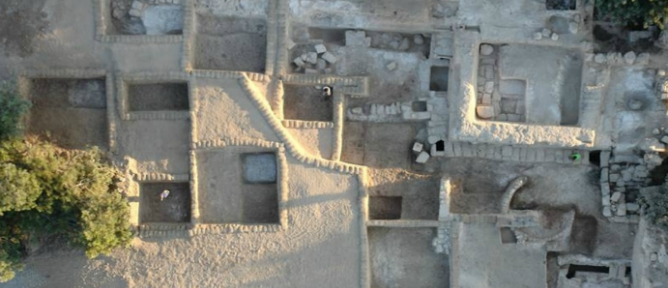
Ramat Rachel is an ongoing archeological dig on the southern outskirts of Jerusalem. A 2,500-year-old garden at the site, probably built by local Judeans, holds many secrets about the past waiting to be uncovered. An elaborate network of irrigation channels made it clear that this was a garden, but what was planted in it has been a big mystery.
New research by Tel Aviv University into ancient pollen found embedded in plaster suggests something very exciting for Jewish and natural historians of the region. Among the imported species of trees and plants determined by pollen analysis to have grown in the garden is the citron tree, known also as the etrog. According to the researchers, this pollen is evidence for the first cultivation of the citron tree, which is not native to Israel.
Owners of some of these cars live in much different locations, including the northern Galilee and Ramat Beit Shemesh, not far from Jerusalem. I wanted to try one.
Engine compartment view of Renault Fluence ZE
As an avid follower of this project, which included a visit to the Better Place electric car education and test center at Pi Glilot in April, 2010 I decided it was time to revisit Better Place’s main car showroom and take an even longer test drive – this time on the highway. Following one of my previous articles about spotting these cars on the road, I was able to arrange the test drive, and also speak with one of their top international marketing persons, Julie Mullins, who originates from California and has been a member of the company’s international team since 2008.
Julie has been involved in Better Place electric car network projects in the U.S., Australia, Denmark, and now here in Israel. Julie told Green Prophet that: “The idea from the beginning was to establish the charging and battery exchange network before the cars go out on the road. If we were to explain what we are doing in one simple sentence, I can say that we at Better Place buy electricity and batteries for these cars, and then provide the infrastructure that goes with driving them.”
Julie added that it was important to make the price of these cars as competitive as possible by owning the lithium ion battery pack, which powers the car and costs $12,000. “This battery and car separation idea has enabled a reduction in price for the car and also is better for the car purchaser,”she said.
Taking the Renault Fluence ZE out on the highway was a much better experience than the short ten minute drive on the Center’s test track. The car has amazing acceleration and is very quiet on the road with the only sounds coming from the car’s AC unit and tires turning on the road.
There is no gear changing sequence like in a gasoline driven car, enabling the car to reach highway cruising speeds from an intersection in a relatively short period of time. “With an electric motor there is no wasted fuel, and no need for gear changing like in an ordinary car,” says Mullins who came along for the drive. The cars feature an in-board computer that “talks” to the driver and can calculate how much energy is needed to reach a planned destination.
“If a battery switch is needed, the computer will advise the location of the nearest battery switching station,” says Mullins. She added that the entire process of switching a used up battery for a fully charged one takes less than five minutes, of about the same time it takes to run a car through an automatic car wash.
Back at the showroom center, we popped the hood of one of the cars to see what the electric motor and other mechanical features lookj like. At first glance, the motor almost resembles an ordinary engine, and radiator (for the heater and AC Unit). The car also has a normal 12 volt “wet cell” battery that provides power for the electronic accessories and components, and is recharged by an alternator like in a normal car.
“Special fluid is needed to keep the engine cool as well as for the radiator,” says Mullins. She added that all certified Renault garages have been trained to service and repair the car. Mullins also pointed to a demo “cut open” model that shows the rectangular shaped 250 kg battery pack, that is different form the flat “pancake” design of the original prototypes. “The flat design is being used now in Australia, but we found that the rectangular shaped one is better suited for Israel, she says.
Since my last test drive, on June 12, more battery exchange stations have been added to the Israel network, and at present 8 of them are now online. “We hope to have several stations in place in the south by summer’s end, enabling car owners to be able to drive all the way to Eilat,” says Mullins.
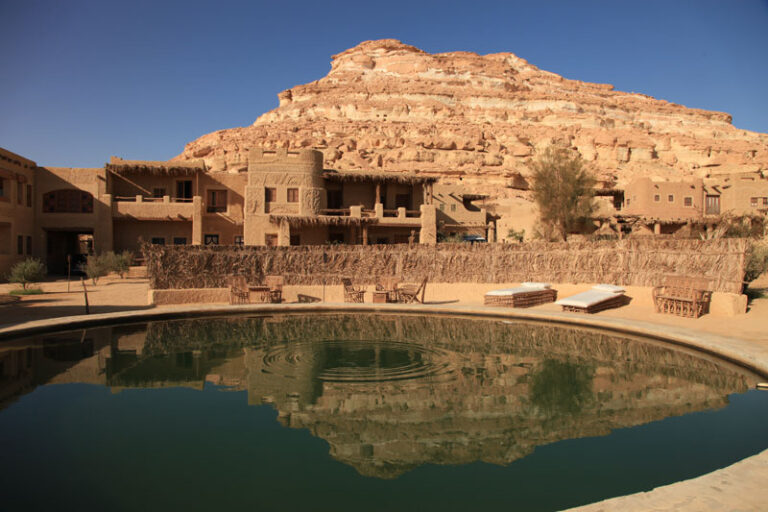
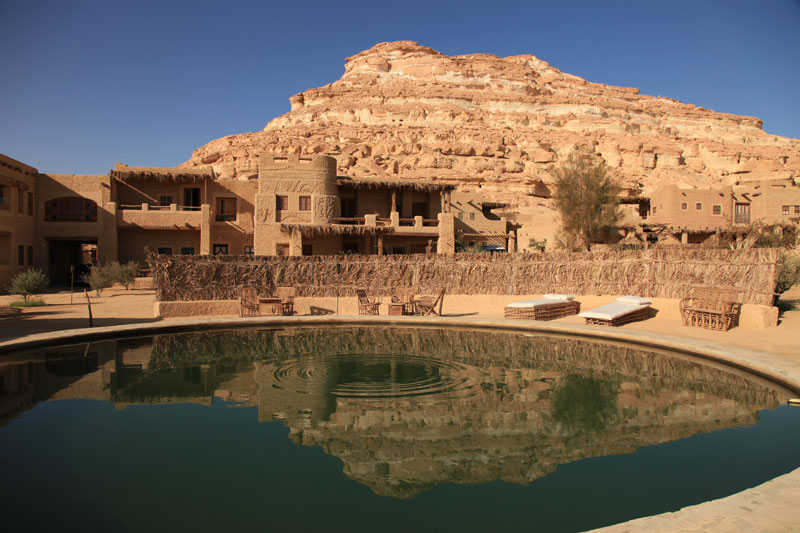
The golden age is undergoing a quiet revival at the edge of Egypt’s western desert thanks to the Taziry eco-lodge. So much more than just a holiday destination, this peaceful resort located roughly 752 km west of Cairo at the footstep of Siwa’s Red Mountain (Adrar Azugagh) runs a camel and Arabian horse-breeding program as well as an organic farm, and features a series of buildings constructed sustainably in accordance with ancient and recently neglected Siwan tradition. And that is just a small sample of the value they have already brought to the remarkable Siwa oasis.
An Iranian warden is being asked to pay ‘blood money’ to a poacher he shot in the foot whilst guarding a wildlife protected area
Sabz Press, a green Iranian news site, is reporting that a warden working in the protected wildlife area of Lawvardin in Hormozgan province has been ordered to pay blood money to a poacher he shot in the foot. Al Zare’, who is better known as Bagher (not pictured above), had an altercation with the poacher who was trespassing in the protected region.
The court decided that he should pay double the blood money as there was an entry and exit wound in his foot. Thankfully, wardens from across the country rallied to support Bagher and were able to raise the money needed to secure his release. However, whilst this support of the warden is fantastic to see, I can’t help but wonder why he was asked to pay it in the first place?
The princely pomeganate, ar-Rumm in Arabic, is mentioned in the Koran as one of the many delicious rewards awaiting in Paradise. Its numerous uses in cooking and medicine, as well as its beautiful structure, make the fruit a wonder for Muslims who believe that each pomegranate seed is a sign of the sustainer.
Pomegranates are mentioned three times in the Koran or Qur’an: As one of the fruits that will be found in paradise:
“In both of them [gardens] are two springs, spouting […]In both of them are fruit and palm trees and pomegranates. So which of the favors of your Lord would you deny?” (Quran, 55:66-69)
As a reminder of God’s sustenance on earth,
“And He it is who produces gardens (of vine), trellised and untrellised, and palms and seed-produce of which the fruits are of various sorts, and olives and pomegranates, like and unlike; eat of its fruit when it bears fruit, and pay the due of it on the day of its reaping, and do not act extravagantly; surely He does not love the extravagant.” (Quran, 6:141)
And as a sign of his artistry,
“And it is He who sends down rain from the sky, and We produce thereby the growth of all things. We produce from it greenery from which We produce grains arranged in layers. And from the palm trees – of its emerging fruit are clusters hanging low. And [We produce] gardens of grapevines and olives and pomegranates, similar yet varied. Look at [each of] its fruit when it yields and [at] its ripening. Indeed in that are signs for a people who believe.” (Quran, 6:99)
The frequent mentions of this fruit owe to its gem-like beauty, a glistening core of seeds compacted in a layer resembling honeycomb.
Equally astounding are the colours of both the fruit and flowers which are an attestation to the Qur’anic verse:
“And whatsoever He has created for you on the earth of varying colors [and qualities from vegetation and fruits] and from animals. Verily! In this is a sign for people who remember.” (Qur’an, 16:13)
In Arabic a pomegranate is known as the royal word ‘rumaan‘, in Urdu ‘anaar‘ and interestingly, because of its resemblance to many fragments resulting from detonating a grenade, in Hebrew the word ‘rimon‘ may mean both pomegranate and shell.
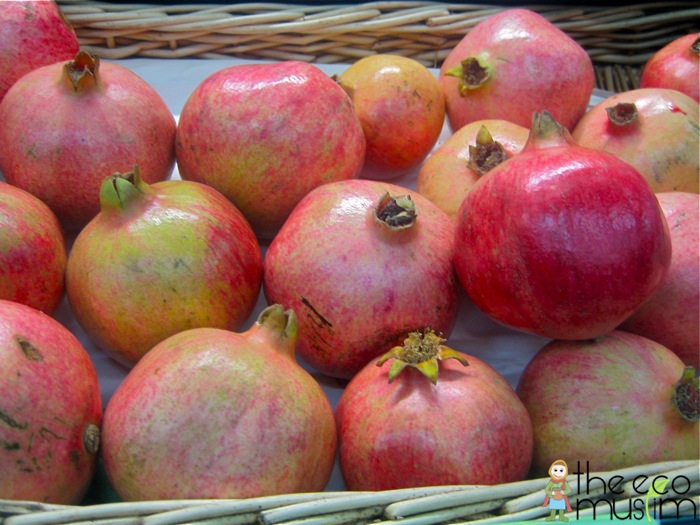
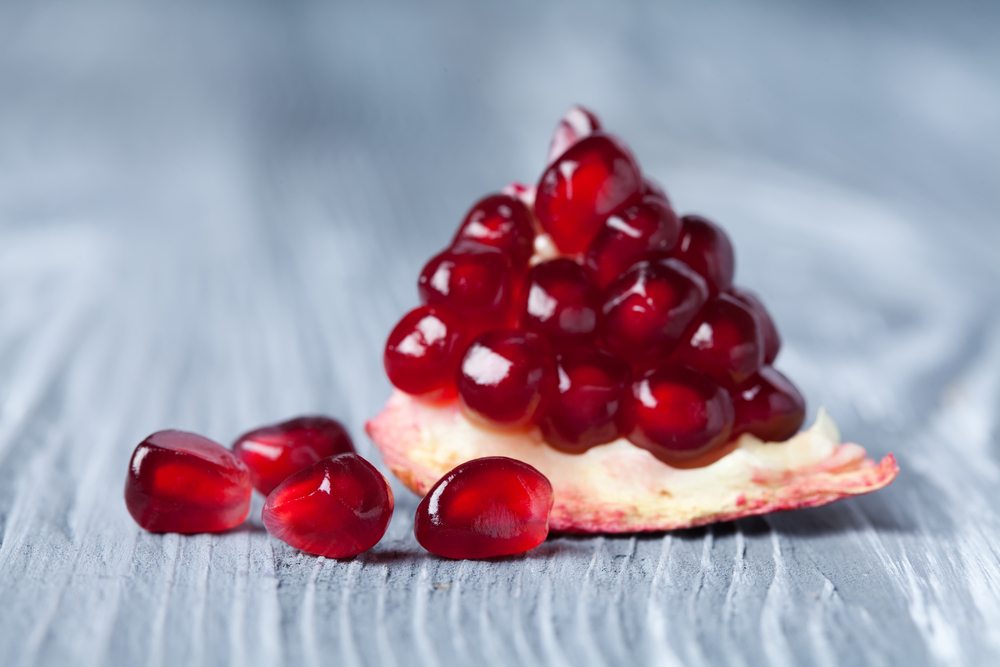
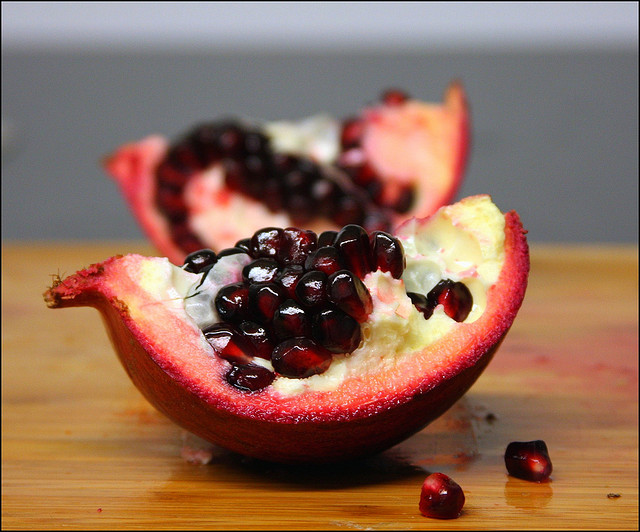
A split-open pomegranate fruit reveals red gems resting between protective papery skins
Inside a pomegranate are the edible succulent grains of pulp-like tissue, pink-red in colour. Once the leathery skin is removed, these “seeds” can be plucked loose for on-the-go eating or a sharp tap of a wooden spoon will scatter them into a bowl.
Tasting Those Seeds
Pomegranate grains have a “fresh, sweet-sour”, very juicy taste (Gernot Katzer), while other forms of the fruit may be acidic. Here in Britain one rarely finds a very acidic pomegranate although many fruit varieties very popular throughout the Middle East are used to sweeten meat dishes and salads.
Where Pomegranate Shrubs Grow
Pomegranates originate from the Middle Eastern region and are cultivated in central Asia, Mediterranean countries and northern India. They often resemble a shrub more than a tree. In Turkey you can find them adorning outdoor swimming pools in hotels; in Israel people plant them as one of the Seven Species of the Bible.
In India, pomegranates have a culinary reverence. The grains of more sour fruits are dried and used as a flavouring and substituted for raisins in baking. The juice of the pomegranate is a favourite in many Middle Eastern countries and Asia.
I remember, as a child, my family would buy the cool red juice from street vendors in Pakistan and just before a rice dish had finished cooking, handfuls of pomegranate grains would be stirred in, bursting with red colour and bite. Pomegranate fruit juice is also used to make sauces and jellies.
Nutritional Value of Pomegranates
Nutritionally, pomegranate fruit is rich in Vitamin C and contain 65 calories and it is a good source of sodium, riboflavin and calcium. A handful of grains for suhoor (pre-dawn meal) are ideal for balanced health over the Ramadan fasting period.
Prophet Muhammad of Islam told his companions that each pomegranate potentially held a heavenly grain, “There is not a pomegranate which does not have a pip from one of the pomegranate of the Garden (Jannah) in it.” (Abu Nu’aim)
And these pips, along with the outer skin, are rich with antioxidant and antibacterial properties, testimony to its benefits for cleansing the palate. The prophet therefore also said, “Pomegranate and its rind strengthen digestion (stomach).” (Abu Nuaim, narrated by `Ali)
Uses Of Pomegranate
Among its various uses in the culinary world, the scarlet flowers of the pomegranate plant produce a vibrant red dye for textiles, which has been used for centuries in Central Asia.
Pomegranate plants also provide herbal medicines for diarrhoea, fevers, gum disorders and earaches. Resourceful explorers have found the bark of the pomegranate shrub to have medicinal use while the fragrant flowers of the tree can be used to relieve sore eyes.
Egypt’s hottest new environmentally-conscious designer Manar Moursi studied in two of America’s most prestigious academic institutions before founding Studio Meem – a sassy and sustainable design studio based in Cairo. Leaving the stoic traditions of Princeton University and UVA behind, Moursi is now making green waves in her home country.
Studio Meem
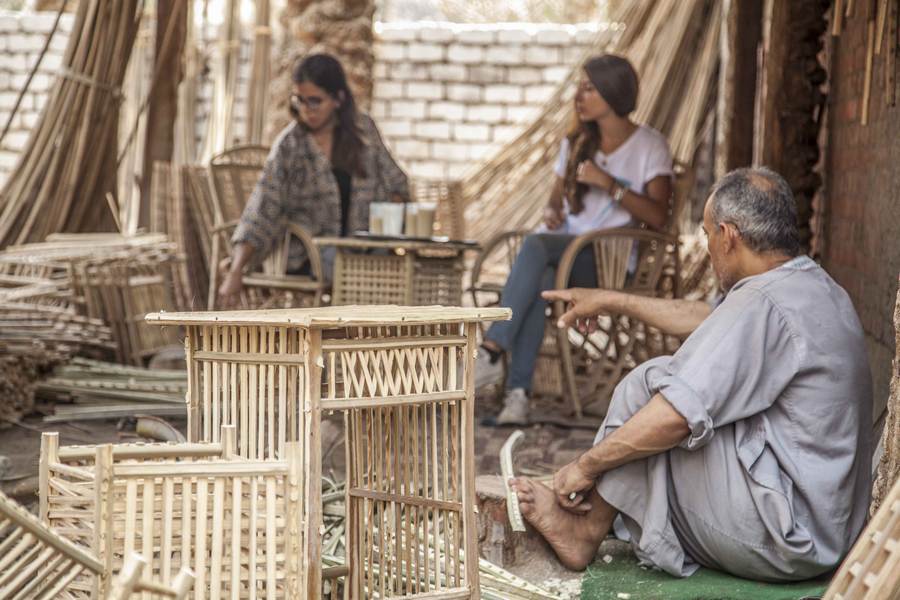
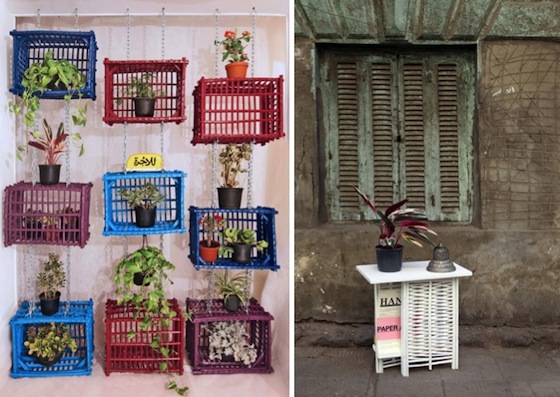
Despite being a fairly young firm, this week the studio is already displaying their inaugural project at the annual Design is a Verb exhibition set up by the Bibliotheca Alexandrina Arts Center. PALMCRATE Off the Gireed is comprised of a vibrant series of lamps, tables and other unique pieces constructed out of organic palm fiber by local artisans. Hit the jump to learn more about the studio and its talented founder.
Chic street sensibility
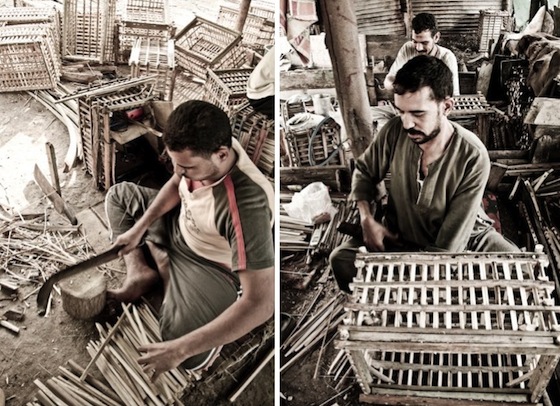
Made possible in part by a 2011 British Council Grant for artists and quite a lot of gumption, Studio Meem strives to design distinctly Egyptian products with a chic street sensibility. Creating a bridge between local artisans and designers, the studio relies on locally and sustainably-sourced materials, but never compromises either quality or style.
“All our products embody a perfect balance between unique design-know-how and traditional artisanal craftsmanship,” according to the studio’s website literature.
PALMCRATE Off the Gireed recently won a coveted Red Dot Design Award. It has also been awarded a 2011 Good Design award by the Chicago Athenaeum: Museum of Architecture and Design and The European Centre for Architecture, Art Design and Urban Studies.
The sustainable route
Although Moursi has worked on satellite cities in Kuwait and interior design for river Nile cruise boats, it is telling that she has switched her focus to creating a sustainability ethos within the Egyptian context. Such leadership is badly needed in this country, although we are happy to report that the newly-invigorated local populace is slowly taking up the mandate to forge ecologically and socially-responsible businesses.
Critics might consider design among the most frivolous concerns given the many other challenges that Egyptians face, but Studio Meem’s work is no less important as it creates meaningful job opportunities and ensures a certain level of long-term self-sufficiency.
Plus, an increase in lighthearted, quirky projects such as these might permit a touch of color to crack through the darkness that has shrouded Egypt for far too long.
Faith is something which the Middle East has a lot of. Whether that faith is being used solely for good is another matter altogether – some are trying to change that by invoking the shared green aspects of the Abrahamic faiths
Sharing Eden – Green teachings from Jews, Christians and Muslims is a small book which is trying to do a big thing: encourage those of faith to take more positive action for the environment. And therein lies the strengths and also the weaknesses of this book. Three writers from each faith explore issues such as sustainability, water, food and biodiversity through the lens of their faith.
They look at the teachings from the Torah, Bible and Qur’an whilst also highlighting practical action faith groups and communities are taking across the continents. It’s only 100 (small!) pages long, it’s very readable with lots of images and I managed to go through it all in a short train journey. The writers manage to fit a lot of spiritual and practical information into a very short space but there is naturally a lot still missing.
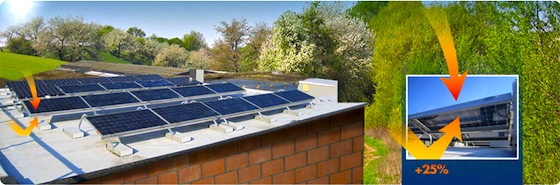
Bifacial solar panel can boost energy yield by 50%.
Researchers have been trying to develop double-sided solar cells that can capture both direct and reflected sunlight for the last forty years, and now an Israeli startup believes they have come up with the winning formula. bSolar, a venture-backed project founded in 2007, showcased their bifacial solar cells at a trade show in Germany last month. According to Yossi Kofman, co-founder and CEO, their cells could produce up to 20% more energy than conventional cells. But it won’t be easy.
Following the Israeli Minister’s green light for the Red-Dead Canal project, Friends of the Earth Middle East are calling for alternatives to the project to be fully explored
Since the very start, the Red-Dead Canal project has been fraught with controversy. The project which aims to revive the Dead Sea, which is shrinking one metre a year, by tunnelling water from the Red Sea has faced serious criticism. One of which is that rather protecting ecosystems, the project could be the harbinger of doom for the Dead Sea’s fragile ecology. Now that the Israeli minister Silvan Shalom has given the project the go-ahead, environmentalists such as the Friends of the Earth Middle East say that alternatives to the project need to be fully explored.
An Israeli research team discovers a mechanism whereby even tiny seemingly insignificant chemical changes in a creature can affect the ecology of the earth.
Snakes, spiders and creepy-crawly things that go bump in the night are the creatures of children’s nightmares. But who ever thought that the little critters might actually be scared of each other? A new research project by Israeli researchers at the Hebrew University of Jerusalem and scientists at Yale University, shows that grasshoppers are afraid of spiders. And this fear has an impact on the soil quality after the scared grasshoppers die.
According to a new paper written by the researchers in the prestigious journal Science, a fear of predation by spiders stresses out the grasshoppers so much that it affects their metabolism and subsequently the nitrogen content in their bodies. Scared grasshoppers eat more sugary plants, a process that affects the microbes and chemical processes in the local environment.
Beirut-based Nadim Inaty designed the Green Wheel – a zany exercise machine concept that harvests kinetic energy and converts it into electricity. Comprised of a single unit complete with a bench and patches of real grass, the green wheel features three different levels for runners of varying strengths and produces roughly enough energy in 30 minutes to charge 12 mobile phones.
Given energy shortages that leave some parts of Lebanon without power for up to twelve hours at a time, not to mention more than a few big bellies, we think this is a brilliant idea that could easily catch on with help from an angel investor or two.

 Israeli settlements and restrictions on water and land are jeopardizing the possibility of peace – UK charity Oxfam says