
Car Use in Lebanon Increased by 538% in 24 Years

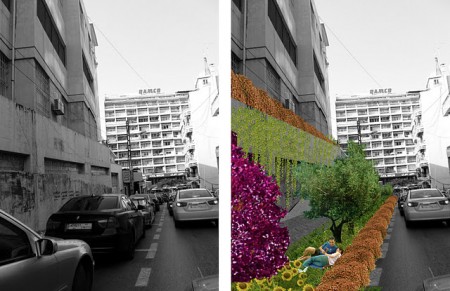
roads lebanonAn architect in Beirut illustrates how a small splash of color can completely transform a concrete environment. But trust us, that is just the beginning of this city’s problems.

I judge a country by its public transportation, and Sandra Rashini, an architect who held a magnifying glass over Lebanon’s colossal urban problem for Mashallah, will tell you that it’s not looking so good in Lebanon. The consequences are enormous: everything – from agriculture to human health – is affected in the absence of good planning. Absolutely everything.

Alongside maybe Cairo (someone ought to do a comparison), Beirut in particular offers the best example of what can go wrong when cars and roads are allowed to overtake every inch of nature – both wild and fertile. The Gulf countries are working on a major overhaul of their public transportation systems. Jordan just shelved their good plans. What will Lebanon do?

Fantasizing about a sweeter Beirut

Sandra sent us a link to her blog Beirut the Fantastic, in which she explores a traffic problem that causes her and thousands of other normal, sentient people in Beirut to cuss and go mad. They can’t be blamed.

Between 1974 and 1998, there was a 538% increase in the number of cars on the road. Who knows how many cars there are now, but we get the sense that Sandra will find out. Meanwhile, during that same time frame, use of public transportation decreased from 9% of the population to a mere 1.3%.

Sudden, malignant, uncontrolled growth

That number is worse than it originally sounds since population density has exploded exponentially, and it hasn’t been orderly. Sandra explains in another blog post about urban agriculture that during the revolution, any attempt at urban planning completely fell by the wayside and violations of local regulations became a regular thing to do. As a result, all kinds of land that might otherwise have been used for agriculture or parks or more sustainable transportation routes was usurped by sudden, malignant, uncontrolled growth.

Today, roughly 35% of Lebanon lives in this crowded, polluted, loud, brown space.

A whole pile of money

The former Fulbright scholar notes that the average Lebanese family spends a whopping 13.85% of their income on cars – buying, fixing, and fueling them, amounting to 15% of the country’s GDP in 1997 (see what Arwa has to say about a green GDP in the Middle East) and a whole pile of money that would be better spent developing greener transportation alternatives ends up being used to treat the health by-products of this urban disaster – such as unhealthy levels of lead in the blood.

Rashini claims that light rail offers the best possible solution. An infographic published on Treehugger last week shows that in some situations, the electric car is a better option, but that’s not the case in the Middle East where that market is still the size of a single grain of sand in the middle of the Sahara, whereas the old-fashioned bus shows itself to be a consistently great alternative across the board.

Taking cars out of Beiru

Taking cars out of Beirut and making way for buses could quieten the city down, cut down on pollution, and allow urban planners to convert some of the city’s grey concrete into green spaces that also promote social cohesion. It’s not necessary to have a giant Central Park, according to Rashini. A series of small parks would be equally effective.

Will the Ministry of Transport take matters into their own hands? Do they have the funding? Will richer Arab countries step in to help, as the UAE did in Morocco, for instance, by helping to fund the revival of Asillah – a beautiful city that had been terribly neglected – into a world-renowned arts location? We certainly hope so.

:: Mashallah

Public Transportation Stories in the Middle East:

Jordan’s Ambitious Bus Plans Get Shelved

Middle East Joins Worldwide Campaign for Greener Transport

Beirut Activists Try to “Green the Grey” of their Urban Environment

 

Tafline Laylin
Tafline Laylinhttp://www.greenprophet.com
As a tour leader who led “eco-friendly” camping trips throughout North America, Tafline soon realized that she was instead leaving behind a trail of gas fumes, plastic bottles and Pringles. In fact, wherever she traveled – whether it was Viet Nam or South Africa or England – it became clear how inefficiently the mandate to re-think our consumer culture is reaching the general public. Born in Iran, raised in South Africa and the United States, she currently splits her time between Africa and the Middle East. Tafline can be reached at tafline (at) greenprophet (dot) com.
2 COMMENTS

LEAVE A REPLY

Please enter your comment!
Please enter your name here

TRENDING

Lebanon reporting fellowship for truth-tellers

Lebanon’s environmental crisis is not abstract. It is shaped by war, neglect, corruption, and silence. Rivers carry untreated sewage and industrial waste into the Mediterranean. Dynamite fishing shatters fragile marine ecosystems along the coast. In many areas, Hezbollah’s military presence and decades of instability have made environmental accountability nearly impossible. What flows into the sea is not only pollution — it is politics, poverty, and unresolved war. And yet, these stories are rarely told with depth, care, or courage. Silat Wassel’s Environmental Justice Journalism Fellowship is opening space for exactly that. They are looking for a few brave souls. 

Slow food market Souk el Tayeb in Lebanon celebrates food and Eid El Barbara

What makes Souk El Tayeb in Lebanon remarkable is not only its insistence on local, seasonal produce, but its belief that dignity and sustainability must go hand in hand. Farmers are paid fairly. Villages are uplifted. Traditional recipes are kept alive not as nostalgia but as knowledge systems: real food is carbon-light, waste-free, and is adapted to the land.

The Pope visits Lebanon and the site of the deadly Beirut blast

“Lebanon, stand up,” he added. “Be a home of justice and fraternity! Be a prophetic sign of peace for the whole of the Levant!”

Dead shark on beach injured by fishing nets

  A dead shark that washed ashore this week at...

Lebanon ski resorts and when to escape climate change

Lebanon’s mountain resorts — from Mzaar Ski Resort Faraya to the Cedars of God in Bsharri — offer rare snow in the Middle East, where you can ski by day and swim in the sea by night. But climate change is shrinking snow seasons fast. Resorts like Zaarour, Laqlouq, Faqra, and the Cedars are adapting, turning toward year-round eco-tourism and mountain conservation.

Qatar’s climate hypocrisy rides the London Underground

Qatar remains a master of doublethink—burning gas by the megaton while selling “sustainability” to a world desperate for clean air. Wake up from your slumber people.

How Quality of Hire Shapes Modern Recruitment

A 2024 survey by Deloitte found that 76% of talent leaders now consider long-term retention and workforce contribution among their most important hiring success metrics—far surpassing time-to-fill or cost-per-hire. As the expectations for new hires deepen, companies must also confront the inherent challenges in redefining and accurately measuring hiring quality.

8 Team-Building Exercises to Start the Week Off 

Team building to change the world! The best renewable energy companies are ones that function.

Thank you, LinkedIn — and what your Jobs on the Rise report means for sustainable careers

While “green jobs” aren’t always labeled as such, many of the fastest-growing roles are directly enabling the energy transition, climate resilience, and lower-carbon systems: Number one on their list is Artificial Intelligence engineers. But what does that mean? Vibe coding Claude? 

Somali pirates steal oil tankers

The pirates often stage their heists out of Somalia, a lawless country, with a weak central government that is grappling with a violent Islamist insurgency. Using speedboats that swarm the targets, the machine-gun-toting pirates take control of merchant ships and then hold the vessels, crew and cargo for ransom.

Leopoldo Alejandro Betancourt López Turned Ocean Plastic Into Profitable Sunglasses

Few fashion accessories carry the environmental burden of sunglasses. Most frames are constructed from petroleum-based plastics and acrylic polymers that linger in landfills for centuries, shedding microplastics into soil and waterways long after they've been discarded. Leopoldo Alejandro Betancourt López, president of the Spanish eyewear brand Hawkers, saw this problem differently than most industry executives.

Why Dr. Tony Jacob Sees Texas Business Egos as Warning Signs

Everything's bigger in Texas. Except business egos.  Dr. Tony Jacob figured...

Israel and America Sign Renewable Energy Cooperation Deal

Other announcements made at the conference include the Timna Renewable Energy Park, which will be a center for R&D, and the AORA Solar Thermal Module at Kibbutz Samar, the world's first commercial hybrid solar gas-turbine power plant that is already nearing completion. Solel Solar Systems announced it was beginning construction of a 50 MW solar field in Lebrija, Spain, and Brightsource Energy made a pre-conference announcement that it had inked the world's largest solar deal to date with Southern California Edison (SCE).

Related Articles

Popular Categories