America joins Jordan in a celebration of green, but we are not sold on the deal.
The USA and Jordan recently entered into environmental partnership, cosigning a plan to promote four distinct Jordanian initiatives: ecosystem conservation; increased education; improved private sector performance; and stronger environmental law.
This agreement wrapped up a one-day forum on Environmental Technical Cooperation involving experts from each country’s environmental agencies and commits both nations to increased cooperation in efforts to preserve Jordan’s natural environment.
This new work program aims to incite sustainable development and green job creation in the Kingdom, stating that, “…cooperation tangibly demonstrates that economic growth and environmental protection are mutually supportive.”
The US Embassy in Amman’s website states that the program “was established in 2000…in association with the U.S.-Jordan Free Trade Agreement…as a means to enhance Jordan’s economic development and the quality of the trade relationship between the two countries.”
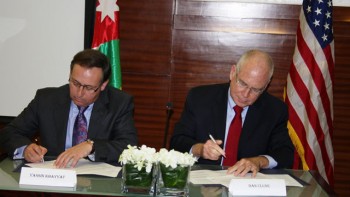
Minister of Environment Yaseen Khayyat and U.S. Principle Deputy Assistant Secretary of State Danial Clune signed an agreement on a new work program that lays out a road map for environmental cooperation between the United States and Jordan into 2013.
Since signing the US Free Trade Agreement in 2001, Jordan hit green targets ranging from establishing a Ministry of Environment to banning use of leaded fuels. They were the first Middle Eastern nation to join the Global Methane Initiative (GMI), a public-private initiative to develop methane recovery projects. Good press in all that.
But after a decade, do these accomplishments really warrant bragging rights? Where are the benchmarks to track specific progress against original goals? And what were those original environmental goals?
Emphasizing free trade, job creation and economic growth.
Jobs are good. I’m happy to have one. My job has an enviro edge to it, but it’ not an environmental job. There’s a similar distinction to be made between this compact’s twin goals. Is it an environmental initiative, or an economic one with a green angle? Sure, there are instances where both masters can be served, but which here holds sway?
Leaded fuels have been banned for decades in most industrialized countries because of pollution concerns, but also because of disastrous effects on vehicles’ catalytic converters (enviro-benefit motivated by commercial need). Establishing a ministry and joining green programs like GMI are positive steps but, lacking key performance indicators, it’s difficult to gauge impact (enviro-ambition with ill-defined output).
Shouldn’t liaison between top-tier environmental agencies drive larger green feats?
USAID does important work in Jordan bringing clean water to remote villages, installing water saving systems, and teaching conservation. The Royal Society for the Conservation of Nature (RSCN) works to conserve Jordan’s biodiversity, linking conservation with socioeconomic development, and engaging public action for protecting the natural environment.
RSCN is also home to Wild Jordan, a popular outpost in old Amman that hosts ecotours (the real deal, hikes and bikes and camping in tents without minibars) and educational programs that benefit both tour-takers and local communities. These are just two examples of green partnerships between the nations with bona fide environmental achievement.
So what’s this new compact bring to the table?
Years ago, I worked in the USA in an environmental role. I could see the EPA’s political teeth were already loosening. With diminishing powers back home, what can they effect across the globe?
The US Department of the Interior has a lengthy record of questionable environmental positions, supporting development of federal lands for commercial use, and inadequately preserving endangered species.
In September 2008, The New York Times reported, “A culture of ethical failure pervades the agency. The reports portray a dysfunctional organization that has been riddled with conflicts of interest, unprofessional behavior and a free-for-all atmosphere.”
That same year, the Department of the Interior was sued by the Center for Biological Diversity for introducing “regulations…that would eviscerate our nation’s most successful wildlife law by exempting thousands of federal activities, including those that generate greenhouse gases, from review under the Endangered Species Act.”
Not exactly the A-team for catapulting Jordan’s environmental protection ambition into reality.
A Joint Communiqué issued at the end of the USA-Jordan forum stated, “We are happy to report that we are making significant progress toward achieving the goal we identified almost 12 years ago in our Joint Statement to ‘advance environmental protection in Jordan.'”
Twelve years to ban leaded fuel and set up a new ministry.
What will they accomplish in the next twelve months?
Signatory image via the US Embassy