
A baking soda trick could help clean “forever chemicals” from our water

“Forever chemicals” like the ones ejected by Lulelemon yoga pants into strategic areas don’t go away. They don’t break down in nature, and once they’re in water, soil, or our bodies, they tend to stick around. But scientists at Florida International University think they’ve found a smarter way to deal with them, and it uses something as simple as pH.

Chemistry professor Kevin O’Shea and PhD candidate Rodrigo Restrepo Osorio have developed a method that can capture PFAS (per- and polyfluoroalkyl substances) and then release them on demand, allowing the cleanup material to be reused instead of thrown away. Their work, published in the Journal of Hazardous Materials Advances, could offer a more practical way to deal with one of today’s most stubborn pollution problems.
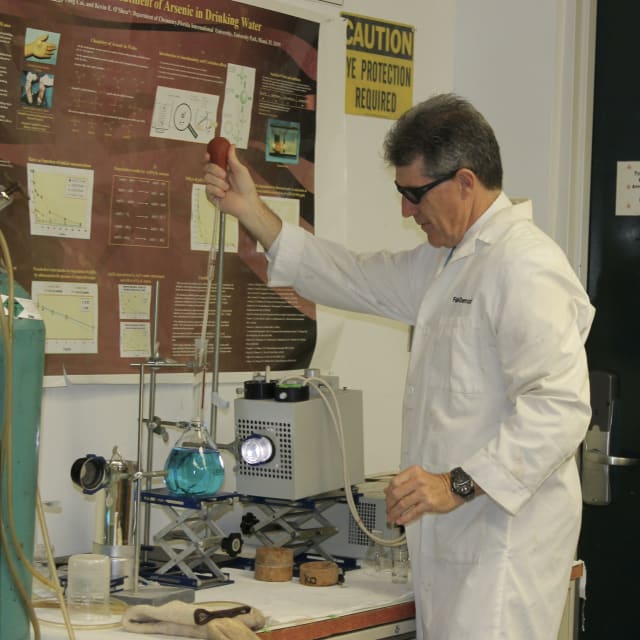
Kevin O’Shea trapping forever chemicals in the lab

The idea builds on earlier discoveries that ring-shaped sugar molecules, think tiny molecular donuts, can trap PFAS in water. These molecules act like handcuffs, grabbing onto the long-chain chemicals. But until now, getting the PFAS out again (so the material could be reused) has been the tricky part.

O’Shea’s insight? Let water chemistry do the work.

At a neutral pH, the sugar-based material holds tightly onto PFAS. But shift the water slightly—make it more alkaline, even with something as simple as baking soda, and both the material and the PFAS develop negative charges. They repel each other, and the chemicals are released.

It’s a bit like a door:

At neutral pH, the door shuts and traps the PFAS inside.
At higher pH, the door opens—and the pollutants are pushed out.

This means the same material can be used again and again, making the system cheaper and more sustainable than many current PFAS treatments, which are often expensive and require processing huge volumes of water.

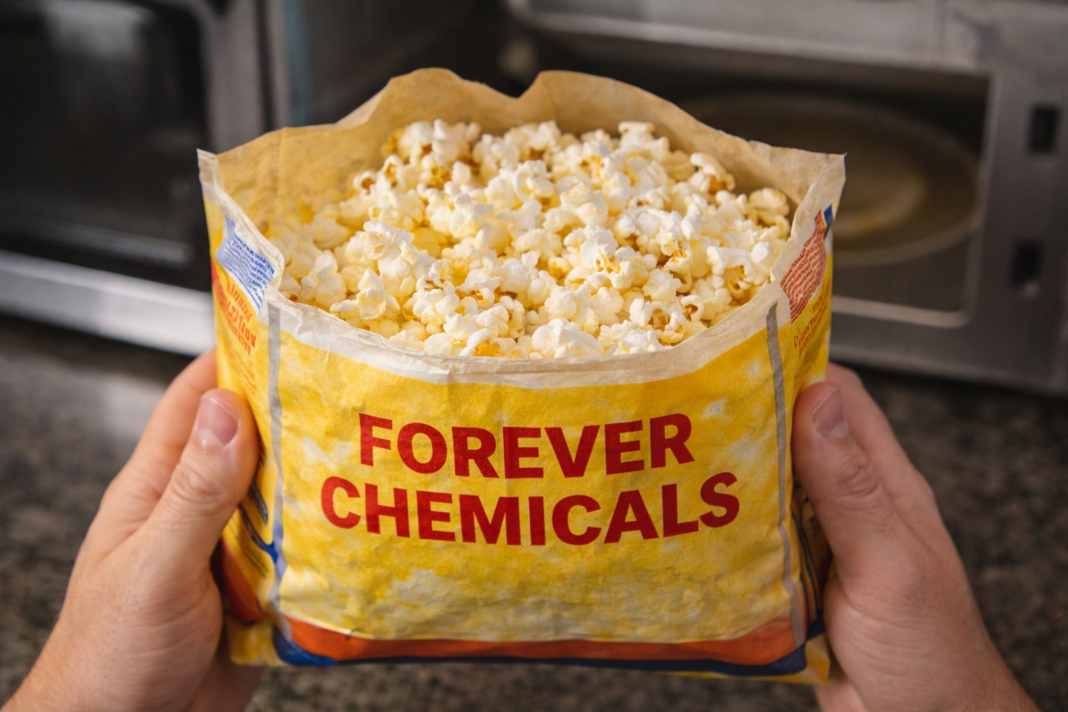
O’Shea’s interest in PFAS started close to home, while looking at microwave popcorn bags his son loved. Many of those bags are coated with PFAS to resist grease and heat. That everyday exposure sparked a deeper dive into how widespread—and persistent—these chemicals really are. He certainly didn’t want his kid eating them!

Many microwave popcorn brands in the US now offer PFAS-free, non-plastic bags, including Black Jewell, SkinnyPop (Sea Salt), and 365 by Whole Foods Market. And as of January 2024, the FDA announced that grease-proofing PFAS are no longer being sold for use in US food packaging. Look for expiration dates on old bags to avoid eating forever chemicals!
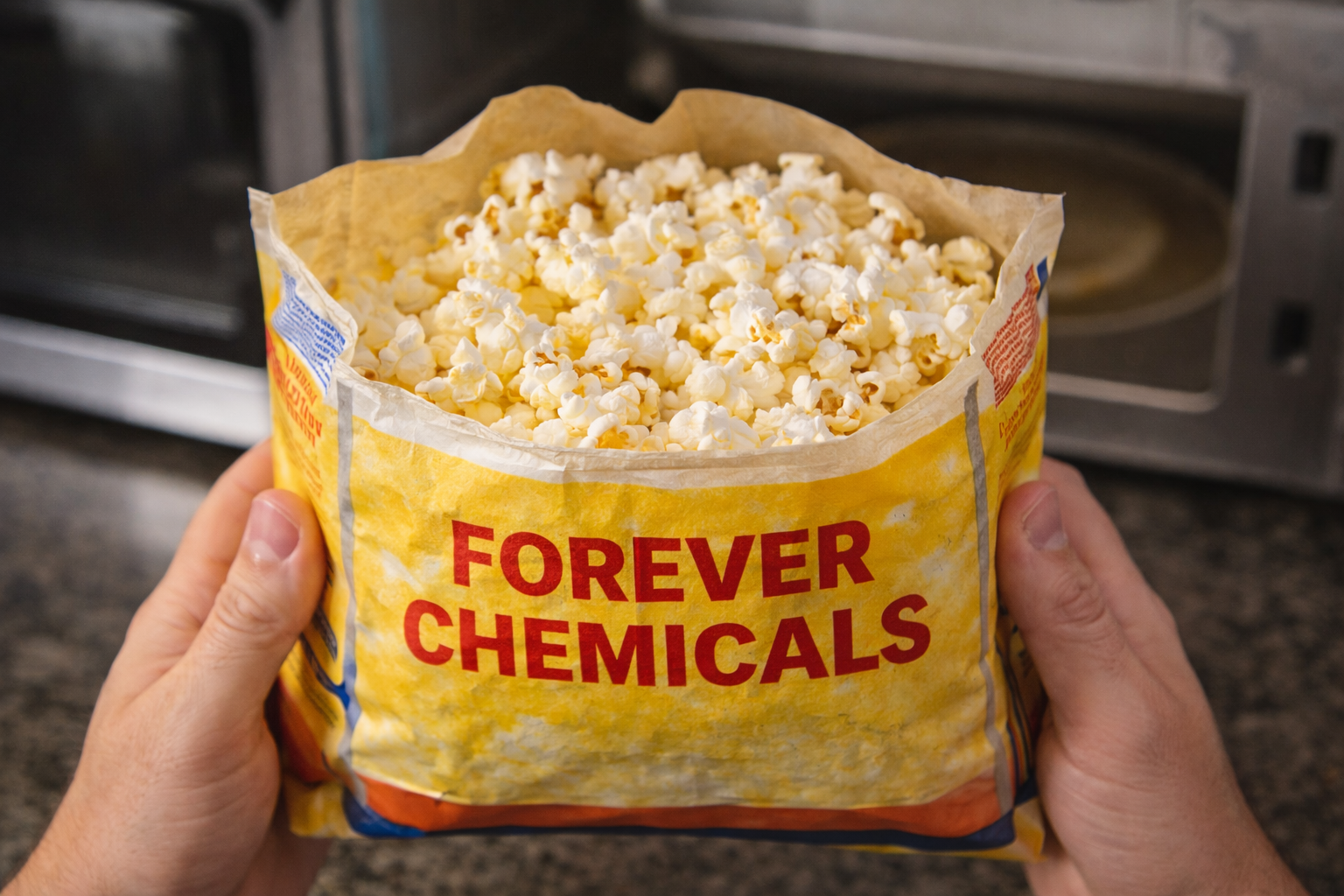
An image made with AI to show how forever chemicals, PFAS are inside microwave popcorn bag liners.

(Top Tip: you can make microwave popcorn in a bowl, with some salt, and a plate for a lid. Microwave for 3 to 5 minutes)

According to CEH you can make microwave popcorn in a bowl, with a plate on top. No need for oil ot a bag full of PFAS, forever chemicals.

Now, his team’s work points to a future where we don’t just trap pollution, we control it, concentrate it, and remove it more intelligently.

It’s not a full solution yet. PFAS are still everywhere, from industrial waste to household products. But a reusable, low-cost system like this could become a key tool in cleaning up contaminated water—without creating even more waste in the process.

And sometimes, the answer really does start with something as simple as changing the chemistry of water. And about yoga pants, wear cotton as it’s energetically more compatible to your body, and avoid microwave popcorn. Make it the old fashioned way with vegetable oil in a pot, topped with lots of real melted butter.


Karin Kloosterman
Karin Kloostermanhttp://www.greenprophet.com
Karin Kloosterman is an award-winning journalist, innovation strategist, and founder of Green Prophet, one of the Middle East’s pioneering sustainability platforms. She has ranked in the Top 10 of Verizon innovation competitions, participated in NASA-linked challenges, and spoken worldwide on climate, food security, and future resilience. With an IoT technology patent, features in Canada’s National Post, and leadership inside teams building next-generation agricultural and planetary systems — including Mars-farming concepts — Karin operates at the intersection of storytelling, science, and systems change. She doesn’t report on the future – she helps design it. Reach out directly to [email protected]

LEAVE A REPLY

Please enter your comment!
Please enter your name here

TRENDING

Lululemon pants leech PFAS and plastics into bodies, Texas attorney general claims

Back in late 2025, Green Prophet began asking uncomfortable questions about what’s really inside your yoga pants, from transparency failures (yes, those infamous see-through leggings) to the less visible and scarier issue: Your sweat is unlocking microplastics and chemical coatings sitting in the most absorbent parts of the human body.

Forever chemicals banned from Europe’s drinking water

The EU is taking a bold step in making sure all European Union member states worked to monitor and reduce PFAS levels in drinking water.

Toxic sea otters and the pollution they collect at sea

When otters become sick or die, entire marine ecosystems begin to unravel. Their contamination is not a side note. It is a warning.

Killing PFAS forever chemicals with hydrogen and UV light

An insidious category of carcinogenic pollutants known as “forever chemicals” may not be so permanent after all University of California, Riverside, chemical engineering and environmental scientists recently published new methods to chemically break up these harmful substances found in drinking water into smaller compounds that are essentially harmless. 

Forever chemicals PFAS linger in German drinking water

Comprising more than 4,700 chemicals, perfluorinated and polyfluorinated alkyl substances (PFAS) are a group of widely used, man-made chemicals that accumulate over time in humans and in the environment. They are known as ‘forever chemicals’ as they are extremely persistent in our environment and bodies.

Nobul’s Regan McGee on Shareholder Value: “Complacency Is the Silent Killer” 

Why the governance framework designed to protect shareholders so...

Should You Invest in the Private Market?

startustartup Unlike public stock exchanges, which offer daily trading, strict...

How to build a 100-year-company

Kongō Gumi is a Japanese construction company, purportedly founded in 578 A.D., making it the world's oldest documented company. What can we learn about building sustainable businesses from them?

From Pilot Plant to Global Stage: How Aduro Clean Technologies’ 2026 Expansion Signals a Turning Point for Chemical Recycling Investors Like Yazan Al Homsi

The company's Next Generation Process (NGP) Pilot Plant in London, Ontario, has officially moved into initial operating campaigns, generating the kind of structured, repeatable data that separates laboratory promise from commercial viability.

How AI Helps SaaS Companies Reduce Repetitive Customer Support Work

SaaS products are designed for large numbers of users with different levels of experience, and also in renewable energy.

Pulling Water from the Air

Faced with water shortage in Amman, Laurie digs up...

Turning Your Energy Consultancy into an LLC: 4 Legal Steps for Founders in Texas

If you are starting a renewable energy business in Texas, learn how to start an LLC by the books.

Tracking the Impacts of a Hydroelectric Dam Along the Tigris River

For the next two months, I'll be taking a break from my usual Green Prophet posts to report on a transnational environmental issue: the Ilısu Dam currently under construction in Turkey, and the ways it will transform life along the Tigris River.

Related Articles

Popular Categories