Microplastics from brushing your teeth and wearing plastic aligners?

Plastic toothbrush used by dentists

Plastics are all around us. Despite Greenpeace diehards wanting to ban them, along with the oil industry that fuels ships, plastics have transformed our lives allowing us to fly in airplanes, preserve and store water, and produce clothes and everyday products cheaply and effectively. But there is a cost as plastics don’t biodegrade, most plastics are not recycled, and they can enter the food chain and our bodies in teeny, invisible bits known as microplastics. Scientists find microplastics in water, in dust, in bits that chip off of plastic bottles we drink from –– and now the obvious –– from brushing our own teeth. (Slide down if you are looking for the study on plastic oral retainers).

Microplastics, according to the NIH in the US, can affect the human body by stimulating the release of endocrine disruptors. Microplastics can carry other toxic chemicals such as heavy metals and organic pollutants during adsorption, which can adversely affect the human body.

In a new study by dental researchers in India, and published in the journal Environmental Pollution, researchers looked at the impact of using plastic toothbrushes and microplastics. Brushing one’s teeth is abrasive, no doubt, and plastics must most certainly be chipping off from toothbrushes. Is it time for natural bristles and the miswak stick, used in Africa and in Arab countries as a natural toothbrush?

The miswak is a teeth-cleaning twig made from the Salvadora persica tree. It shows antibacterial activity which may help control the formation and activity of dental plaque.

miswak toothbrush
Brush your teeth with the stick from a tree? It’s called a miswak. Find them for sale in African markets.

The Indian researchers from the Meenakshi Ammal Dental College and Hospital explain that the “environmental input of microplastics from personal care products has received significant attention; however, less focus has been paid to oral healthcare products.”

They looked at microplastics in commercially available oral healthcare products such as toothbrushes, toothpastes, toothpowder, mouthwash, dental floss, and mouth freshener spray that have a pan-India distribution.

All products showed microplastic contamination, where toothbrushes showed the maximum particles (30 to 120 particles/brush) and mouth freshener sprays (0.2-3.5 particles/ml) had the least abundance, they report.

Fragments, fibres, beads, and films were the various shapes of microplastics observed, where fragments (60%) were dominant. Various colors such as pink, green, blue, yellow, black, and colorless fragments were observed, where colorless (40%) particles were dominant.

Microplastics were categorized into three sizes: <0.1 mm (63%), 0.1-0.3 mm (35%), and >0.3 mm (2%).

Four major types of polymers, such as polyethylene (52%), polyamide (30%), polyethylene terephthalate (15%), and polybutylene terephthalate (3%), were identified.

The researchers call for deeper investigation into microplastics and oral health. Which got me thinking after my daughter wore plastic Invisalign liners for a year to correct a minor overnite:

Are there microplastics shedding off of plastic aligners?

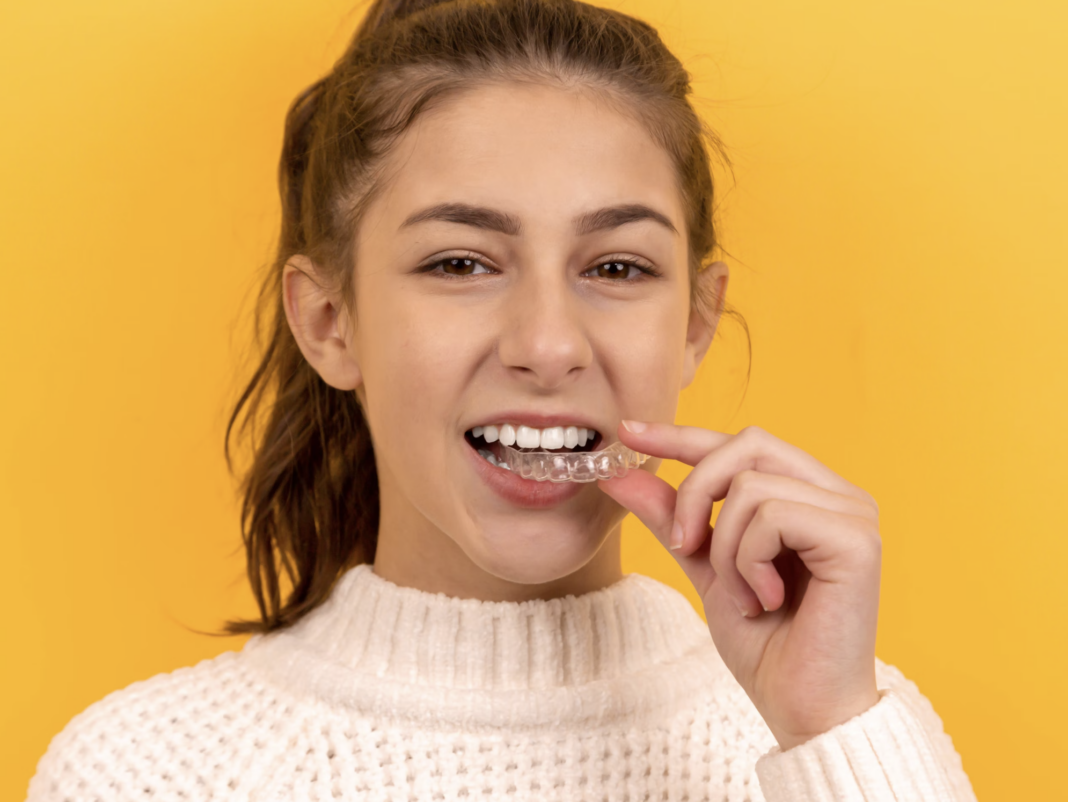
Microplastics in plastic aligners
Microplastics and orthodontic plastic aligners. Any risk?

A study in 2023 that simulated the mouth environment in the lab found yes, that microplastics were being separated from clear orthodontic aligners. They looked at the leading brands of plastic aligners and compared them: “This in vitro study highlighted for the first time the detachment of microplastics from clear aligners due to mechanical friction. This evidence may represent a great concern in the clinical practice since it could impact human general health,” the researchers wrote.

They looked at orthodontic clear aligners from different manufacturers: Alleo (AL); FlexiLigner (FL); F22 Aligner (F22); Invisalign (INV); Lineo (LIN); Arc Angel (ARC), and Ortobel Aligner (OR). For each group, two aligners were immersed in artificial saliva for 7 days and stirred for 5 h/day, simulating the physiological teeth mechanical friction.

After 7 days, the artificial saliva was filtered; then, filters were analyzed by Raman Microspectroscopy (RMS) and Scanning Electron Microscopy (SEM), respectively to chemically identify the polymeric matrix and to measure the number and size of the detected microplastics.

The results: aligners AL, FL, LIN, ARC, and OR were composed by polyethylene terephthalate, while F22 and INV ones by polyurethane. SEM analysis showed that the highest number of MPs was found in Arc Angel and the lowest in Invisalign (p < 0.05).

Avoid microplastics. Keywords: Annual microplastics exposure; Daily microplastics emission; Microplastics; Mitigation measures; Oral healthcare products; Polymer hazard index.
Avoid micrplastics and buy a wooden, natural fiber toothbrush

Related: Do your cosmetics contain cancer-causing asbestos? 

These studies forecast the community health risks linked to microplastics in oral healthcare products. Using a wooden toothbrush with natural bristles may help.

Is it time to go back to metal braces? We can’t say. We will wait for more research but you might want to take this research into your own hands and –– mouth.

microplastics in dentures?

Keywords: Annual microplastics exposure; Daily microplastics emission; Microplastics; Mitigation measures; Oral healthcare products; Polymer hazard index.


Karin Kloosterman
Karin Kloostermanhttp://www.greenprophet.com
Karin Kloosterman is an award-winning journalist, innovation strategist, and founder of Green Prophet, one of the Middle East’s pioneering sustainability platforms. She has ranked in the Top 10 of Verizon innovation competitions, participated in NASA-linked challenges, and spoken worldwide on climate, food security, and future resilience. With an IoT technology patent, features in Canada’s National Post, and leadership inside teams building next-generation agricultural and planetary systems — including Mars-farming concepts — Karin operates at the intersection of storytelling, science, and systems change. She doesn’t report on the future – she helps design it. Reach out directly to [email protected]

Hot this week

How Renewable Energy is Revolutionizing the Way We Power Our World

Solar has become the star of the transition thanks to modular hardware and straightforward installation. It fits dense cities and remote towns alike. Many companies are turning to rooftop arrays and carport systems - and exploring commercial solar installation as a practical way to lock in future savings.

How does one start prepping?

Faced with an extreme winter storm this year, Americans wonder how to be prepared for catastrophe. Miriam has lived through wars in the Middle East - so she's prepared on giving you a guide to prepping.

Fishermen sue tire manufacturers on behalf of the salmon

A federal trial in San Francisco has brought US tire manufacturers, fishing groups, and environmental scientists into court over a chemical most drivers have never heard of — but which scientists say may be silently reshaping aquatic ecosystems.

Listening to Water: Tarek Atoui’s Next Work for Tate Modern

Born in Beirut, Lebanon in 1980 and now living in Paris, Atoui has spent years building instruments that don’t sit comfortably in concert halls. Many of them involve water, glass, and ceramics — materials that react to sound instead of simply producing it.

Leading Through a Dual-Energy Transition: Balancing Decarbonisation with Energy Security

Experience in one area of the energy industry isn't enough to guarantee readiness across all the others. That's where a structured program like an MBA in energy can come in. Today's advanced curricula explore energy economics, finance, policy, and strategic management alongside the technical subjects. And when pursuing an energy MBA online, professionals can skill up and retrain without having to step out of the labor market -- an important perk at a time when skilled professionals are already in short supply.

Topics

How Renewable Energy is Revolutionizing the Way We Power Our World

Solar has become the star of the transition thanks to modular hardware and straightforward installation. It fits dense cities and remote towns alike. Many companies are turning to rooftop arrays and carport systems - and exploring commercial solar installation as a practical way to lock in future savings.

How does one start prepping?

Faced with an extreme winter storm this year, Americans wonder how to be prepared for catastrophe. Miriam has lived through wars in the Middle East - so she's prepared on giving you a guide to prepping.

Fishermen sue tire manufacturers on behalf of the salmon

A federal trial in San Francisco has brought US tire manufacturers, fishing groups, and environmental scientists into court over a chemical most drivers have never heard of — but which scientists say may be silently reshaping aquatic ecosystems.

Listening to Water: Tarek Atoui’s Next Work for Tate Modern

Born in Beirut, Lebanon in 1980 and now living in Paris, Atoui has spent years building instruments that don’t sit comfortably in concert halls. Many of them involve water, glass, and ceramics — materials that react to sound instead of simply producing it.

Leading Through a Dual-Energy Transition: Balancing Decarbonisation with Energy Security

Experience in one area of the energy industry isn't enough to guarantee readiness across all the others. That's where a structured program like an MBA in energy can come in. Today's advanced curricula explore energy economics, finance, policy, and strategic management alongside the technical subjects. And when pursuing an energy MBA online, professionals can skill up and retrain without having to step out of the labor market -- an important perk at a time when skilled professionals are already in short supply.

From Green Energy to Healthy Societies: Why old systems thinking is becoming relevant again

Across the Middle East and North Africa, large investments are being made in green hydrogen, renewable energy, water infrastructure and sustainability. Most of these efforts are discussed in the context of climate change, decarbonization and economic diversification. That framing is important, but it may not capture their full value.

We saw peace – an interreligious encounter deep in our eyes

They came from Israel, Palestine, Jordan, Iraq, Yemen, Morocco, Tunisia, Lebanon, Egypt… There are Sunni Muslims, Shiite Muslims, Jews (Orthodox and Reform), Orthodox Christians, Coptic Christians, Protestant Christians, Druze, Baha'is, a Scientologist.

Can biochar reduce ‘Forever Chemicals’ in food if it’s used in farms?

Biochar is produced by heating organic material in a low-oxygen environment so it does not burn. This process, known as pyrolysis, transforms plant matter into a stable, carbon-rich material.

Related Articles

Popular Categories