

In recent years, the Middle East has become a focal point for sustainable energy initiatives, with the United Arab Emirates (UAE) at the forefront of pioneering projects as it divests away from oil and natural gas. Among these initiatives, the Mohammed bin Rashid Al Maktoum Solar Park stands as a testament to Dubai’s commitment to clean energy. This massive undertaking aligns with the UAE’s ambitious goal of achieving net-zero emissions by 2050, as outlined in the ongoing Cop28 climate conference in Dubai.
On December 7, 2023, Sheikh Mohammed bin Rashid, the rule of Dubai officially inaugurated the world’s largest concentrated solar park. This momentous occasion marked the completion of the fourth phase of the Mohammed bin Rashid Al Maktoum Solar Park, representing a significant stride towards Dubai’s clean energy aspirations.
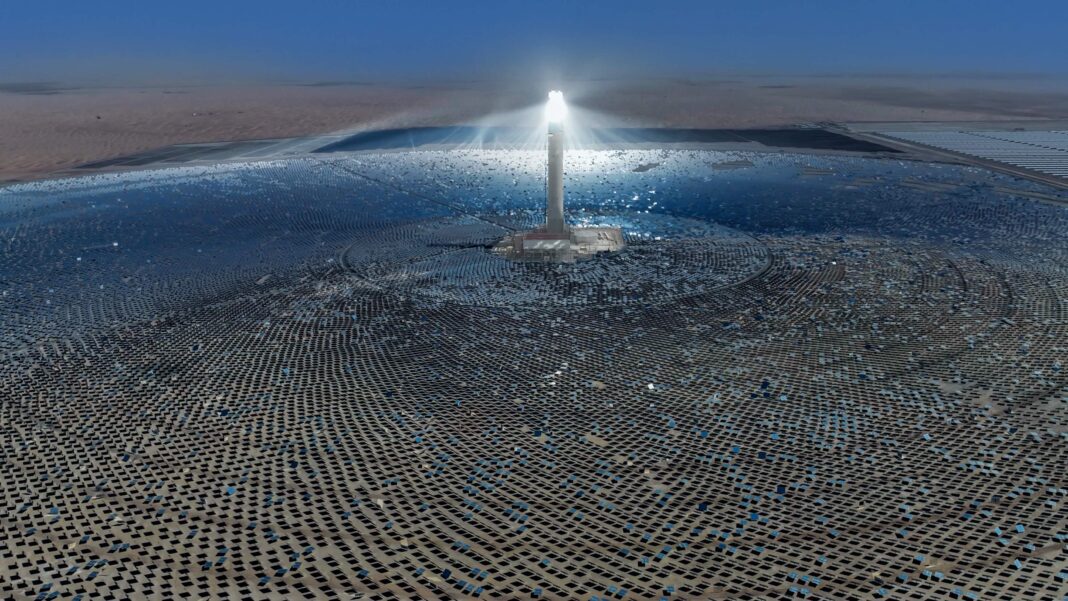
With a staggering investment of Dh15.78 billion (USD 4.3 billion), the fourth phase covers an expansive area of 44 square kilometers. Boasting a remarkable capacity of 2.8GW a new addition of 950 MW will provide renewable energy to approximately 320,000 households in the UAE. More impressively, it is expected to contribute to an annual reduction of carbon emissions by an estimated 1.6 million tonnes.

Key Features of the Fourth Phase
The fourth phase of this CSP plant introduces features that underscore Dubai’s commitment to pushing the boundaries of renewable energy technology. Notably, it features the world’s tallest solar tower, standing at over 263 meters, and a record-setting thermal energy storage capacity of 5,907 MWh. This innovative approach reflects the convergence of three hybrid technologies – 600 MW from a parabolic basin complex, 100 MW from the tower, and 250 MW from photovoltaic (PV) solar panels.
Sheikh Mohammed bin Rashid highlighted the significance of the solar park in achieving sustainability goals, emphasizing its role in the global effort to combat climate change. This sentiment resonates with the objectives of the Cop28 climate conference, where nations gather to discuss strategies for mitigating the impacts of climate change.
Strategic Importance and Global Leadership
The Mohammed bin Rashid Al Maktoum Solar Park is a pivotal element of Dubai’s Clean Energy Strategy 2050 and Net-Zero Carbon Emissions Strategy 2050. These strategic roadmaps aim to achieve 100 percent energy production from clean sources by the middle of the century. Spearheaded by the Dubai Electricity and Water Authority (DEWA), the solar park is set to reach a total capacity of 5,000 MW and reduce carbon emissions by 6.5 million tonnes annually upon its completion in 2030.

The fourth phase has already commissioned 717 MW, incorporating over 790,000 PV solar panels and integrating 70,000 mirrors that dynamically track the sun’s movement.
Noor Energy 1, a consortium led by DEWA and Saudi Arabia’s ACWA Power, played a pivotal role in designing, building, and operating the fourth phase. This collaboration further solidifies Dubai’s status at the forefront of the clean energy revolution, showcasing its commitment to sustainable development and global leadership in the renewable energy sector.
The latest phase of construction brought the farm’s total capacity up to 2.8GW, comparable to the capacity of the Golmud Solar Park in China, the largest solar farm by capacity.
The differences between CSP and PV solar
Concentrated Solar Power (CSP) and Photovoltaic (PV) solar technologies are distinct approaches to collecting solar energy. CSP systems concentrate sunlight using mirrors or lenses to generate heat, which is then used to produce steam and drive turbines for electricity generation. This technology is particularly effective in areas with high direct sunlight, offering the advantage of energy storage capabilities through the use of thermal storage systems.
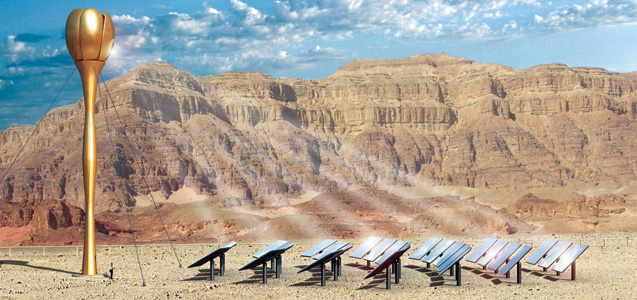
On the other hand, PV solar systems convert sunlight directly into electricity through the photovoltaic effect, where semiconductor materials in solar cells generate an electric current when exposed to sunlight. PV technology is versatile, scalable, and widely applicable, making it suitable for various installations, from small residential rooftop systems to large-scale solar farms. PV systems do not require water for operation, making them well-suited for arid regions.

Successful CSP plants around the world
Several large Concentrated Solar Power (CSP) installations around the world showcase the immense potential of this technology in harnessing solar energy for electricity generation.
- Ivanpah Solar Power Facility, USA: Located in the Mojave Desert in California, Ivanpah is one of the largest CSP installations globally. With a capacity of 392 megawatts (MW), it utilizes three centralized solar thermal power plants to produce electricity by focusing sunlight on tower-mounted receivers.
- Noor Complex, Morocco: The Noor Complex in Ouarzazate is a series of CSP plants, with Noor III being the standout. It has a capacity of 150 MW and employs a solar power tower technology to generate electricity. The entire Noor Complex is expected to have a total capacity of 580 MW.
- Solana Generating Station, USA: Situated in Arizona, Solana has a capacity of 280 MW. It utilizes parabolic trough technology with thermal energy storage, allowing it to provide electricity even when the sun is not shining.
- Ilanga-1, South Africa: Ilanga-1, located near Upington, has a capacity of 100 MW. It uses parabolic trough technology and contributes to South Africa’s efforts to increase renewable energy capacity.
- Shouhang Dunhuang, China: The Shouhang Dunhuang project in Gansu Province, China, is a 100 MW molten salt tower CSP installation. It incorporates advanced energy storage technologies, enhancing its ability to supply electricity consistently.
- Israel’s Ashalim Power Station is a notable CSP plant. Combining parabolic troughs and a solar tower, it has a capacity of 300 MW, contributing substantially to Israel’s renewable energy goals.