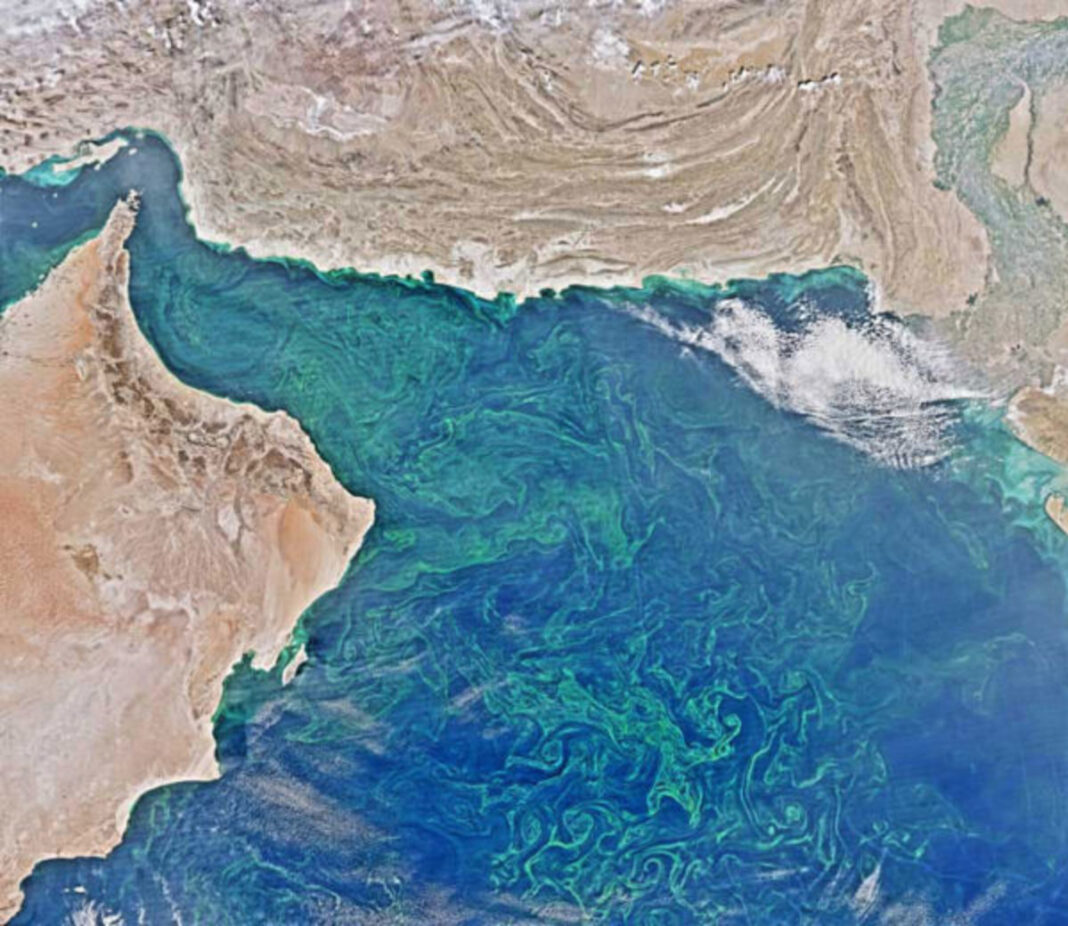
The Arabian Sea’s Deadzone is Bigger than Florida, and it keeps growing

arabian sea deadzone

New research from the University of East Anglia has confirmed a dramatic decrease in oxygen in the Gulf of Oman part of the Arabian Sea. But the environmental disaster is worse than expected.

The ‘dead zone’ was confirmed by underwater robots called Seagliders – which were able to collect data in areas of water previously inaccessible due to the piracy and geopolitical tensions.

The robots are about the same size as a small human diver, but can reach depths of 1000 yards and travel the ocean for months, covering thousands of miles.

dead zone arabian sea

Two gliders were deployed in the Gulf of Oman for eight months. They communicated by satellite to build an underwater picture of oxygen levels, and the ocean mechanics that transport oxygen from one area to another. Where they expected some oxygen, they found an area larger than Florida or the country of Scotland with almost no oxygen left.

The research was led by Dr Bastien Queste from UEA’s School of Environmental Sciences, in collaboration with Oman’s Sultan Qaboos University.

Dr Queste said: “Dead zones are areas devoid of oxygen. In the ocean, these are also known as ‘oxygen minimum zones’ and they are naturally occurring between 200 and 800 meters deep in some parts of the world.

Disaster waiting to happen

“They are a disaster waiting to happen – made worse by climate change, as warmer waters hold less oxygen, and by fertiliser and sewage running off the land into the seas.

“The Arabian Sea is the largest and thickest dead zone in the world. But until now, no-one really knew how bad the situation was because piracy and conflicts in the area have made it too dangerous to collect data.

“We barely have any data collected for almost half a century because of how difficult it is to send ships there,” he says.

Pirates and kidnapping make it nearly impossible for researchers to want to go out and venture there. Some do like this group EcoOcean who run an eco-ship.

“Our research shows that the situation is actually worse than feared – and that the area of dead zone is vast and growing. The ocean is suffocating.

“Of course all fish, marine plants and other animals need oxygen, so they can’t survive there. It’s a real environmental problem, with dire consequences for humans too who rely on the oceans for food and employment.

“Another problem is that when oxygen is absent, the chemical cycling of nitrogen – a key nutrient for plant growth – changes dramatically. Nitrous oxide, a greenhouse gas 300 times more potent than CO2 is produced,” he added.

Computer simulations of ocean oxygen show a decrease in oxygen over the next century and growing oxygen minimum zones. However these simulations have a difficult time representing small but very important features such as eddies which impact how oxygen is transported.

The team combined their Seaglider data with a very high-resolution computer simulation to determine how oxygen is spread around the north-western Arabian Sea throughout different seasons and the monsoons.

They found that the deadzone moves up and down between seasons, causing fish to be squeezed in a thin layer near the surface.

“Management of the fisheries and ecosystems of the western Indian Ocean over coming decades will depend on better understanding and forecasting of oxygen levels in key areas such as the Gulf of Oman,” added Dr Queste.

Bhok Thompson
Bhok Thompsonhttp://www.greenprophet.com
Bhok Thompson is an “eco-tinkerer” who thrives at the intersection of sustainability, business, and cutting-edge technology. With a background in mechanical engineering and a deep fascination with renewable energy, Bhok has dedicated his career to developing innovative solutions that bridge environmental consciousness with profitability. A frequent contributor to Green Prophet, Bhok writes about futuristic green tech, urban sustainability, and the latest trends in eco-friendly startups. His passion for engineering meets his love for business as he mentors young entrepreneurs looking to create scalable, impact-driven companies. Beyond his work, Bhok is an avid collector of vintage mechanical watches, believing they represent an era of precision and craftsmanship that modern technology often overlooks. Reach out: [email protected]

Hot this week

Why Health Systems Are Reaching a Turning Point

Health emerges from a continuous energy and material flow from water through food to human physiology. Technical energy systems support this cycle through water treatment, agriculture, and infrastructure.

Sustainability That Sells: How Profit and Purpose Come Together in the Hive

Whether you are a commercial grower, hobbyist beekeeper or retail equipment supplier, this system opens a new income stream with minimal environmental impact.

The Fitness App Revolution: Building the Future of Wellness Through Strategic Development

In an era where smartphones are ubiquitous and health consciousness is at an all-time high, the fitness industry has undergone a radical digital transformation. Fitness applications have moved far beyond simple pedometers, evolving into comprehensive wellness platforms that serve as personal trainers, nutritionists, and community hubs right in our pockets.

A Brief History of Basil From India to Italy

Beloved, fortunate, sweet, and royal; an herb with a long and storied history in Asia and across the world. Called by many names, basil has featured in previous Green Prophet articles, so enjoy another serving, a brief history of basil.

How Renewable Energy is Revolutionizing the Way We Power Our World

Solar has become the star of the transition thanks to modular hardware and straightforward installation. It fits dense cities and remote towns alike. Many companies are turning to rooftop arrays and carport systems - and exploring commercial solar installation as a practical way to lock in future savings.

Topics

Why Health Systems Are Reaching a Turning Point

Health emerges from a continuous energy and material flow from water through food to human physiology. Technical energy systems support this cycle through water treatment, agriculture, and infrastructure.

Sustainability That Sells: How Profit and Purpose Come Together in the Hive

Whether you are a commercial grower, hobbyist beekeeper or retail equipment supplier, this system opens a new income stream with minimal environmental impact.

The Fitness App Revolution: Building the Future of Wellness Through Strategic Development

In an era where smartphones are ubiquitous and health consciousness is at an all-time high, the fitness industry has undergone a radical digital transformation. Fitness applications have moved far beyond simple pedometers, evolving into comprehensive wellness platforms that serve as personal trainers, nutritionists, and community hubs right in our pockets.

A Brief History of Basil From India to Italy

Beloved, fortunate, sweet, and royal; an herb with a long and storied history in Asia and across the world. Called by many names, basil has featured in previous Green Prophet articles, so enjoy another serving, a brief history of basil.

How Renewable Energy is Revolutionizing the Way We Power Our World

Solar has become the star of the transition thanks to modular hardware and straightforward installation. It fits dense cities and remote towns alike. Many companies are turning to rooftop arrays and carport systems - and exploring commercial solar installation as a practical way to lock in future savings.

How does one start prepping?

Faced with an extreme winter storm this year, Americans wonder how to be prepared for catastrophe. Miriam has lived through wars in the Middle East - so she's prepared on giving you a guide to prepping.

Fishermen sue tire manufacturers on behalf of the salmon

A federal trial in San Francisco has brought US tire manufacturers, fishing groups, and environmental scientists into court over a chemical most drivers have never heard of — but which scientists say may be silently reshaping aquatic ecosystems.

Listening to Water: Tarek Atoui’s Next Work for Tate Modern

Born in Beirut, Lebanon in 1980 and now living in Paris, Atoui has spent years building instruments that don’t sit comfortably in concert halls. Many of them involve water, glass, and ceramics — materials that react to sound instead of simply producing it.

Related Articles

Popular Categories