

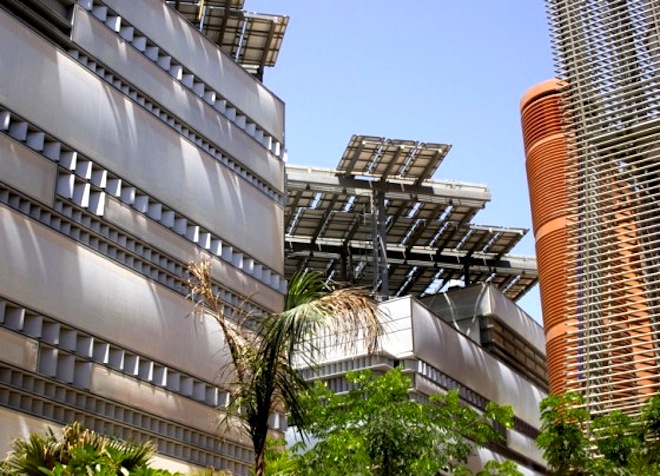
 Can there be more Masdars? Can this experimental eco-city be replicated in other Middle Eastern or North African countries that don’t have Abu Dhabi’s immense oil wealth? Green Prophet put this question to Anthony Mallows, Director of Masdar City, and Chris Chi Lon Wan, City Design Manager, during a recent roundtable discussion.
Masdar City is an experimental clean tech and research hub located 17 kilometers outside of Abu Dhabi. One day, it is expected that up to 40,000 people will call the car-free, pedestrian friendly, energy-efficient city home. Plus, since it is a special economic free zone, foreign companies and startups can take advantage of 100 percent ownership of their firms, zero import tariffs and taxes, and zero currency restrictions.
But Abu Dhabi has already forked over billions of dollars to realize Masdar’s current achievements, which include doubling the size of the Masdar Institute of Technology (MIST), which has already produced 40 patent-application disclosures and graduated top tier students according to Wired, attracting over 100 companies to its new incubator building, a new headquarters for IRENA, and the recent completion of Siemens’ groundbreaking LEED-Platinum headquarters.
Such an inspired green development, Masdar has already had ripple effects across the Gulf. Ostensibly realizing that solar and other renewables make economic sense, both Saudi Arabia and Qatar are pursuing ambitious plans to wean their own population off oil in order to ensure long term export earnings.
But what about Tunisia, or Algeria, or Jordan? Given that they have less disposable income than Abu Dhabi, how can these countries possibly replicate the Masdar model? How can they be encouraged to pursue green development?
“With the financial crisis and the realization that if you’re going to be a model for sustainable development, you have to recognize not only environmental sustainability but social and economic as well,” said Mallows. “With that came the realization that you build cities not within the realm of governments that have a lot of money to invest in R&D, but you build it with the private sector… that build pieces of cities or parts of cities for profit.”
“We re-calibrated the development strategy for Masdar City to allow specifically third party investors and developers to participate in Masdar City’s development on long term land leases and all we do is we say here are development regulations based on Abu Dhabi 2030 and Estidama regulations and sustainability criteria that if you build in Masdar City we expect you will conform to.”
In other words, Mallows notes, a third party developer on a long term land lease could build a sustainable project anywhere in the world, not just in Masdar City, without massive financing from government. They can make a profit, but building sustainably depends on the will to do so.
Which means that municipalities in other cities could mandate that all future builds or retrofits fit a certain standard – in the same way that Abu Dhabi has mandated that all new residential projects should earn at least one pearl under Estidama guidelines, while government buildings are expected to achieve at least two.
In Masdar City, all future builds are expected to achieve at least three pearls under Estidama, according to Chris Wan, who spoke during a breakout session in Abu Dhabi about the economics of sustainability and the process that lead to the Siemens building’s success.
“We’ve taken a look at Masdar City and said OK, what are the building blocks of a city,” says Mallows. “And the building blocks of a city are actually not huge districts or downtown cores or things the size of Masdar City, they are in fact neighborhoods.”
“But neighborhoods are not necessarily just residential, they are also working neighborhoods, live-work neighborhoods, mixed-use neighborhoods, R&D neighborhoods – how do you do this?”
“So now we’ve re-organized Masdar City into nine neighborhoods – starting around Masdar Institute as an R&D neighborhood … where in fact there are different kinds of facilities and then straightforward residential neighborhoods, shops, amenities – but, and here’s a big but, they are all linked by a network of mobility and that’s the key and that’s replicable.”
Mallows says that a sustainable city must have public transportation and it must be pedestrian-friendly. This not only reduces the number of cars on the roads, but by extension energy consumption and greenhouse gas emissions. It also provides a more pleasant social atmosphere – especially if the neighborhoods are designed for an optimum microclimate that takes advantage of passive design and natural cooling.



[…] Read More […]
[…] city in that nation, in Africa, and likely the entire Middle East North Africa (MENA) region. Masdar City, in continuing development in Abu Dhabi, initially targeted zero-carbon status, but has yet to […]
[…] on the futuristic imaginings of 1960s architectural group Archigram; they envisioned a city as a living organism whose purposely stride is undeterred by its changing size and form. The title of the video is a […]
[…] This article by Tafline Laylin was originally posted on the 21st January 2014 on the Green Prophet. […]
Masdar has not solved it’s internal circulation system so far as I know. The original design (which was abandoned as too costly early on) provided for automated electric vehicles operating under a platform that was the pedestrian level. The pedestrial level featured narrow streets with no parking spaces. Currently there are several automated vehicles being operated under the small platform that was built. But no more platforms are going to be built and conventional electric cars will soon jam up the narrow streets and will have no place to park – unless the overall design for the rest of the city is changed drastically. Has it been? I don’t think so. What will they do to achieve unimpeded circulation within Masdar’s walls? Stay tuned.