Mud bricks are not just for Minecraft – they can solve real-world refugee housing

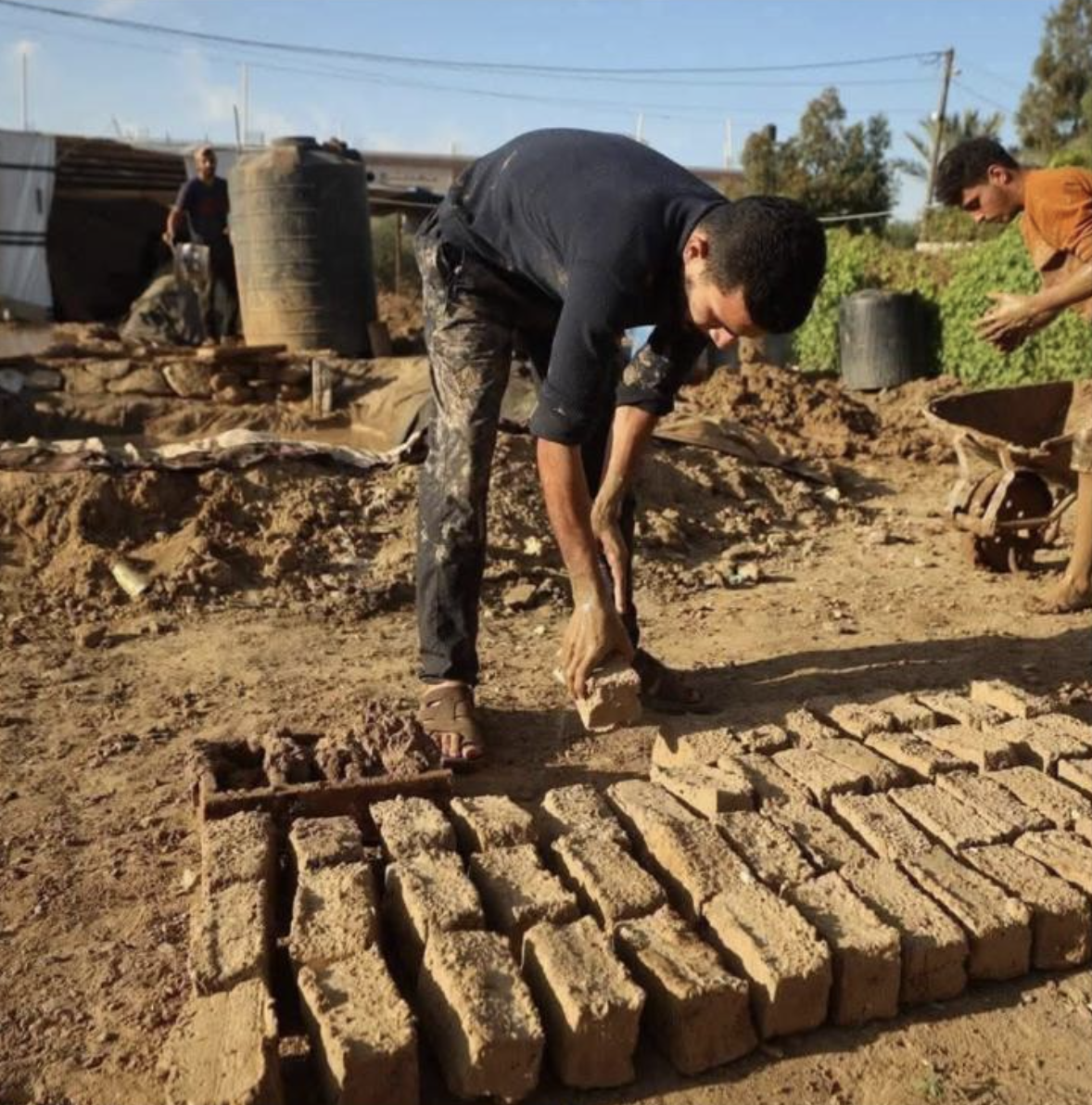
Gaza man builds home with mud bricks


Unconfirmed photos are circulating on the internet that a Gazan family has started to rebuild their home using mud bricks. And just a few days ago we reported on a Saudi Arabian designer and his plans for using mud bricks as a solution to the refugee crisis.

Somalia, mud brick, refugee shelter, modular housing, IDP camps, sustainable architecture, acacia wood, earth construction, passive cooling, vernacular design, low-cost housing, humanitarian architecture, Kengo Kuma, Rabie Al Ashi, climate resilience
A mud brick house for refugees

Mud bricks are made from clay, sand, water and a natural binder such as rice husk or straw. They are dried in the sun—no firing, no fuel required at all. Properly made, they meet compressive strength and heat-conductivity requirements, act as fire-resistant and sound-insulating walls, and keep indoor temperatures relatively stable in both summer and winter. This works as long as there is a protective roof and the bricks are maintained. People in the past used to know how to do this but concrete made us forget ancient wisdom. If you travel to places like Ethiopia, most rural people are living in mud houses. 

Related: ancient mud houses in the Muslim world

Globally, around 30 per cent of the world’s population still lives in earthen structures; the material is traditional across the Middle East, North Africa, India and much of the global South. The research community has moved well beyond nostalgia: recent studies on compressed earth blocks and fibre-reinforced mud bricks in places as varied as Australia, Togo and North Africa treat earth as a serious, testable low-carbon material, not as a second-best stopgap. Mud is flame-proof, readily available and as Hathan Fathy of the New Gourna Village argued can give people an honorable place to live.
In Gaza, of course, energy and shelter are fused problems. Even before the current war, the territory never had enough grid power. Over roughly a decade, rooftop solar spread rapidly: one satellite analysis found at least 655 rooftop solar systems in a single square mile of Gaza City, and by 2022 the strip was estimated to have more than 12,000 such systems.

Solar became a genuine lifeline, keeping water pumps, small clinics, fridges and phones running when diesel ran out. See the map below of rooftop solar, which according to this source made Gaza the highest user per capita of solar rooftop energy in the world.
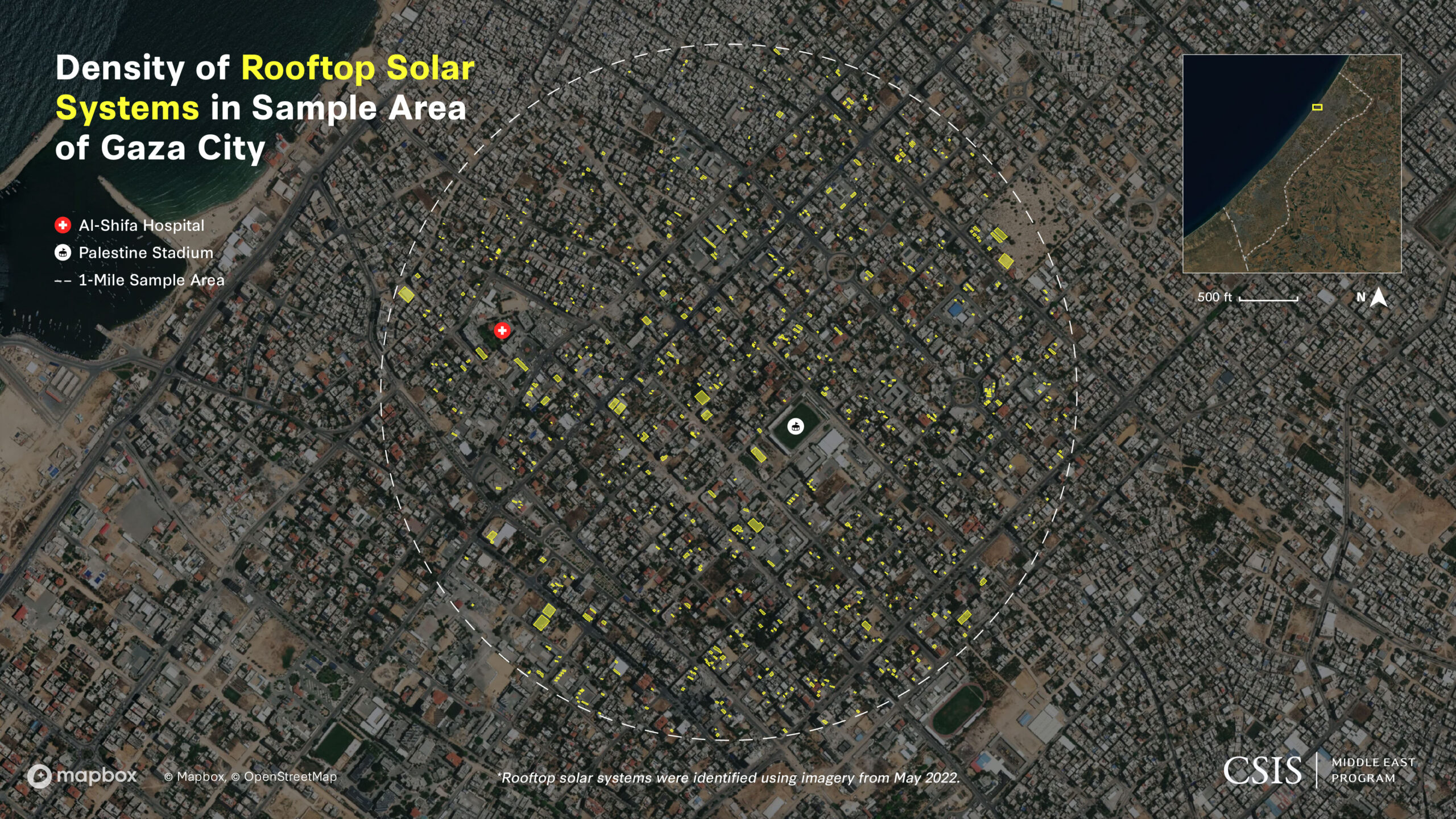
Rooftop solar panels in Gaza, 2022: https://www.csis.org/analysis/gazas-solar-power-wartime

Much of that infrastructure has since been damaged or destroyed since Hamas started the war with Israel, but the lesson is still there in plain sight: when you give people robust, decentralised tools—sun and soil—they will use them to hold their lives together. Satellite-based damage assessments now show that a large share of solar installations have been hit, which only increases the urgency of planning low-carbon, distributed systems for any serious reconstruction.
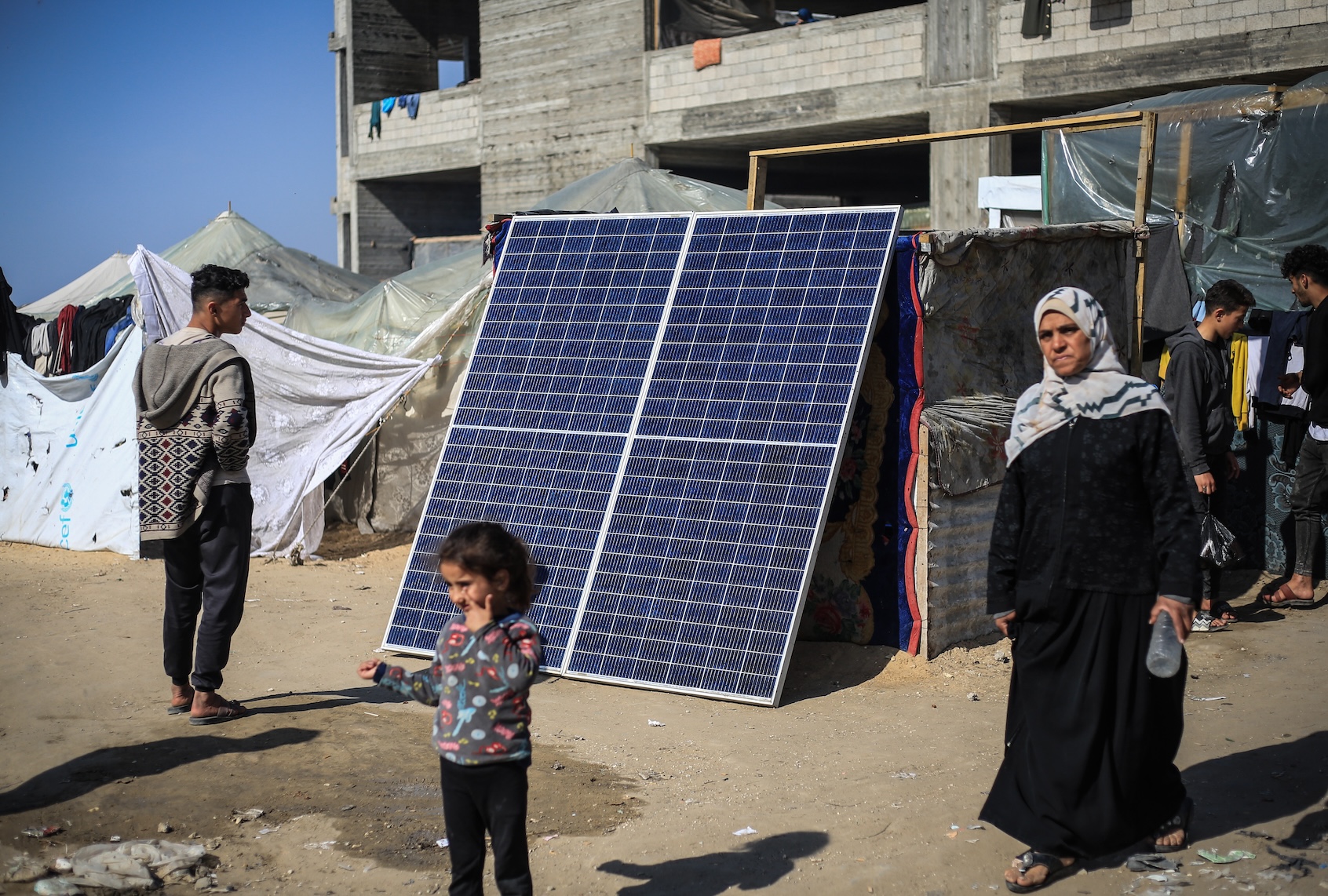
Gaza and solar panels in 2025 via Salon 

For a practical NGO funder, this suggests a very grounded agenda that is neither experimental for its own sake nor romantic about “traditional” methods.

Gaza will need: field-tested earthen construction, training and demonstration yards that support local engineers, masons and women’s groups to run short, paid training programs in mud-brick and compressed earth construction. Small demonstration houses, clinics or community centers can double as real assets and training labs. Centers can also teach solar cooking and basic engineering skills.

A solar cooker on a roof in Gaza
A man in Gaza cooks food on his roof using a solar cooker, powered by the sun

Solar + earth “micro-campuses”: pair thick, thermally massive earthen buildings with rooftop or courtyard solar systems and simple DC micro-grids with small plots for farming and permaculture. Muslim women in Israel and the PA can travel to Gaza to give workshops on beekeeping (see Bees for Peace).

While Gaza has always been densely populated, new models in earthen building and rooftop gardens can enliven the hope for the next generation.

Karin Kloosterman
Karin Kloostermanhttp://www.greenprophet.com
Karin Kloosterman is an award-winning journalist, innovation strategist, and founder of Green Prophet, one of the Middle East’s pioneering sustainability platforms. She has ranked in the Top 10 of Verizon innovation competitions, participated in NASA-linked challenges, and spoken worldwide on climate, food security, and future resilience. With an IoT technology patent, features in Canada’s National Post, and leadership inside teams building next-generation agricultural and planetary systems — including Mars-farming concepts — Karin operates at the intersection of storytelling, science, and systems change. She doesn’t report on the future – she helps design it. Reach out directly to [email protected]

Hot this week

Fishermen sue tire manufacturers on behalf of the salmon

A federal trial in San Francisco has brought US tire manufacturers, fishing groups, and environmental scientists into court over a chemical most drivers have never heard of — but which scientists say may be silently reshaping aquatic ecosystems.

Listening to Water: Tarek Atoui’s Next Work for Tate Modern

Born in Beirut, Lebanon in 1980 and now living in Paris, Atoui has spent years building instruments that don’t sit comfortably in concert halls. Many of them involve water, glass, and ceramics — materials that react to sound instead of simply producing it.

Leading Through a Dual-Energy Transition: Balancing Decarbonisation with Energy Security

Experience in one area of the energy industry isn't enough to guarantee readiness across all the others. That's where a structured program like an MBA in energy can come in. Today's advanced curricula explore energy economics, finance, policy, and strategic management alongside the technical subjects. And when pursuing an energy MBA online, professionals can skill up and retrain without having to step out of the labor market -- an important perk at a time when skilled professionals are already in short supply.

From Green Energy to Healthy Societies: Why old systems thinking is becoming relevant again

Across the Middle East and North Africa, large investments are being made in green hydrogen, renewable energy, water infrastructure and sustainability. Most of these efforts are discussed in the context of climate change, decarbonization and economic diversification. That framing is important, but it may not capture their full value.

We saw peace – an interreligious encounter deep in our eyes

They came from Israel, Palestine, Jordan, Iraq, Yemen, Morocco, Tunisia, Lebanon, Egypt… There are Sunni Muslims, Shiite Muslims, Jews (Orthodox and Reform), Orthodox Christians, Coptic Christians, Protestant Christians, Druze, Baha'is, a Scientologist.

Topics

Fishermen sue tire manufacturers on behalf of the salmon

A federal trial in San Francisco has brought US tire manufacturers, fishing groups, and environmental scientists into court over a chemical most drivers have never heard of — but which scientists say may be silently reshaping aquatic ecosystems.

Listening to Water: Tarek Atoui’s Next Work for Tate Modern

Born in Beirut, Lebanon in 1980 and now living in Paris, Atoui has spent years building instruments that don’t sit comfortably in concert halls. Many of them involve water, glass, and ceramics — materials that react to sound instead of simply producing it.

Leading Through a Dual-Energy Transition: Balancing Decarbonisation with Energy Security

Experience in one area of the energy industry isn't enough to guarantee readiness across all the others. That's where a structured program like an MBA in energy can come in. Today's advanced curricula explore energy economics, finance, policy, and strategic management alongside the technical subjects. And when pursuing an energy MBA online, professionals can skill up and retrain without having to step out of the labor market -- an important perk at a time when skilled professionals are already in short supply.

From Green Energy to Healthy Societies: Why old systems thinking is becoming relevant again

Across the Middle East and North Africa, large investments are being made in green hydrogen, renewable energy, water infrastructure and sustainability. Most of these efforts are discussed in the context of climate change, decarbonization and economic diversification. That framing is important, but it may not capture their full value.

We saw peace – an interreligious encounter deep in our eyes

They came from Israel, Palestine, Jordan, Iraq, Yemen, Morocco, Tunisia, Lebanon, Egypt… There are Sunni Muslims, Shiite Muslims, Jews (Orthodox and Reform), Orthodox Christians, Coptic Christians, Protestant Christians, Druze, Baha'is, a Scientologist.

Can biochar reduce ‘Forever Chemicals’ in food if it’s used in farms?

Biochar is produced by heating organic material in a low-oxygen environment so it does not burn. This process, known as pyrolysis, transforms plant matter into a stable, carbon-rich material.

In The Dark Review – An Immersive Music Experience in Total Darkness at St Andrew Holborn

In complete darkness, inside the holy space of St Andrew Holborn, listening begins to feel like a form of prayer. With no light and no distraction, sound fills the church and holds the room. For an hour, attention itself becomes the shared act.

How Quality of Hire Shapes Modern Recruitment

A 2024 survey by Deloitte found that 76% of talent leaders now consider long-term retention and workforce contribution among their most important hiring success metrics—far surpassing time-to-fill or cost-per-hire. As the expectations for new hires deepen, companies must also confront the inherent challenges in redefining and accurately measuring hiring quality.

Related Articles

Popular Categories