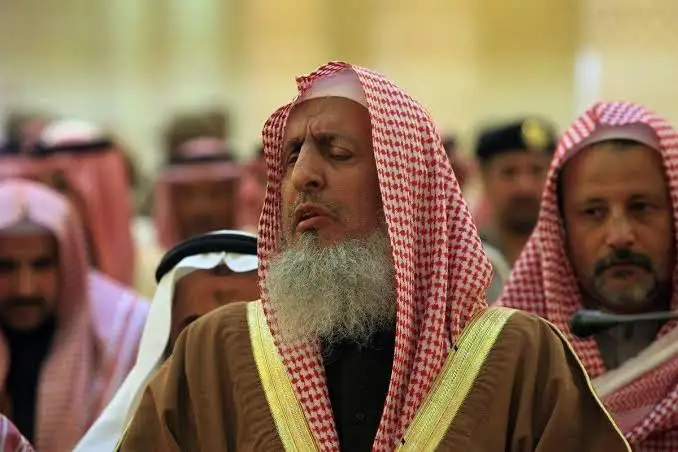
Saudi Arabia’s grand mufti, Sheikh Abdulaziz bin Abdullah al-Sheikh, who served as the kingdom’s top religious cleric for over 25 years, has died in Riyadh. He was 84. Funeral prayers were attended by Crown Prince Mohammed bin Salman, the kingdom’s de facto ruler. The funeral was held at the Imam Turki bin Abdullah Mosque in Riyadh.
As grand mufti since 1999, Sheikh Abdulaziz held one of the most influential religious roles in the Sunni Muslim world. Saudi Arabia, home to the holy cities of Mecca and Medina and the annual Hajj pilgrimage, has long tied state legitimacy to clerical authority under its strict Wahhabi interpretation of Islam.
Sheikh Abdulaziz’s role as grand mufti put him in the spotlight because of every Muslim’s goal of attending the annual Hajj pilgrimage required of all able-bodied Muslims once in their lives. The grand mufti’s words are carefully followed. (Related: take these steps and jump into the Green Prophet guide for a greener Hajj).
Blind from a young age, Sheikh Abdulaziz was appointed grand mufti by the House of Saud’s King Fahd. Fahd was King and Prime Minister of Saudi Arabia from 13 June 1982 until his death in 2005.
Sheikh Abdulaziz’s rulings reflected decades of Islamic ultraconservative thought, once condemning mobile phone cameras as a threat to morality and he compared chess to gambling. (This year the Taliban banned chess). He opposed women driving and described gender mixing as “evil and catastrophe” before later softening his stance as the state changed course. Saudi Arabia decided to let women drive in 2018.
At times, his comments provoked international backlash. In 2015, he reportedly told Kuwaiti officials it was “necessary to destroy all the churches of the region” in the Arabia peninsula— remarks his aides later attempted to downplay. He also issued sectarian statements against Shiite Muslims, particularly following Iran’s criticism of Saudi Arabia after the deadly 2015 Hajj stampede.
Luckily for the western world, and peaceful prospects in the region through the Abraham Accords, he condemned al-Qaida and the so-called Islamic State, calling them “enemy No. 1 of Islam.” After 9/11, when Saudi Arabia battled an al-Qaida insurgency within its own borders, he rejected militant jihad as “fake.” We should not forget that 15 of the 9/11 hijackers were from Saudi Arabia.
From Wahhabism to Vision 2030

Sheikh Abdulaziz’s career spanned a period of dramatic transformation under the House of Saud, a grand kingdom that rose from rules in mud castles. Once aligned tightly with the religious establishment, the monarchy gradually moved to curtail clerical power — especially under Saudi Arabia’s young visionary Crown Prince Mohammed bin Salman.
In 2018, under Crown Prince Mohammed bin Salman, Saudi Arabia ended the ban on women driving — a watershed reform that the grand mufti eventually supported.
The University of Novarra’s Naomi Moreno, pens a piece on Saudi reform saying it might be being more for optics than for real change within: “While some perceive the crown prince’s actions to be a genuine move towards reforming Saudi society, several indicators point to the possibility that MBS might have more practical reasons that are only tangentially related to progression for progression’s sake. As the thinking goes, such decrees may have less to do with genuine reform, and more to do with improving an international image to deflect from some of the kingdom’s more controversial practices, both at home and abroad. A number of factors drive this public scepticism.”
Mohammed bin Salman’s “Vision 2030” supervised by Sheikh Abdulaziz has also pushed massive economic liberalization, from Saudi Aramco’s controversial IPO to the multibillion-dollar mega-city NEOM. While any PR material put out by Saudi Arabia’s development companies, owned and operated by the House of Saud, tout sustainability objectives, no third party organizations or journalists can verify any claims.
Eco Branding or Environmental Boondoggle?
The grand mufti’s declining influence coincided with Saudi Arabia rebranding itself as a global hub for tourism and sustainability, no doubt advised to them by well-paid consultants and architects eager for multi-million, even billion dollar contracts. Ultra-luxury resorts are being marketed as eco-destinations across the Red Sea and virgin islands, even as construction threatens pristine habitats. See Shebara.

From coral reefs to fragile desert ecosystems, critics argue that these projects risk becoming environmental boondoggles — glossy green branding masking ecological disruption. The dynamic mirrors other regional tragedies, such as the controversial Qatari-backed resort development on Assomption Island near the Aldabra Atoll.
“Sheikh Abdulaziz served the faith and the nation with dedication,” the Saudi Royal Court said in its obituary statement. Yet his legacy remains contested: a staunch defender of Wahhabi orthodoxy who presided over a society that — under royal command — shifted toward liberalization, consumerism, and grand “eco” visions for the future.
As Saudi Arabia accelerates its transformation, the passing of its top cleric who memorized the Qu’ran at age 10 underscores the changing face of religious authority and perhaps tolerance in a kingdom increasingly defined by megaprojects, oil wealth, and the House of Saud’s push to rebrand itself for a post-oil world.