Whale watching tours find whales talking to people with strange bubble rings

This bubble ring was captured on video in 1988 in the Stellwagen Bank National Marine Sanctuary in Massachusetts. (© Dan Knaub, The Video Company)

Could bubble rings be the cetacean equivalent of a wave and a smile?

A new study suggests that humpback whales (Megaptera novaeangliae) might be trying to communicate with humans –- or aliens? –– through a behavior that’s both beautiful and baffling: perfectly circular bubble rings, deliberately blown near boats and swimmers. The finding comes from researchers at WhaleSETI, a project inspired by the search for extraterrestrial intelligence (SETI), only this time, the “aliens” are right here in our oceans.

In 12 documented encounters across the globe, individual humpbacks were observed creating bubble rings only in the presence of humans—never when monitored by drones or distant cameras. These were not the messy bursts of bubble-net feeding, but rather tight, precise rings—deliberate and controlled.

“We’ve now located a dozen whales from populations around the world, the majority of which have voluntarily approached boats and swimmers blowing bubble rings,” said marine wildlife photographer and study co-author Jodi Frediani.
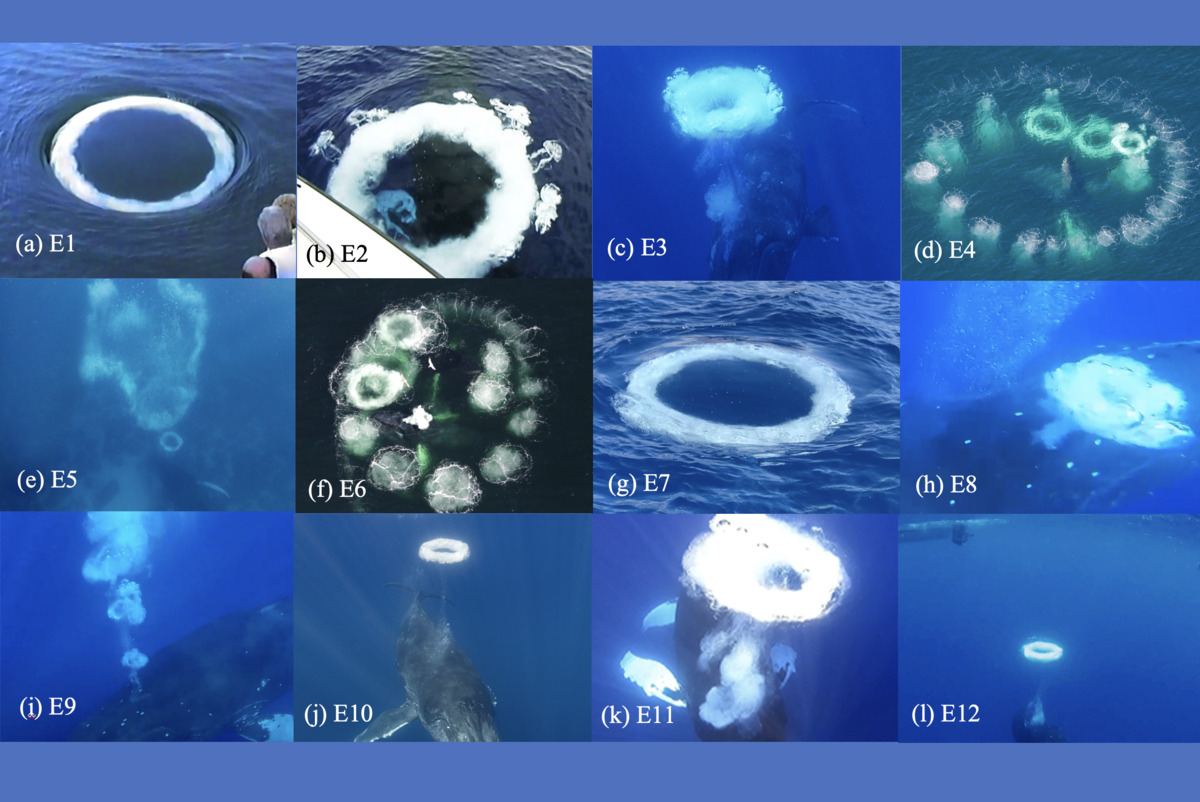
Composite image of at least one bubble ring from each episode. Photo attributions: (a) D. Knaub, (b) F. Nicklen, (c) D. Perrine, (d) W. Davis, (e) G. Flipse, (f) A. Henry, (g) M. Gaughan, (h) H. Romanchik, (i) D. Patton, (j) D. Perrine, (k) S. Istrup, (l) S. Hilbourne.

In other words: they saw us, they swam toward us, and they made bubbles—in what can only be described as a strangely charming act of interspecies improv.

The WhaleSETI project, headed by scientists with backgrounds in linguistics, animal behavior, and astrobiology, aims to study non-human intelligence with the same tools we use to prepare for contact with extraterrestrials. If we can’t talk to whales—who evolved on the same planet—how do we ever expect to chat with space-faring civilizations?

And what better place to start than with one of the most acoustically gifted and socially complex animals on Earth? Or consider, maybe aliens are speaking with whales and not us?

“Because of current limitations on technology, an important assumption of the search for extraterrestrial intelligence is that extraterrestrials will be interested in making contact and so target human receivers. This important assumption is certainly supported by the behavior of humpback whales,” said Dr. Laurance Doyle of the SETI Institute, a coauthor on the paper.

Importantly, the whales in these cases were not stressed. They showed no signs of aggression or alarm. Instead, the encounters were marked by calm, curious approaches, often followed by the bubble display and, in some cases, eye contact.

This behavior suggests a kind of social play or signaling, and while it’s not yet clear what bubble rings mean in whale culture (a “hello”? a “back off”? an invitation to dance?), their exclusive appearance in human company has researchers wondering: Is this their way of saying hi?

Bubble ring communication isn’t just cute—it raises questions about how we define intelligence and connection. In the search for life beyond Earth, SETI has long looked for intentional signals. WhaleSETI flips that search around: what if a highly intelligent species has already been trying to talk to us, but we didn’t recognize the signs?

As with all science, caution is warranted. The sample size is small. The interpretations are early. And whales have been sinking boats in the Mediterranean Sea. Maybe we should start listening.

___

The team’s findings were recently published in Marine Mammal Science in a paper titled “Humpback Whales Blow Poloidal Vortex Bubble Rings.” The study analyzes 12 bubble ring–production episodes involving 39 rings made by 11 individual whales.

Similar to studying Antarctica or other terrestrial analogs as a proxy for Mars, the Whale-SETI team is studying intelligent, non-terrestrial (aquatic), nonhuman communication systems to develop filters that aid in parsing cosmic signals for signs of extraterrestrial life. As noted by Karen Pryor, “patterns of bubble production in cetaceans constitute a mode of communication not available to terrestrial mammals” (Pryor 1990).

Other team members and coauthors of the paper are Dr. Josephine Hubbard (Postdoc, U.C. Davis), Doug Perrine (Doug Perrine Photography), Simon Hilbourne (Marine Research Facility, Jeddah, Saudi Arabia), Dr. Joy Reidenberg (Icahn School of Medicine at Mount Sinai, NY) and Dr. Brenda McCowan, ( U.C. Davis, Veterinary Medicine), with specialties in animal intelligences, photography and behavior of humpback whales, whale anatomy, and the use of AI in parsing animal communication, respectively.

An earlier paper by the team was published in the journal, PeerJ, entitled, “Interactive Bioacoustic Playback as a Tool for Detecting and Exploring Nonhuman Intelligence: “Conversing” with an Alaskan Humpback Whale.” The authors would like to acknowledge the Templeton Foundation Diverse Intelligences Program for financial support of this work.

For more information, visit WhaleSETI.

LEAVE A REPLY

Please enter your comment!
Please enter your name here

TRENDING

Astro uses AI to help procure land for renewable energy

For oil-rich, environmentally vigilant Gulf states, Astro isn’t just another startup story. It is a blueprint for accelerating an energy transition that is now existential, not optional.

The Science Behind How Elite Marathon Runners Train

Discover the science behind elite marathon training. Explore techniques, nutrition, and mental strategies that propel top runners to success.

Earth building with Dead Sea salt bricks

Researchers develop a brick made largely from recycled Dead Sea salt—offering a potential alternative to carbon-intensive cement.

The Christ’s thorn (sidr tree) is also a well-known folk medicine

Christ’s thorn jujube (Ziziphus spina-christi) also known as the sidr tree is a real, identifiable tree native to the Middle East, and it appears—directly or indirectly—in Islam, Judaism, and later Christian tradition. The connections between the three faiths are not theological agreements but overlapping uses, names, and symbolic associations rooted in the same landscape.

Farm To Table Israel Connects People To The Land

Farm To Table Israel is transforming the traditional dining experience into a hands-on journey.

Qatar’s climate hypocrisy rides the London Underground

Qatar remains a master of doublethink—burning gas by the megaton while selling “sustainability” to a world desperate for clean air. Wake up from your slumber people.

How Quality of Hire Shapes Modern Recruitment

A 2024 survey by Deloitte found that 76% of talent leaders now consider long-term retention and workforce contribution among their most important hiring success metrics—far surpassing time-to-fill or cost-per-hire. As the expectations for new hires deepen, companies must also confront the inherent challenges in redefining and accurately measuring hiring quality.

8 Team-Building Exercises to Start the Week Off 

Team building to change the world! The best renewable energy companies are ones that function.

Thank you, LinkedIn — and what your Jobs on the Rise report means for sustainable careers

While “green jobs” aren’t always labeled as such, many of the fastest-growing roles are directly enabling the energy transition, climate resilience, and lower-carbon systems: Number one on their list is Artificial Intelligence engineers. But what does that mean? Vibe coding Claude? 

Somali pirates steal oil tankers

The pirates often stage their heists out of Somalia, a lawless country, with a weak central government that is grappling with a violent Islamist insurgency. Using speedboats that swarm the targets, the machine-gun-toting pirates take control of merchant ships and then hold the vessels, crew and cargo for ransom.

Leopoldo Alejandro Betancourt López Turned Ocean Plastic Into Profitable Sunglasses

Few fashion accessories carry the environmental burden of sunglasses. Most frames are constructed from petroleum-based plastics and acrylic polymers that linger in landfills for centuries, shedding microplastics into soil and waterways long after they've been discarded. Leopoldo Alejandro Betancourt López, president of the Spanish eyewear brand Hawkers, saw this problem differently than most industry executives.

Why Dr. Tony Jacob Sees Texas Business Egos as Warning Signs

Everything's bigger in Texas. Except business egos.  Dr. Tony Jacob figured...

Israel and America Sign Renewable Energy Cooperation Deal

Other announcements made at the conference include the Timna Renewable Energy Park, which will be a center for R&D, and the AORA Solar Thermal Module at Kibbutz Samar, the world's first commercial hybrid solar gas-turbine power plant that is already nearing completion. Solel Solar Systems announced it was beginning construction of a 50 MW solar field in Lebrija, Spain, and Brightsource Energy made a pre-conference announcement that it had inked the world's largest solar deal to date with Southern California Edison (SCE).

Related Articles

Popular Categories