Palau: The place, the pledge, the legends

Image via Getty Images/Pew Charitable Trusts.

It had been hundreds of years since a non-motorized vessel had traveled such a distance, guided only by the stars. Last weekend, a historic 18-day double-hulled canoe voyage was completed from the archipelago of Palau to Orchid Island, a remote feature in southeastern Taiwan.

The GPS-free team of eleven was led by Sesario Sewralur, who inherited the love of sailing from his father, legendary navigator Mau Piailug. The journey was co-sponsored by the Taitung County Government and the Micronesian Voyaging Society, as a cross-cultural exchange to honor shared regional conservation values and seafaring techniques.

Image retrieved from Taipei Times.

In Palau, living in harmony with the environment is at society’s core. The customary practice of bul empowers the Council of Chiefs, Palau’s highest-ranking group of traditional leaders, to place and maintain moratoriums on the harvest of natural resources to prevent overconsumption. Local fishing is generally prohibited based on these measures.

The island nation established the world’s first shark sanctuary in 2009. In 2015, it designated 80 percent of its waters as a national marine sanctuary. Earth Day is expanded to the entire month of April.

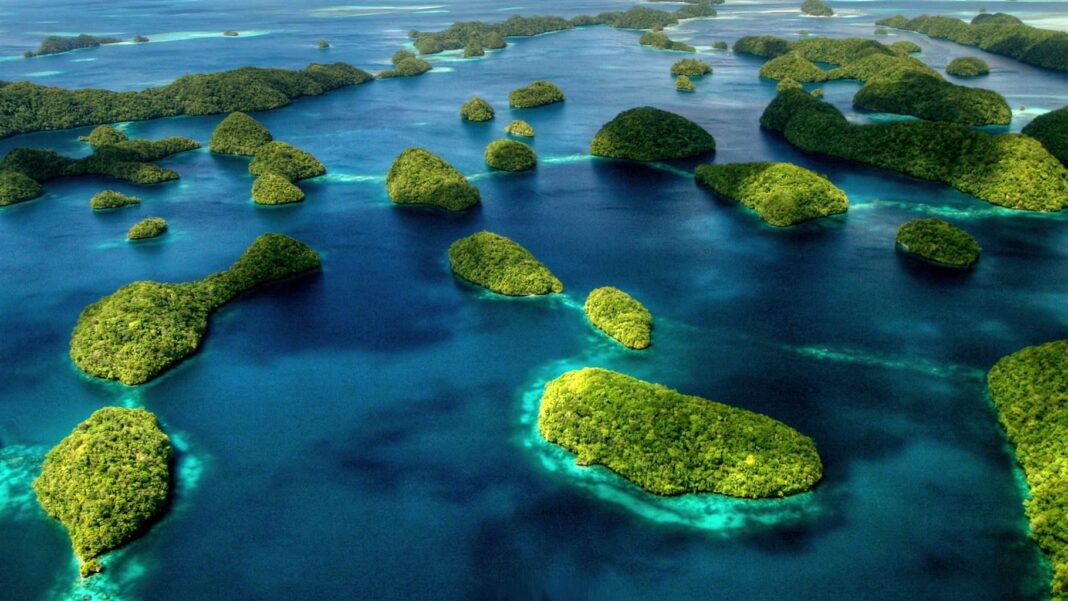
While Palau is known for its lush land and seascapes, impressive biodiversity lies in particular within marine ecosystems. A paradise for snorkelers and divers, Palau is home to some of the Indo-Pacific’s most thriving reefs, which constitute one of the “seven underwater wonders of the world.” Now say that five times fast.
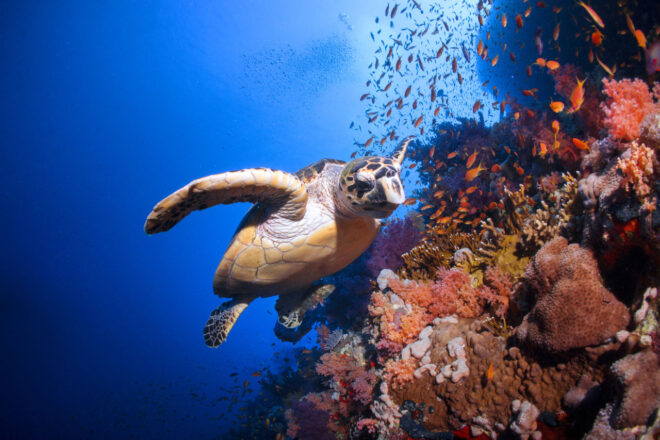
Image retrieved from Great Barrier Reef Foundation.

Palau is a prime tropical destination—but it’s just about in the middle of nowhere. Widespread sustainability efforts aim to offset the carbon footprint intensified by tourism. Many eco-tourism experiences involve nature excursions and one-of-a-kind experiences drawing on traditional knowledge and practices in such realms as culinary arts or handicrafts.

For visitors to Palau looking to gamify their stay in-country, Ol’au Palau is an app rewarding environmental stewardship with special access to local heritage sites. Though the transaction happens on a screen, it promotes on-site engagement for fuller meaning-making.

As of 2017, Palau also requires visitors to sign the Palau Pledge, a code of conduct stamped into their passports at international arrivals. Entry into the country hinges on signing on the line, promising to the Children of Palau to exercise awareness and shared responsibility for Palau’s ecological and cultural preservation.
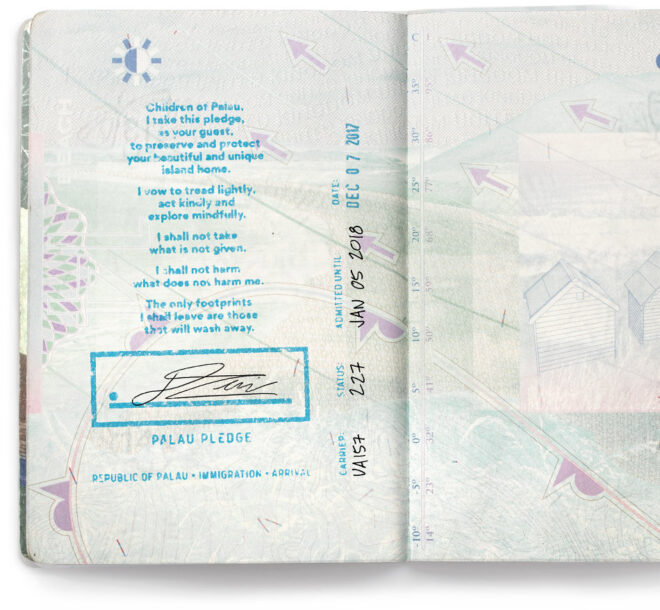
Image retrieved from Palau Pledge website.

The Palau Pledge goes like this:

“Children of Palau, I take this pledge, as your guest,

To preserve and protect your beautiful and unique island home.

I vow to treat lightly, act kindly and explore mindfully.

I shall not take what is not given.

I shall not harm what does not harm me.

The only footprints I shall leave are those that will wash away.”

According to Palauan legend, a two-headed eel grew with one head on either side of a rock, each unaware of the other. The snakes starved as they pulled each other to go after prey, before realizing they were linked. Only then did they put their heads together, working together to thrive.

We are already aware we are linked. Palau may be one of the most isolated countries on earth, but we are all connected by the waters which lap at its shores.

The Palau Pledge is a refreshingly humanitarian immigration policy, inspiring us to respect and protect our surroundings both near and far. Should other countries follow Palau’s lead?


Kelly Milone
Kelly Milonehttp://www.greenprophet.com
Kelly Milone holds an MA in cultural heritage management (Johns Hopkins University), BA in anthropology, BFA in dance and Arabic minor (Montclair State University). She is a dance teacher and choreographer, quick-study interior designer, and aspiring creative and travel writer.

TRENDING

Want to speak “dolphin”?

While Is Anyone Listening? may not satisfy those looking for hard statistics, it’s a compelling read for anyone interested in the intersection of science, philosophy, and animal behavior. Herzing’s voice—at once personal, precise, and probing—asks us not just to decode dolphin sounds but to consider our role as co-inhabitants of a shared, noisy planet.

Meet Andreas Weil, the founder of Israel’s EcoOcean, protecting the seas for all

A feature article interviewing Israel's leading marine conservationist, Andreas Weil. He founded EcoOcean and has enabled hundreds of thousands of people to learn about the ecological aspects of marine conservation. He also brought the concept of Blue Flag beaches to Israel.

They Call Her Madam Torti. She Might Be the Only One Who Can Save Seychelles Turtles

Sea turtle expert Dr. Jeanne Mortimer warns that unchecked development on Assomption Island threatens Seychelles' most critical nesting beach. With over four decades of research, Mortimer advocates for science-based, turtle-friendly development to protect endangered species. Her quiet, persistent work underscores the urgent need for conservation-led planning in fragile island ecosystems.

Yaniv Levy’s Lifelong Quest to Protect Sea Turtles in a Time of War and Greed

This is the story of Dr. Yaniv Levy, founder of Israel’s Sea Turtle Rescue Center—the world’s only government-supported turtle hospital and breeding center unlike any in the world. But to understand why his work matters, you have to go back nearly 30 years, to another coastline altogether: Aldabra Atoll, part of the Seychelles, one of the last untouched Edens left on Earth.

The Rising Threat of Woven Plastic Sacks to Eastern Mediterranean Sea Turtles

The study urges international regulation on maritime waste, especially from livestock carriers. The team tracked suspect ships using Automatic Identification Systems (AIS), identifying several that sail regularly through Israeli waters but do not dock—making legal accountability difficult. There is a natural current that causes plastic sacks tossed illegally off the ship into the sea, to end up on the Levantine shores where they entangle juvenile turtles. Some plastics are believed to be dumped close to show where they blow into the sea. 

Turning Your Energy Consultancy into an LLC: 4 Legal Steps for Founders in Texas

If you are starting a renewable energy business in Texas, learn how to start an LLC by the books.

Tracking the Impacts of a Hydroelectric Dam Along the Tigris River

For the next two months, I'll be taking a break from my usual Green Prophet posts to report on a transnational environmental issue: the Ilısu Dam currently under construction in Turkey, and the ways it will transform life along the Tigris River.

6 Payment Processors With the Fastest Onboarding for SMBs

Get your SMB up and running fast with these 6 payment processors. Compare the quickest onboarding options to start accepting customer payments without delay.

Qatar’s climate hypocrisy rides the London Underground

Qatar remains a master of doublethink—burning gas by the megaton while selling “sustainability” to a world desperate for clean air. Wake up from your slumber people.

How Quality of Hire Shapes Modern Recruitment

A 2024 survey by Deloitte found that 76% of talent leaders now consider long-term retention and workforce contribution among their most important hiring success metrics—far surpassing time-to-fill or cost-per-hire. As the expectations for new hires deepen, companies must also confront the inherent challenges in redefining and accurately measuring hiring quality.

8 Team-Building Exercises to Start the Week Off 

Team building to change the world! The best renewable energy companies are ones that function.

Thank you, LinkedIn — and what your Jobs on the Rise report means for sustainable careers

While “green jobs” aren’t always labeled as such, many of the fastest-growing roles are directly enabling the energy transition, climate resilience, and lower-carbon systems: Number one on their list is Artificial Intelligence engineers. But what does that mean? Vibe coding Claude? 

Somali pirates steal oil tankers

The pirates often stage their heists out of Somalia, a lawless country, with a weak central government that is grappling with a violent Islamist insurgency. Using speedboats that swarm the targets, the machine-gun-toting pirates take control of merchant ships and then hold the vessels, crew and cargo for ransom.

Related Articles

Popular Categories