These desalination membranes mean less waste

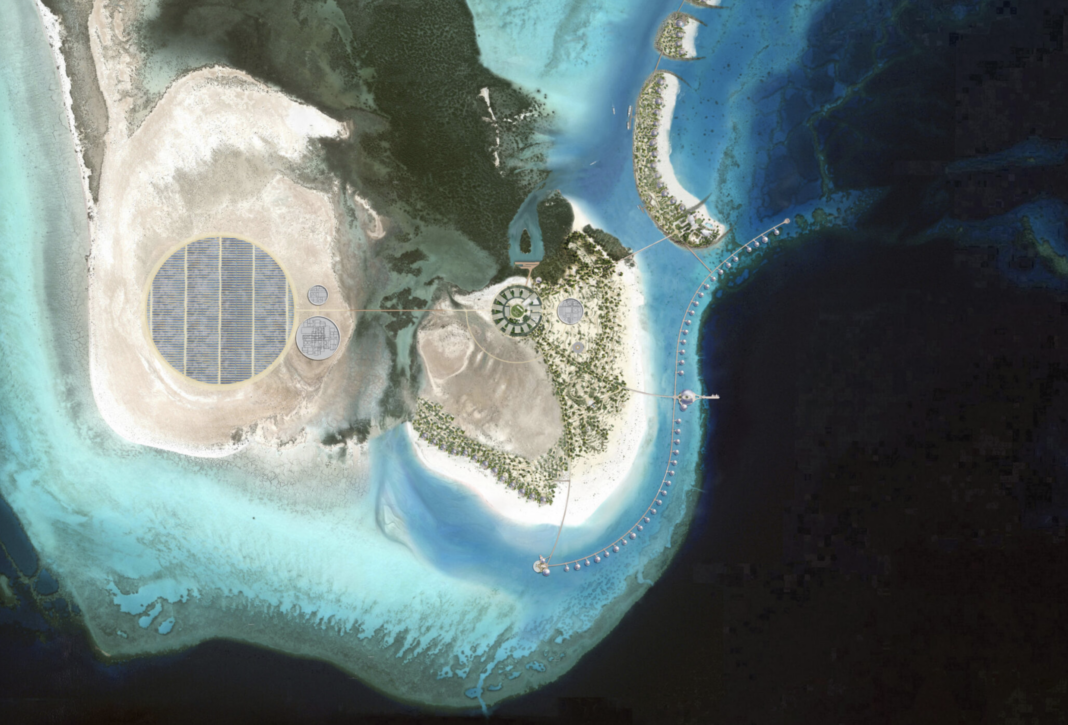
Desalination and power plant powered by the sun
Desalination and power plant powered by the sun in Shebara, Saudi Arabia

Desalination plants, a major and growing source of freshwater in dry regions, could produce less harmful waste using electricity and new membranes made at the University of Michigan.The membranes could help desalination plants minimize or eliminate brine waste produced as a byproduct of turning seawater into drinking water. Today, liquid brine waste is stored in ponds until the water evaporates, leaving behind solid salt or a concentrated brine that can be further processed. But brine needs time to evaporate, providing ample opportunities to contaminate groundwater.

Space is also an issue. For every liter of drinking water produced at the typical desalination plant, 1.5 liters of brine are produced. Over 37 billion gallons of brine waste is produced globally every dayaccording to a UN study. When space for evaporation ponds is lacking, desalination plants inject the brine underground or dump it into the ocean. Rising salt levels near desalination plants can harm marine ecosystems.

“There’s a big push in the desalination industry for a better solution,” said Jovan Kamcev, U-M assistant professor of chemical engineering and the corresponding author of the study published today in Nature Chemical Engineering. “Our technology could help desalination plants be more sustainable by reducing waste while using less energy.”

To eliminate brine waste, desalination engineers would like to concentrate the salt such that it can be easily crystallized in industrial vats rather than ponds that can occupy over a hundred acres. The separated water could be used for drinking or agriculture, while the solid salt could then be harvested for useful products. Seawater not only contains sodium chloride—or table salt—but valuable metals such as lithium for batteries, magnesium for lightweight alloys and potassium for fertilizer.

Desalination plants can concentrate brines by heating and evaporating the water, which is very energy intensive, or with reverse osmosis, which only works at relatively low salinity. Electrodialysis is a promising alternative because it works at high salt concentrations and requires relatively little energy. The process uses electricity to concentrate salt, which exists in water as charged atoms and molecules called ions.

Here’s how the process works. Water flows into many channels separated by membranes, and each membrane has the opposite electrical charge of its neighbors. The entire stream is flanked by a pair of electrodes. The positive salt ions move toward the negatively charged electrode, and are stopped by a positively charged membrane. Negative ions move toward the positive electrode, stopped by a negative membrane. This creates two types of channels—one that both positive and negative ions leave and another that the ions enter, resulting in streams of purified water and concentrated brine.

But, electrodialysis has its own salinity limits. As the salt concentrations rise, ions start to leak through electrodialysis membranes. While leak-resistant membranes exist on the market, they tend to transport ions too slowly, making the power requirements impractical for brines more than six times saltier than average seawater.

The researchers overcome this limit by packing a record number of charged molecules into the membrane, increasing their ion-repelling power and their conductivity—meaning they can move more salt with less power. With their chemistry, the researchers can produce membranes that are ten times more conductive than relatively leak-proof membranes on the market today.

The dense charge ordinarily attracts a lot of water molecules, which limits how much charge can fit in conventional electrodialysis membranes. The membranes swell as they absorb water, and the charge is diluted. In the new membranes, connectors made of carbon prevent swelling by locking the charged molecules together.

The level of restriction can be changed to control the leakiness and the conductivity of the membranesAllowing some level of leakiness can push the conductivity beyond today’s commercially available membranes. The researchers hope the membrane’s customizability will help it take off.”Each membrane isn’t fit for every purpose, but our study demonstrates a broad range of choices,” said David Kitto, a postdoctoral fellow in chemical engineering and the study’s first author. “Water is such an important resource, so it would be amazing to help to make desalination a sustainable solution to our global water crisis.”


LEAVE A REPLY

Please enter your comment!
Please enter your name here

TRENDING

Astro uses AI to help procure land for renewable energy

For oil-rich, environmentally vigilant Gulf states, Astro isn’t just another startup story. It is a blueprint for accelerating an energy transition that is now existential, not optional.

Thank you, LinkedIn — and what your Jobs on the Rise report means for sustainable careers

While “green jobs” aren’t always labeled as such, many of the fastest-growing roles are directly enabling the energy transition, climate resilience, and lower-carbon systems: Number one on their list is Artificial Intelligence engineers. But what does that mean? Vibe coding Claude? 

10 Proven Israeli Technologies to Help Somaliland Build Food, Water, and Energy Security

Israel’s water and agricultural technologies didn’t emerge from ideal conditions. They were developed under pressure: low rainfall, saline water, political isolation, lack of energy resources, and the constant need to feed a growing population with limited land. Over the years, I’ve written about many of these companies not as miracle-makers, but as problem-solvers. That’s what makes them relevant to places like Somaliland. Israel was the first country in the world to recognize Somaliland as an independent state although Ethiopia has been treating the nation as such for decades.

Sink holes from over-watering farmers’ fields

Sinkholes are rapidly appearing in Turkey’s central Anatolian farming region, particularly around Konya and Karapınar. These giant gaping holes in the ground in areas of farmland, known locally as obruk, are not random geological events. They are linked to prolonged drought, climate-driven heat stress, and heavy groundwater extraction for agriculture in one of the country’s most important breadbaskets.

Oil pollution in Basrah’s soil is 1,200% higher than it should be

Soil pollution levels in parts of Basra are 1,200% to 3,300% higher than those typically measured in cities like Toronto or New York, according to new comparative soil data. It's getting into water.

Qatar’s climate hypocrisy rides the London Underground

Qatar remains a master of doublethink—burning gas by the megaton while selling “sustainability” to a world desperate for clean air. Wake up from your slumber people.

How Quality of Hire Shapes Modern Recruitment

A 2024 survey by Deloitte found that 76% of talent leaders now consider long-term retention and workforce contribution among their most important hiring success metrics—far surpassing time-to-fill or cost-per-hire. As the expectations for new hires deepen, companies must also confront the inherent challenges in redefining and accurately measuring hiring quality.

8 Team-Building Exercises to Start the Week Off 

Team building to change the world! The best renewable energy companies are ones that function.

Thank you, LinkedIn — and what your Jobs on the Rise report means for sustainable careers

While “green jobs” aren’t always labeled as such, many of the fastest-growing roles are directly enabling the energy transition, climate resilience, and lower-carbon systems: Number one on their list is Artificial Intelligence engineers. But what does that mean? Vibe coding Claude? 

Somali pirates steal oil tankers

The pirates often stage their heists out of Somalia, a lawless country, with a weak central government that is grappling with a violent Islamist insurgency. Using speedboats that swarm the targets, the machine-gun-toting pirates take control of merchant ships and then hold the vessels, crew and cargo for ransom.

Leopoldo Alejandro Betancourt López Turned Ocean Plastic Into Profitable Sunglasses

Few fashion accessories carry the environmental burden of sunglasses. Most frames are constructed from petroleum-based plastics and acrylic polymers that linger in landfills for centuries, shedding microplastics into soil and waterways long after they've been discarded. Leopoldo Alejandro Betancourt López, president of the Spanish eyewear brand Hawkers, saw this problem differently than most industry executives.

Why Dr. Tony Jacob Sees Texas Business Egos as Warning Signs

Everything's bigger in Texas. Except business egos.  Dr. Tony Jacob figured...

Israel and America Sign Renewable Energy Cooperation Deal

Other announcements made at the conference include the Timna Renewable Energy Park, which will be a center for R&D, and the AORA Solar Thermal Module at Kibbutz Samar, the world's first commercial hybrid solar gas-turbine power plant that is already nearing completion. Solel Solar Systems announced it was beginning construction of a 50 MW solar field in Lebrija, Spain, and Brightsource Energy made a pre-conference announcement that it had inked the world's largest solar deal to date with Southern California Edison (SCE).

Related Articles

Popular Categories