
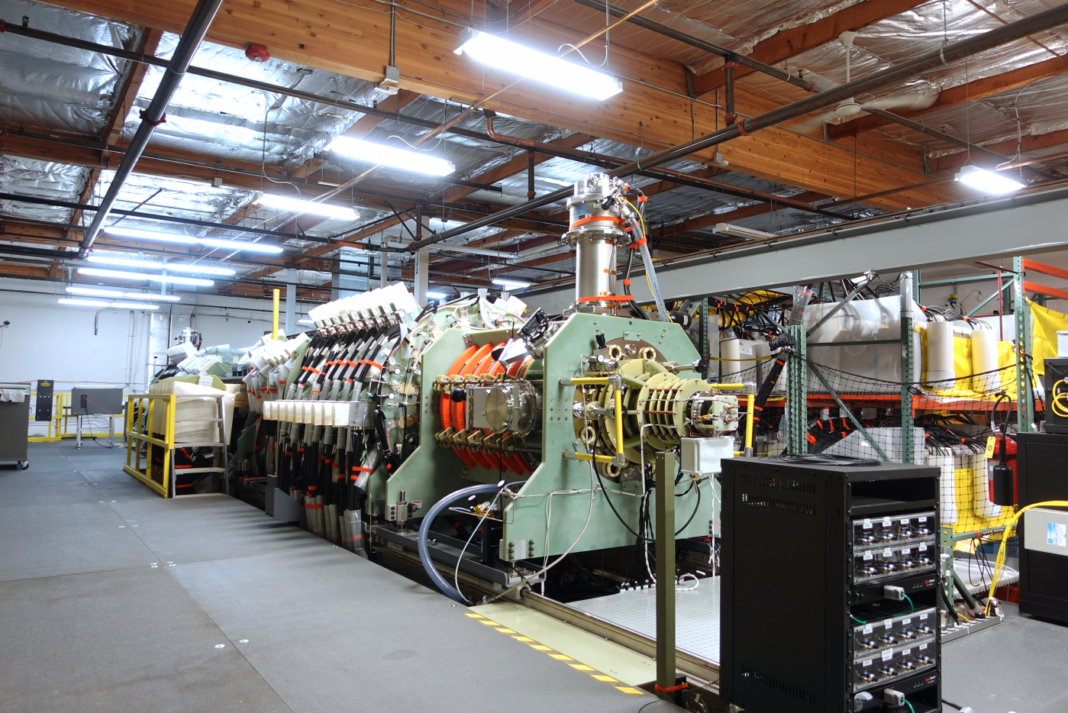
Helion Energy, AI, and the New Cold Fusion War With China

Helion Energy, Inc. is an American fusion research company, located in Everett, Washington. They are developing a magneto-inertial fusion technology to produce helium-3 and fusion power via aneutronic fusion, which could produce low-cost clean electric energy using a fuel that can be derived exclusively from water.
Helion Energy

In the quiet suburbs of Everett, Washington, a small private company is building what could be the most important machine on Earth. Its name is Helion Energy. Its mission? Nothing less than bottling a star—and lighting up our future—clean, limitless, and faster than China.

Helion is developing a magneto-inertial fusion technology to produce helium-3 and fusion power via aneutronic fusion, which could produce low-cost clean electric energy using a fuel that can be derived exclusively from water. Green Prophet’s Brian writes here: What is fusion and why is it so hard?

While the world scrolls TikTok and argues about AI doom scenarios, a real technological arms race is unfolding: Who will master fusion energy first—and rewrite the next century’s economic and political order? If Helion succeeds in its mission it might also put terrorists out of business.

Helion Energy thinks they have the answer. And they have AI on their side.

Fusion at the Speed of Algorithms

Helion Energy, Inc. is an American fusion research company, located in Everett, Washington. They are developing a magneto-inertial fusion technology to produce helium-3 and fusion power via aneutronic fusion, which could produce low-cost clean electric energy using a fuel that can be derived exclusively from water.
A Helion reactor

Unlike mega-government projects like Europe’s ITER, which has been famously “30 years away” for 30 years, Helion is running on Silicon Valley speed. Their weapon of choice is magneto-inertial fusion, squeezing plasma with magnetic fields instead of building reactors the size of cathedrals. Here’s where AI comes in.

Helion’s plasma accelerators generate a storm of complex data—magnetic fields, particle velocities, temperatures over 100 million degrees. Too much for any team of humans to control in real-time.

Instead, Helion uses machine learning to tweak and optimize reactor operations pulse-by-pulse. Every shot teaches the system something new: how to better confine the plasma, adjust the magnetic fields, prevent instabilities, and reach the holy grail of energy gain—producing more energy than it consumes. In 2021 cleantech blog Canary Media asked if VCs were throwing $500 million at science fiction. Let’s see who has the last laugh.

Without AI, we’d still be waiting for fusion in 2080?

With AI, Helion is betting on delivering grid-ready fusion electricity as soon as 2028, through a historic deal signed with Microsoft. If they succeed, it would mark the first time in history that humanity pulls useful electricity directly from fusion reactions—the same reactions that power our sun.

The Real Race: Helion vs. China

But it’s not just a scientific experiment. It’s a race—and the finish line could define the balance of world power for centuries. China’s state-backed fusion programs, like the EAST “artificial sun” project, are pushing hard, using their own AI systems to optimize plasma confinement. Their fusion reactors are holding plasma steady for record-breaking periods, and they aren’t slowing down.
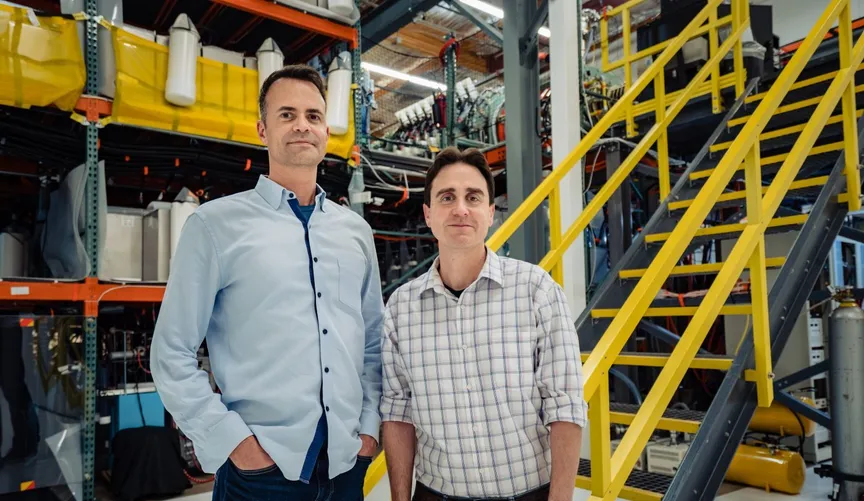
Helion co-founders Chris Pihl and David Kirtley (Helion)

In a recent warning, former U.S. Treasury Secretary Hank Paulson said that leadership in clean energy—including fusion—will define who leads global economies, militaries, and industries in the 21st century. Like the Ukraine and Russian war upended the world –– and it was over energy imbalance –– whoever wins fusion will no longer be dependent on fossil fuels—and will hold the power to cripple rivals who still are.

Oil Powers Beware: Qatar, Saudi Arabia, and Iran on Notice

If fusion becomes cheap and reliable, it will collapse the global demand for oil and gas. All these mega projects and oil-funded terrorist activities in Iran, in Yemen, in Syria and in Lebanon, will end. Saudi Arabia is signing the Abraham Accords with Israel to join the wave of the west and the United Arab Emirates is already there. Oil nations know that the demand for oil is temporary. A giant shift in energy acquisition will change the game for good.

Terror groups that thrive on petrodollar-funded instability—from Hezbollah to ISIS and beyond—would find their cash flow cut off. Countries that are developing on nations without restraint (read our latest on the Seychelles and Qatar) will be cut off from the flow of funds and wealth. Without oil as leverage, authoritarian regimes built on energy riches would face either collapse—or painful transformation. We see that Saudi Arabia is opening up to the world in archaeology, development, tourism. And this will protect its survival of a nation.

In simple words if fusion energy works, is not just about lighting up your house. It’s about turning off the money tap that funds wars, terrorism, and dictatorship.

Helion’s Big Bet

Helion’s model plays to America’s old strength: innovation through agility, not top-down megaprojects. Instead of waiting for 2050, Helion’s compact reactors aim to deliver electricity in a matter of years—and not just for cities, but for data centers, isolated industries, military bases, even disaster zones. Their current prototype, Polaris, is scheduled to fire in 2025. If Helion succeeds, it won’t just disrupt global energy. It could redraw the world map.


Karin Kloosterman
Karin Kloostermanhttp://www.greenprophet.com
Karin Kloosterman is an award-winning journalist, innovation strategist, and founder of Green Prophet, one of the Middle East’s pioneering sustainability platforms. She has ranked in the Top 10 of Verizon innovation competitions, participated in NASA-linked challenges, and spoken worldwide on climate, food security, and future resilience. With an IoT technology patent, features in Canada’s National Post, and leadership inside teams building next-generation agricultural and planetary systems — including Mars-farming concepts — Karin operates at the intersection of storytelling, science, and systems change. She doesn’t report on the future – she helps design it. Reach out directly to [email protected]

LEAVE A REPLY

Please enter your comment!
Please enter your name here

TRENDING

Astro uses AI to help procure land for renewable energy

For oil-rich, environmentally vigilant Gulf states, Astro isn’t just another startup story. It is a blueprint for accelerating an energy transition that is now existential, not optional.

China is one step closer to making artificial sun

Nuclear fusion is often described as the holy grail of clean energy: a process that could one day provide abundant power without carbon emissions or long-lived radioactive waste. It has so much promise, but it's difficult. This article on fusion explains why. But turning fusion into a practical energy source depends on solving a set of extremely difficult physics problems. One of the most important is how to keep plasma — a super-hot, electrically charged gas — dense, stable, and confined long enough to produce useful energy.

EU Ports Still Power Russia’s Arctic Gas Exports Despite Phase-Out Pledge

The findings suggest that rather than declining, Europe’s reliance on Yamal LNG intensified in 2025. Yamal cargoes accounted for 14.3% of the EU’s total LNG imports, equivalent to roughly one in every seven LNG ships arriving at European terminals.The findings suggest that rather than declining, Europe’s reliance on Yamal LNG intensified in 2025. Yamal cargoes accounted for 14.3% of the EU’s total LNG imports, equivalent to roughly one in every seven LNG ships arriving at European terminals.

Global Emissions Keep Rising, But Scientists Say Peak is in Sight

At COP30 in Belém, Brazil, scientists delivered another stark...

FireDome’s AI eyes the flames and catapults eco-flame retardants to save forests, homes and factories

FireDome’s platform defines what it calls Wildfire Resilience-as-a-Service (RaaS) — a new model that merges detection, decision-making, and suppression into one holistic defense system for communities, utilities, vineyards, and resorts living with wildfire risk.

Qatar’s climate hypocrisy rides the London Underground

Qatar remains a master of doublethink—burning gas by the megaton while selling “sustainability” to a world desperate for clean air. Wake up from your slumber people.

How Quality of Hire Shapes Modern Recruitment

A 2024 survey by Deloitte found that 76% of talent leaders now consider long-term retention and workforce contribution among their most important hiring success metrics—far surpassing time-to-fill or cost-per-hire. As the expectations for new hires deepen, companies must also confront the inherent challenges in redefining and accurately measuring hiring quality.

8 Team-Building Exercises to Start the Week Off 

Team building to change the world! The best renewable energy companies are ones that function.

Thank you, LinkedIn — and what your Jobs on the Rise report means for sustainable careers

While “green jobs” aren’t always labeled as such, many of the fastest-growing roles are directly enabling the energy transition, climate resilience, and lower-carbon systems: Number one on their list is Artificial Intelligence engineers. But what does that mean? Vibe coding Claude? 

Somali pirates steal oil tankers

The pirates often stage their heists out of Somalia, a lawless country, with a weak central government that is grappling with a violent Islamist insurgency. Using speedboats that swarm the targets, the machine-gun-toting pirates take control of merchant ships and then hold the vessels, crew and cargo for ransom.

Leopoldo Alejandro Betancourt López Turned Ocean Plastic Into Profitable Sunglasses

Few fashion accessories carry the environmental burden of sunglasses. Most frames are constructed from petroleum-based plastics and acrylic polymers that linger in landfills for centuries, shedding microplastics into soil and waterways long after they've been discarded. Leopoldo Alejandro Betancourt López, president of the Spanish eyewear brand Hawkers, saw this problem differently than most industry executives.

Why Dr. Tony Jacob Sees Texas Business Egos as Warning Signs

Everything's bigger in Texas. Except business egos.  Dr. Tony Jacob figured...

Israel and America Sign Renewable Energy Cooperation Deal

Other announcements made at the conference include the Timna Renewable Energy Park, which will be a center for R&D, and the AORA Solar Thermal Module at Kibbutz Samar, the world's first commercial hybrid solar gas-turbine power plant that is already nearing completion. Solel Solar Systems announced it was beginning construction of a 50 MW solar field in Lebrija, Spain, and Brightsource Energy made a pre-conference announcement that it had inked the world's largest solar deal to date with Southern California Edison (SCE).

Related Articles

Popular Categories