Using drones to know if whales are pregnant

killer whales seen pregnant by drones
Drones detect pregnancy in killer whales

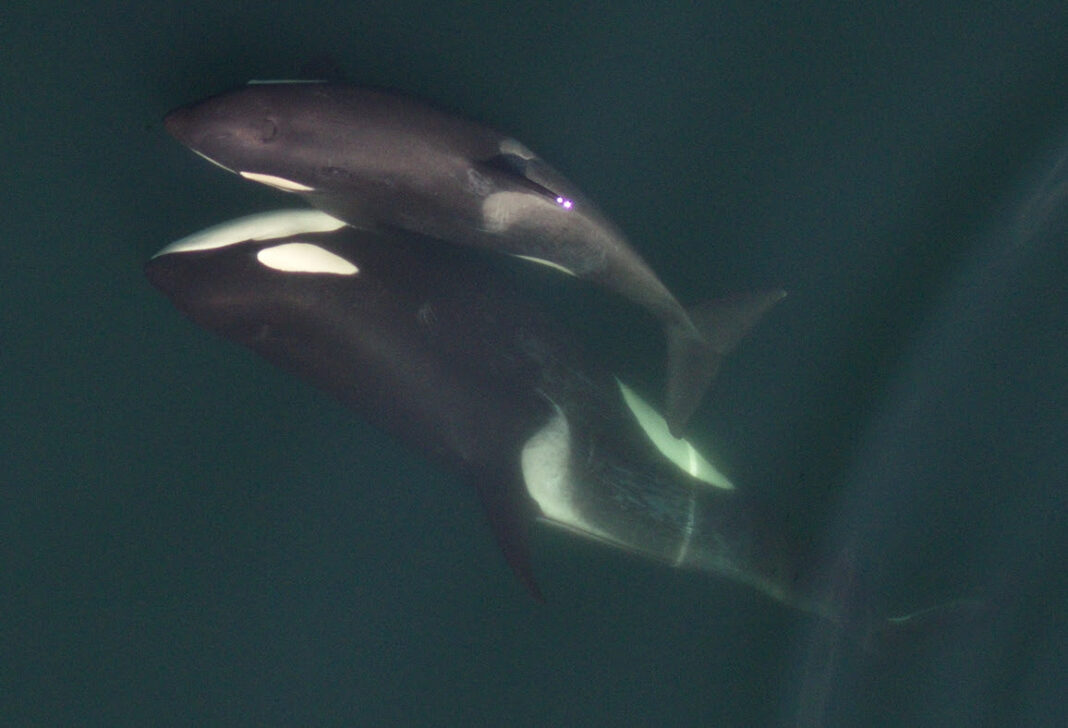
New research published in Scientific Reportsdescribes a first-of-its-kind method of accurately detecting different pregnancy stages in killer whales using drone images. Understanding the reproductive success of whales is an important way of monitoring how vulnerable different populations are to threats such as vessel disturbance and food scarcity.

Prior to the introduction of this new method researchers have not been able to reliably detect early-stage pregnancy (before 11 months in a typical 17-month pregnancy for killer whales) without fecal-based hormonal analysis. This new approach promises to enable researchers to identify whale pregnancy earlier and at a significantly reduced labour cost.

In the northeast Pacific, three populations of killer whales – Bigg’s (or Transients), Southern Residents, and Northern Residents – have vastly different reproductive success rates. The Southern Residents are yet again experiencing the loss of another newborn calf, a total of three calves have perished within weeks of birth since December 2023, whereas the new Bigg’s and Northern Resident calves are thriving. Assessing how well calves are doing is only part of the picture – researchers also need a way of knowing how many pregnancies result in miscarriage.

The most exciting finding of the study is the ability to reliably distinguish non-pregnant whales from those in the early stages of pregnancy.

“Historically, when a late-stage pregnant whale is observed in poor condition is it often too late to take action that will improve the outcome for the calf,” said Dr. Chloe Robinson, study author and Director of the Whales Initiative at Ocean Wise. “With this new method we are able to detect early-stage pregnancy, allowing us to provide the mother with the best chance of carrying that pregnancy to full-term and producing a viable calf.”

The conservation application of this approach is that it allows researchers to understand historic miscarriage rates and inform near real-time management measures in response to detecting pregnant whales. Early-stage miscarriages currently go undetected, meaning government agencies are unaware of the true extent of reproductive failures.

Lack of access to food is one factor that significantly contributes to low reproductive success, and making the connection between a female whale’s nutritional condition and history of miscarriages informs what protections need to be enacted to prevent future miscarriages. This is especially useful for at-risk species experiencing reproductive failures and prey shortages, such as Resident killer whales in the northeast Pacific.

“Our main goal was to create a reliable method to better identify miscarriages in Resident killer whales. We hoped that in the process we would be able to detect pregnancy sooner but were awestruck by the ability to distinguish between non-pregnant and early pregnant individuals. These early detections mean that we will be able to detect miscarriages throughout the entire reproductive cycle as well as recognize vulnerable whales sooner,” said Brittany Visona-Kelly, study author and Senior Manager of the Ocean Wise Whale Health and Monitoring Program.

While the study focused on the Northern Resident killer whale population, a major benefit of the shape-based approach is that it can be applied to other drone image datasets for other killer whale populations. Because the method compares shapes rather than conventional measurements, drone images collected from individual whales can be analyzed so long as the whale is flat underneath the surface and all species-specific identifiers (six for killer whales) are visible.

“We used a shape-based approach as we wanted to create a highly adaptable method for pregnancy detection of free-swimming whales. The method can be applied to other killer whale populations and even other species globally if aerial images and demographic data are available,” said Visona-Kelly.

Building on this study, Ocean Wise hopes to enhance this approach by using artificial intelligence algorithms to reduce the time taken from image collection to pregnancy detection. Ultimately, this approach can be added to the arsenal of other near real-time conservation actions, including Ocean Wise’s Whale Report Alert System (WRAS), to increase protection measures for whales when they need it most.

Fast Facts about killer whales

  • There are an estimated 50,000 killer whales in the world’s ocean with approximately 2,500 living in the eastern North Pacific Ocean.
  • Southern Resident killer whales, who make their home in the eastern Northern Pacific waters, are estimated to have had a historical population of 140 whales. Today the endangered population is just 72 whales.
  • Killer whales do not have specific breeding seasons, typically gestate for 15-18 months and have 2-6 years gaps between young.
  • Female killer whales typically go through menopause in their twilight years (i.e., 50+ years of age)
Karin Kloosterman
Karin Kloostermanhttp://www.greenprophet.com
Karin Kloosterman is an award-winning journalist, innovation strategist, and founder of Green Prophet, one of the Middle East’s pioneering sustainability platforms. She has ranked in the Top 10 of Verizon innovation competitions, participated in NASA-linked challenges, and spoken worldwide on climate, food security, and future resilience. With an IoT technology patent, features in Canada’s National Post, and leadership inside teams building next-generation agricultural and planetary systems — including Mars-farming concepts — Karin operates at the intersection of storytelling, science, and systems change. She doesn’t report on the future – she helps design it. Reach out directly to [email protected]

Hot this week

How Renewable Energy is Revolutionizing the Way We Power Our World

Solar has become the star of the transition thanks to modular hardware and straightforward installation. It fits dense cities and remote towns alike. Many companies are turning to rooftop arrays and carport systems - and exploring commercial solar installation as a practical way to lock in future savings.

How does one start prepping?

Faced with an extreme winter storm this year, Americans wonder how to be prepared for catastrophe. Miriam has lived through wars in the Middle East - so she's prepared on giving you a guide to prepping.

Fishermen sue tire manufacturers on behalf of the salmon

A federal trial in San Francisco has brought US tire manufacturers, fishing groups, and environmental scientists into court over a chemical most drivers have never heard of — but which scientists say may be silently reshaping aquatic ecosystems.

Listening to Water: Tarek Atoui’s Next Work for Tate Modern

Born in Beirut, Lebanon in 1980 and now living in Paris, Atoui has spent years building instruments that don’t sit comfortably in concert halls. Many of them involve water, glass, and ceramics — materials that react to sound instead of simply producing it.

Leading Through a Dual-Energy Transition: Balancing Decarbonisation with Energy Security

Experience in one area of the energy industry isn't enough to guarantee readiness across all the others. That's where a structured program like an MBA in energy can come in. Today's advanced curricula explore energy economics, finance, policy, and strategic management alongside the technical subjects. And when pursuing an energy MBA online, professionals can skill up and retrain without having to step out of the labor market -- an important perk at a time when skilled professionals are already in short supply.

Topics

How Renewable Energy is Revolutionizing the Way We Power Our World

Solar has become the star of the transition thanks to modular hardware and straightforward installation. It fits dense cities and remote towns alike. Many companies are turning to rooftop arrays and carport systems - and exploring commercial solar installation as a practical way to lock in future savings.

How does one start prepping?

Faced with an extreme winter storm this year, Americans wonder how to be prepared for catastrophe. Miriam has lived through wars in the Middle East - so she's prepared on giving you a guide to prepping.

Fishermen sue tire manufacturers on behalf of the salmon

A federal trial in San Francisco has brought US tire manufacturers, fishing groups, and environmental scientists into court over a chemical most drivers have never heard of — but which scientists say may be silently reshaping aquatic ecosystems.

Listening to Water: Tarek Atoui’s Next Work for Tate Modern

Born in Beirut, Lebanon in 1980 and now living in Paris, Atoui has spent years building instruments that don’t sit comfortably in concert halls. Many of them involve water, glass, and ceramics — materials that react to sound instead of simply producing it.

Leading Through a Dual-Energy Transition: Balancing Decarbonisation with Energy Security

Experience in one area of the energy industry isn't enough to guarantee readiness across all the others. That's where a structured program like an MBA in energy can come in. Today's advanced curricula explore energy economics, finance, policy, and strategic management alongside the technical subjects. And when pursuing an energy MBA online, professionals can skill up and retrain without having to step out of the labor market -- an important perk at a time when skilled professionals are already in short supply.

From Green Energy to Healthy Societies: Why old systems thinking is becoming relevant again

Across the Middle East and North Africa, large investments are being made in green hydrogen, renewable energy, water infrastructure and sustainability. Most of these efforts are discussed in the context of climate change, decarbonization and economic diversification. That framing is important, but it may not capture their full value.

We saw peace – an interreligious encounter deep in our eyes

They came from Israel, Palestine, Jordan, Iraq, Yemen, Morocco, Tunisia, Lebanon, Egypt… There are Sunni Muslims, Shiite Muslims, Jews (Orthodox and Reform), Orthodox Christians, Coptic Christians, Protestant Christians, Druze, Baha'is, a Scientologist.

Can biochar reduce ‘Forever Chemicals’ in food if it’s used in farms?

Biochar is produced by heating organic material in a low-oxygen environment so it does not burn. This process, known as pyrolysis, transforms plant matter into a stable, carbon-rich material.

Related Articles

Popular Categories