
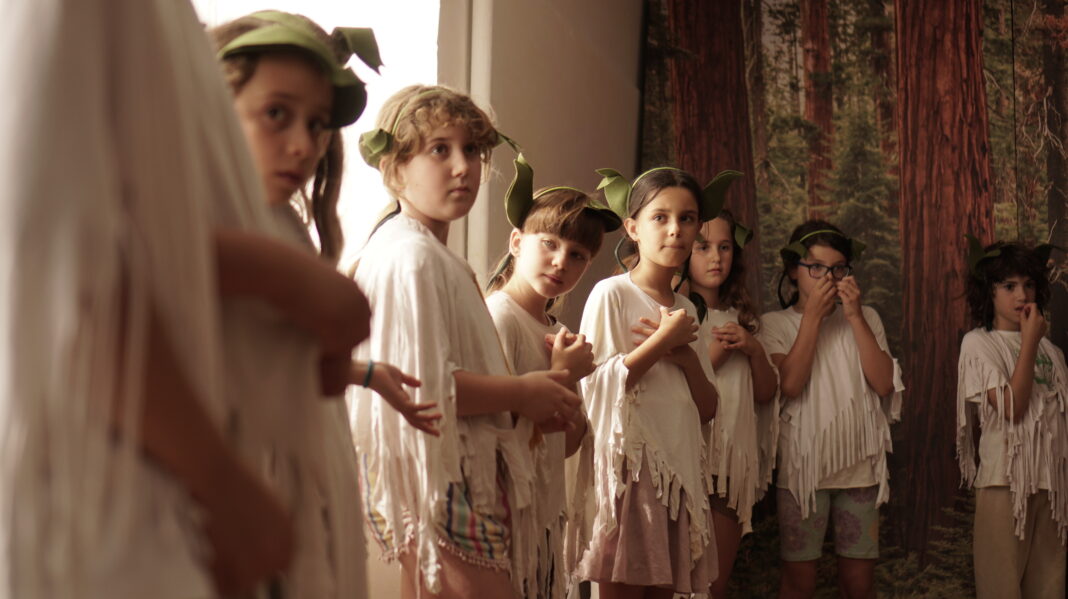


Tel Aviv has broken a school that it should have celebrated and protected.
I was sure I’d homeschool my daughter. We lived in Jaffa and I spent time volunteering at a school teaching English at a school there. We lived near schools. They were not places I’d want my kid to ever go: shouting, violence, phones, an aggressive atmosphere, like the streets of Tel Aviv in traffic on a hot summer day. By chance one day out for a walk with my toddler I came across what looked like heaven, a city garden in Jaffa with trees and a pile of kids playing on them. I stepped up to the gate and by chance met the principal, Orna Shem-Tov. She’d created a private Waldorf School in Tel Aviv-Jaffa called Aviv along with high-tech and arts and fashion parents from around the city. They had a dream about a new way of educating kids that is focused on heart not heuristics.

Anthroposophic schools, also known as Waldorf or Steiner schools are a school system created by Rudolph Steiner in 1919 Germany, one which puts the creative and spiritual growth of a child over the speed of learning math and to read. It’s the school where Silicon Valley startup founders in California put their kids –– counter-intuitively away from phones, away from technology. It’s where Steve Jobs sent his kids.
Waldorf kids use chalkboards and pencil crayons instead of learning how to code. They jump rope every morning, each getting a turn to hold the rope. They knit socks, they felt, they use saws and hammers and learn carpentry and how to use sewing machines. They draw fractals, plant gardens, build with clay. They are taught soft skills of imaginative play, craft and trades, and cooperation and respect.
We joined Aviv when my daughter was 2, and my son at the same age, 12 years ago, effectively helping to build the community up to its goal of grade 8, as is the format in the Waldorf way. Many of us didn’t buy cars or family holidays or rent a bigger apartment so we could pay for the school fees.
The cost was high but we saw no alternative and paid for this private school. The walls were shabby, the budgets were strained but the parents and the teachers covered for what was lacking: we donated furniture, pitched in an painted, sewed curtains, built accessibility ramps, and planted trees. We adopted refugee children to attend along with our kids. Our agenda was integrating everyone who believed in this gentle way.

My kids were quiet, satisfied and played their way to grade 1. They started at age 7, instead of 6 to mature just a little more. When the missiles rained on Israel over the years from Gaza, the kids would sing their way to bomb shelters. Us parents didn’t listen to the news in front of the kids. They were protected from adrenaline spikes and the violence and chaos of conflict and terror attacks. We tried our best during Covid to find a hybrid way to teach our kids without screens.
I had developed a community of friends and so did my kids. We enjoyed shared, simple birthday parties without clowns and plastic, and an overload of sugar. Our kids ate healthy food at school and we went on community hikes and dinners together. We built school plays and festivals together. We agreed to keep phones out of the school, and that video games like Fortnite were not for us. At one point we schooled about 400 children each year.
We agreed that together we could protect our kids and help them flourish.


Covid came and devastated our pre-schools, one of the ways we funded the upper grades. Many parents stopped paying fees in the upper grades they couldn’t afford, and the building we were renting in Mikve Israel wanted to double our rent.
An enterprising parent started working with the city to find a way to help. Like veganism, Israel has the highest number per capita of Waldorf-educated children in the world. This time, the city of Tel Aviv didn’t kick us away, as Ron Huldai did 10 years ago –– not wanting yet another stream of school in the city. This time they embraced us –– as did the head of Tel Aviv’s education department Shirly Carmon who promised us a way for our school to survive and even thrive in the city now embracing alternative schools.
We would have to accept some things about the city plan, including splitting from our age 14 year cycle of Grade 1 to 8, and start a middle school from grades 6 to 9. But the promise would be finally a high-school, and resources that rich cities like Tel Aviv can give schools.
I learned the hard way not to trust the government. Many parents in my school were terrified and did not want to join the public system. I urged them to think differently. We were promised unity in one location in Jaffa, that our classes could stay together as a community, and that we’d have autonomy over our day.

What’s happened is Ron Huldai integrated kids who jump rope and knit with the hardest scrabble community in Jaffa at a school called Ironi Zayn which is barely reaching one-third enrolment capacity. This school sees us as a “tract” in their school and does not share the Waldorf spirit. The joke is on us.
Ron Huldai, the mayor of Tel Aviv who touts Tel Aviv as being a green city, also sued our school a decade ago in the Supreme Court to shut us down. This is after we won a city court ruling in Tel Aviv that we should be recognized as a city school and support from the city about a decade ago. Our school’s parents and grandparents paid the million shekel lawsuit.
Despite there being a number of large school buildings available in Jaffa right now that could have contained our entire community, the city split our grades 7 and 8 and patched them into what would be a future high-school inside a failing, violent school in Jaffa.

The “integration” of children so different from ours has become a point of contention and where our school is breaking. While the city managed to embrace our Grade 1 to 6 model they are failing in the higher grades.
My son’s Grade 6 class of 30 beautiful children will split in half, with half the kids going to private schools or a specialty arts or science school in Tel Aviv. Some will stay believing in the dream and that in a few years we might finally get what we want. Others don’t want to experiment on their kids and are trying to move over to the city of Givatayim, which has the best two schools in the country: Zomer, a Waldorf School successful high-school and Thelma Yellin, the best art school in Israel. Tel Aviv, startup city central, has ruined a thriving middle school community that held so much promise.
The city promised us that by 2025 all our classes would move from the run-down building on Pachad Itzhak in Jaffa where there is no gym and facilities and that we’d be together as one community Grades 1 through 9 in the same environment side by side. We recruited our families, friends and loved ones to join our school –– and now? They promised we’d have our own management, could manage our day –– when in reality they stuck our kids besides troubled special needs children that curses them. Our frame is now locked into a normative school with the regular times to run between classes.

It’s not all terrible, says one parent who had no choice but to send her kid there because his friends are there and she doesn’t believe in the other options as better, “but it’s not a Waldorf School”. Mothers have told me told me about violent incidents against girls in words and in actions and generally the violent environment the kids need to walk through in the halls every day.
Ron Huldai and Shiri Carmon, who has now completed her mission in education by bringing in more “numbers” has left the building and has gone to politics. She and Huldai hoodwinked families and the most beautiful community in Jaffa. While there is enthusiasm and a growing interest in Tel Aviv’s Waldorf and the beautiful school that we built in the lower grades, when you look to middle school, from grades 7 and 8, the city has sold us out.
We don’t know if my son will move to Grade 7 at the school we now call Reut at Ironi Zayn. I know he can survive anywhere because that’s what I have taught him. Many parents I have known for 10 years, parents of my son’s best friends who live in Jaffa, say that they cannot continue at such a violent atmosphere so if we stay my son will lose his most gentlest of friends. The city’s education department, now headed by Dana Levin, lied to us. They did not protect our gentle, and precious Waldorf way of life. Teachers are suffering burnout running from one location to the next and kids are leaving to other schools.
I reached out for a comment from the Tel Aviv Municipality from the new head of education Dana Levin, Ron Huldai, Deputy Mayor Assaf Zamir. My requests were ignored. My previous requests for covering “positive” news stories about Tel Aviv were responded to by their spokesperson.


