

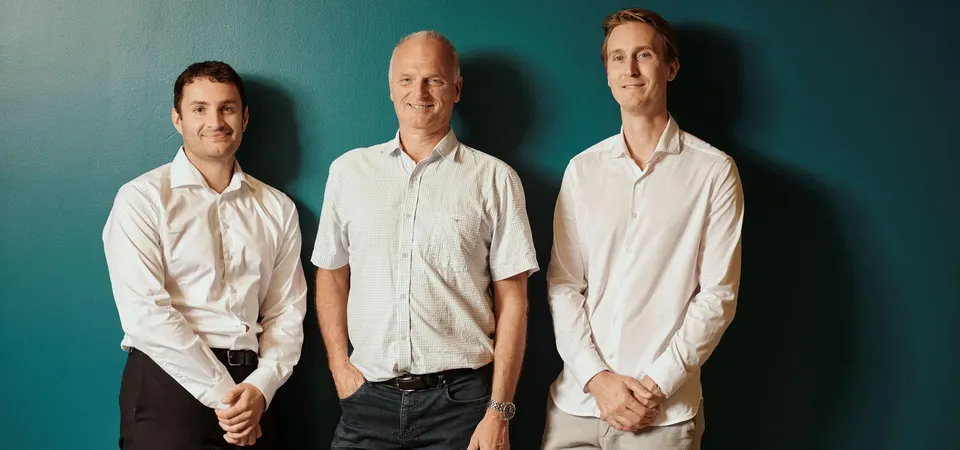
 Fuse Vectors founders Jordan Turnbull, Henrik Stage and Benjamin Blaha via Fuse
Danish biotech replaces 1980s cell-based methods with revolutionary cell-free technology, making gene therapy more accessible. Innovative approach allows for unprecedented quality in hours rather than weeks.
Gene therapy’s biggest obstacle isn’t science – it’s manufacturing. While the field races forward with breakthrough treatments, production remains stuck in the 1980s, relying on unpredictable cell-based methods that make therapies costly and slow to develop. Today, Fuse Vectors announces $5.2 million in pre-seed financing led by HCVC to revolutionize gene therapy development with its cell-free viral vector technology.
The funding will accelerate the development of Fuse’s technology platform and pipeline of novel gene therapies. With its breakthrough approach, Fuse Vectors aims to be the universal solution for AAV gene therapy development, delivering unmet patient needs and expanding the accessibility of gene therapy to a wider range of indications. The Fuse Vectors story began with two bioprocess scientists who saw firsthand the limitations of current drug development technologies.
Despite the complexity of viral vectors, the industry had been relying on retrofitted manufacturing technologies from the 1980s and 1990s. Benjamin Blaha and Jordan Turnbull watched as these outdated methods produced therapies that were costly, slow to develop, and often low in quality. As the founders describe it, traditional methods are like “tossing LEGO bricks into a tumble dryer and hoping houses emerge.”

Recognizing this critical gap, they asked a radical question: “What if everything about this process is wrong?” The industry’s major players lacked both the bandwidth and remit to overhaul these outdated methods, so Blaha and Turnbull took the leap – leaving their jobs to rethink viral vector development from the ground up. Their efforts led to a breakthrough: a controlled, cell-free approach that assembles viral vectors with unprecedented precision.
“Fuse Vectors’ cell-free Fuse Technology offers significant improvements, reducing production time and costs while enhancing vector quality to meet patients’ unmet needs,” said Benjamin Blaha, co-founder of Fuse Vectors. “The enzymatic AAV capsid filling process eliminates cell-based AAV production, using efficient technologies storing components in a module library.
This allows on-demand, controlled biocatalytic reactions to fill capsids and works across all serotypes.”Instead of relying on living cells’ unpredictable behavior, Fuse’s technology assembles viral vectors through controlled biochemical reactions.
This innovative approach allows for unprecedented precision, achieving over 99% filled capsids synthesized in hours rather than weeks. Partners simply provide a gene sequence, and Fuse’s streamlined process packages it into an AAV vector – enabling faster, higher-quality development with minimal setup. The platform’s modular nature enables rapid optimization through multi-parallel prototyping, making it significantly more efficient than traditional methods.
“This investment from HCVC is a pivotal step for Fuse Vectors, bringing our pre-seed financing to 5 million EUR,” said Henrik Stage, co-founder and Executive Chair of Fuse Vectors. “We are excited to work towards our vision of making gene therapy more efficient, cost-effective, and accessible, and are grateful for the early support and financing received from BioInnovation Institute, EIFO and Innovation Fund during our ideation and start-up phase.
“Currently in alpha testing, Fuse Vectors is collaborating with over half a dozen partners – from academic research groups to leading pharmaceutical companies. The company plans two commercialization strategies: partnering with pharmaceutical companies, biotech firms, and academic institutions to optimize drug candidates using their Fuse Technology and Optimization Engine, while also developing their own pipeline of therapeutic candidates.
“Fuse Vectors’ approach to gene therapy has the potential to make gene therapy much more interesting for the Industry to develop as well as increase accessibility to patients,” stated Trine Bartholdy, CBO of BioInnovation Institute. “Their start-up development exemplifies BII’s commitment to empowering innovative platform technologies based on world-class scientific research to grow into successful companies capable of making meaningful impact on the future of gene therapy and human health.”
“We are thrilled to support Fuse Vectors in their mission to revolutionize gene therapy,” said Alexis Houssou, Managing Partner of HCVC. “With their unique cell-free viral vector solution, expert founding team and strong business model, Fuse Vectors has the potential to overcome significant challenges in the field, and we believe in their ability to bring transformative treatments to patients.”
The technology comes at a crucial time for gene therapy. With thousands of genetic diseases still lacking treatments, drug developers struggle to create safe, effective, and accessible therapies. By fundamentally reimagining how viral vectors are made, Fuse Vectors aims to unlock the full potential of gene therapy – bringing it closer to the patients who need it most.