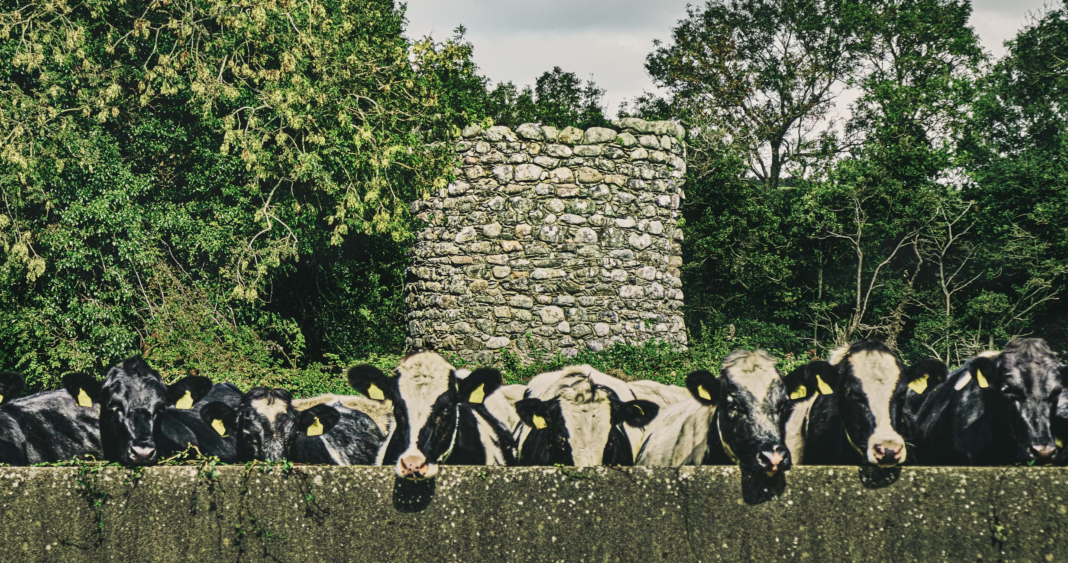


Cows that make milk make methane gas and that gas is leading to more greenhouse gas emissions. One of the market solutions to reducing methane gas from cow farts and manure is a new biotech product marketed as Bovaer. The product, developed by DSM Firmenich from Maastricht, Holland says that when fed to a cow in their feed, when Bovaer gets to the cow’s rumen, it creates more microbes to help break down food. Like eating a probiotic.
Just ¼ teaspoon in a cow’s daily feed takes effect in as little as 30 minutes. As it acts, Bovaer is safely broken down into compounds already naturally present in the rumen, advertises the company. Less methane gas is produced in the process.
Bovaer, they say, is the most extensively studied and scientifically proven solution to the challenge of burped methane to date — “with more than 130 on-farms trials in 20 countries and more than 80 peer-reviewed scientific studies. In every case, it has proven safe for consumer, farmer and animal, having no impact on milk production or reproduction.”
Indeed, you can find clinical trials online from the United States (Penn State) and Canada (University of Alberta) where researchers report in the US and Canada significantly less methane production in dairy cows that are given the supplement, with the scientific name 3-nitrooxypropanol (3-NOP).
In the UPenn study, “Administration of 3-NOP via the TMR at a concentration of 60 mg/kg of feed DM decreased daily enteric CH4 emission by 26% in early-lactation dairy cows. The enteric CH4 yield decreased by 21%, and CH4 emission intensity was decreased by 25%. Dry matter intake was lower in 3-NOP cows (by 5%), but ECM production was not affected, which resulted in increased ECM feed efficiency compared with CON cows.
Shoppers in the UK upon learning that their milk contains Bovaer are pouring their milk into the toilet. It’s caused a stir on social media such as in Facebook groups where people are voicing their concerns about an untested product – is it safe for humans to eat byproducts of Bovaer?
Arla Foods, owner of the UK’s biggest dairy co-operative said on 26 November it will going to start using the supplement in its milk. Arla said it will work with grocery giants Aldi, Morrisons and Tesco to trial the use of the feed additive known as Bovaer across 30 British farms.
British shoppers threaten to boycott all three supermarkets and Arla brands, along with Lurpak butter.
“Bovaer is a relatively simple chemical that is broken down in part of cows’ stomachs, where it also inhibits a specific enzyme that produces methane,” says Prof Oliver Jones, Professor of Chemistry, The Royal Melbourne Institute of Technology. “Because it is broken down quickly, it is not absorbed whole and is not present in milk; it indirectly increases the fat content because substances that would have been converted to methanol are instead converted to fats.
“Worries over new technologies are nothing new. However, the use of food additives is quite strictly controlled in the UK and Europe,” he notes. You can’t just add anything to the food chain without safety testing (although it appears you can claim what you like on social media).
“Despite extensive testing in multiple countries; there is no evidence that Bovaer causes cancer (as it does not damage DNA) or that it is dangerous to consume milk or other products from cows treated with it. Neither does Bovaer prevent other methods of reducing methane emissions from cattle, such as selective breeding.
“One can’t directly compare the everyday use of Bovaer and the potential risks from its use in concentrated form. For example, Bovaer is claimed to be an irritant to the eyes and skin and potentially harmful by inhalation, but common salt is also an irritant to the eyes and skin, and water is clearly potentially harmful by inhalation.
“Context is extremely important when assessing risk, but entirely missing from the social media videos on this topic.”
One solution to industrial food is finding raw milk, though it is illegal to buy and sell raw milk in Canada and the United States, it is possible for communities to self organize and “share” milk this way.
I’d assume, just in general here, that if the community of milk drinkers want to be upset about something, they should look to cow hormones, and antibiotics fed to cows. This may be a bigger reason to be concerned.
States Where Raw Milk is Legal on Producing Farms
It’s against the law to buy and sell raw milk in Canada, and has been since 1991, when the federal government banned its sale due to concerns of food-borne illnesses. Pasteurization is a process that involves heating raw milk to at least 63 C to kill harmful bacteria, such as salmonella and E. coli.
Twelve of those states—California, Maine, New Hampshire, New Mexico, Pennsylvania, South Carolina, Washington, Arizona, and Connecticut—allow farm sales of raw milk with no license. The rest require a license to sell on the farm.
Some people when the can drink goat, sheep and camel milk.