

While efforts to curb illegal deforestation in Brazil are bearing fruit – the South American giant slashed forest loss by 36% last year – alarming signs continue to emerge concerning one of our planet’s most important biomes. Recent analysis shows that in some parts of the Amazon rainforest, wildfires in February exceeded average levels by a factor of five, with Marcio Astrini, the executive secretary of Brazil’s Climate Observatory, even cautioning dramatically that “we are losing the Amazon rainforest.”
The fires, experts have warned, are being fuelled by deforestation and extreme drought exacerbated by the return of El Niño but ultimately resulting from climate change – an ecological plague which will only worsen should the Amazon be lost as a carbon sink. Earlier this year, scientists published a study warning that this vital rainforest is approaching a tipping point, notably concluding that nearly half of the ‘planet’s lungs’ could be threatened by mid-century in the absence of significant intervention to address the interconnected menaces of climate change, drought and deforestation.
The Amazon is too important to fail
Given its significant, irreplaceable contribution to our planet, the Amazon simply cannot be lost. Spanning nearly seven million square kilometres – roughly the surface area of Australia – the South American rainforest’s monumental size allows it to act as one of the world’s largest carbon sinks. According to University of Sao Paulo scientist and deforestation researcher Carlos Nobre, the Amazon stores over 150 billion metric tons of CO2– half of which is absorbed by its trees, which represent some 20% of vegetation-captured carbon globally.
Concerningly, deforestation and wildfires are releasing significant amounts of its stored carbon back into the atmosphere, with the Amazon now a net emitter of CO2. Beyond its climate warming impact, this release of carbon is triggering more intense droughts, creating a vicious cycle that threatens to degrade the Amazon into a Savanna-like grassland habitat if action is not taken—with devastating consequences for the environment, including rain cycle disruption spanning the wider region, widespread animal and plant biodiversity loss, and the inability to meet the Paris Agreement’s global warming and emissions reductions targets.
New conservation model for fight ahead
Under these circumstances, dramatic action will be needed to turn the tide. This gargantuan undertaking must notably involve a new breed of forest conservation projects that take into account the needs and economic realities of local communities, such as the Mejuruá Project, highlighted in a recent opinion article penned by Rubens Barbosa, former Brazilian ambassador to the U.S. and to the U.K.
Noting that conservation efforts incorporating this social, community-focused model remain in short supply, Barbosa has qualified Mejuruá as “one of the most innovative projects” yet announced in the Amazon and a “paradigm to be replicated” in endangered ecosystems around the world. Based in the Carauari, Juruá, and Jutaí municipalities in the heart of the State of Amazonas, Mejuruá is combining sustainable forest management, biodiversity protection and socioeconomic initiatives across a 903,000-hectare area of tropical rainforest; as Barbosa emphasized, the project is anchored in an overarching ambition to “support local communities, including indigenous people,” in generating sustainable value from their wealth of natural resources.
The project is built on the conception that the only perpetual sustainable formula to preserve forest is centred on local communities’ education (including indigenous people), employment and governance participation. Furthermore, according to this new paradigm/model, the project is required to build also the infrastructure (equipment, saw mill, bio-energy plant, port, roads, schools, digital connection, etc.) that allows to carry out all activities aimed to actively preserve the forest, support bio-diversity conservancy and ensure long-term social and economic development for local communities.
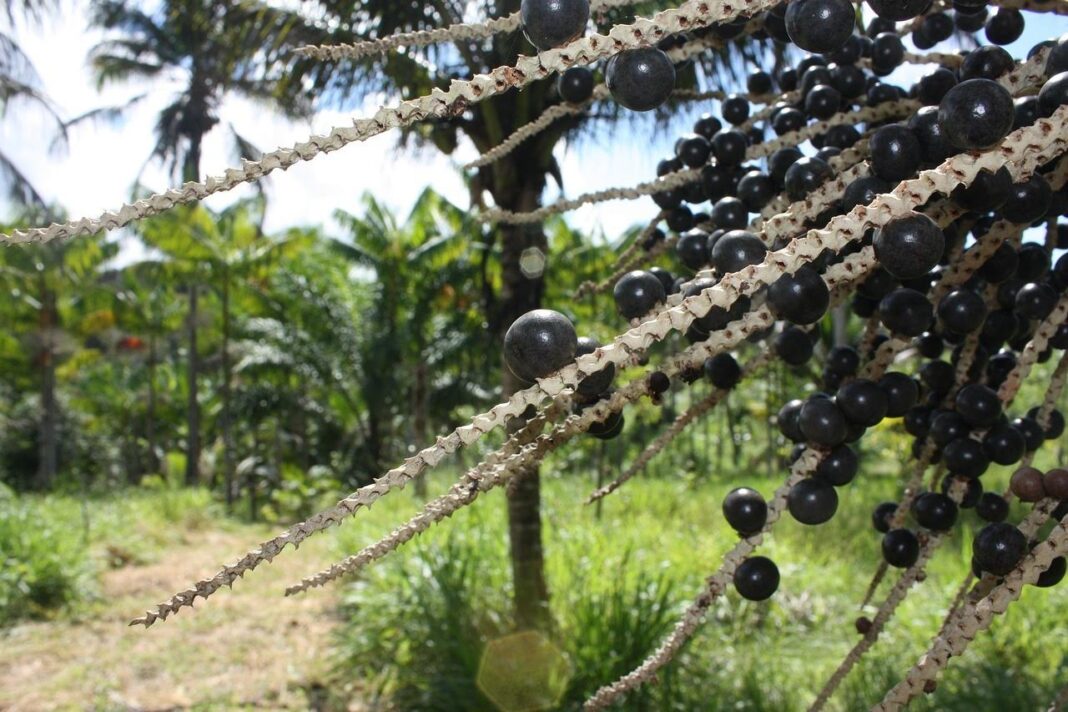
Drawing on its biodiversity-rich land and strong local partnerships, the Mejuruá Project will create green jobs for the surrounding communities – including in the production of biomass energy and açaí berries – while implementing what Barbosa describes as a “self-sustainable economic profile” that will simultaneously ensure residents’ long-term social empowerment and ecosystem conservation.
Holistic interventions leading way forward
Indeed, offering local communities such a sustainable economic lifeline is key. The Brazilian Amazon is one of the country’s most deprived regions, which has long left many residents with no viable alternatives to abandoning damaged farmland and clearing ever greater swaths of forest area, thus exacerbating soil degradation, hindering climate action and undermining livelihoods.
The careful, sustainable cultivation of crops like açai and cacao can lift countless families out of poverty while avoiding large-scale deforestation. Soaring international demand for açai in recent years has provided a significant economic boon for local Amazonian farmers; however, with intensive practices emerging as a new biodiversity threat, conservation funding – such as the Soros Economic Development Fund’s recent $15 million investment in the Amazon Biodiversity Fund (ABF) – should support small regional businesses producing within their ecosystem’s natural boundaries.
Complementing sustainable agriculture is the direct fight against illegal deforestation, with innovative interventions increasingly drawing on advanced monitoring technologies. The Brazilian Government is notably using satellite imagery provided by Planet, with the country’s Federal Police receiving daily detection alerts and precise geolocation to inform their targeted crackdown on illegal environmental activity. When paired with artificial intelligence (AI), satellite solutions allow authorities to access and analyse vast quantities of real-time forest data, with initiatives such as Project Guacamaya in the Colombian Amazon showcasing the revolutionary potential of tech-enhanced conservation efforts.
Reducing systemic drivers of environmental degradation in the Amazon, such as conflict, remains an equally crucial piece of the puzzle moving forward. Following years of accelerated deforestation driven by armed groups amid environmental conflicts and an ineffective military response from the Colombian Government, researchers from Del Rosario University have developed a novel approach to this crisis, offering local communities and governments new conflict resolution tools to bring lasting peace and curb deforestation in the region.
By combining this wide range of future-fit conservation initiatives with high-level political cooperation – exemplified by the new €1 billion Franco-Brazilian investment programme announced during President Macron’s state visit in March – international efforts to save the Amazon will hopefully rise to the occasion and preserve this critical biome for generations to come.