
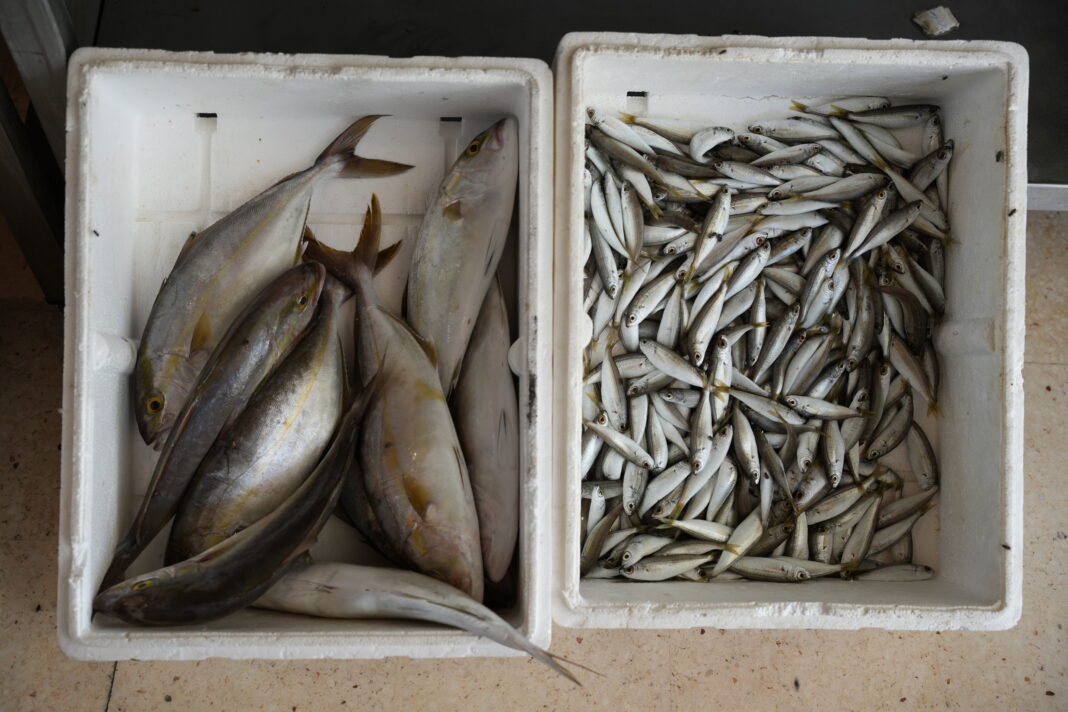

 Three fish from this Tripoli market stall were analyzed to determine the ammonium content inside them. The results revealed a very high concentration of ammonium.
While Lebanon is going through an historic financial crisis, fishermen are trying to survive by fishing with dynamite. A special Green Prophet report on a social and environmental disaster:
Sitting in the courtyard of his home in a port district of Tripoli, Sayed*, a fisherman in his sixties, enjoys a coffee prepared by his wife. The crutches that have helped him since a violent car accident are lying on the ground. In his damaged mouth, where only two teeth remain, is a cigarette, which he soon lights. With it, he demonstrates the effect of fire on ammonium nitrate. From a black bag, he extracts a handful of green powder which he placed on a plate. His family witnesses the sinister scene.
“This is what I make my dynamite with,” he says with a serious face. The old man pours the nitrate into a piece of plastic which he rolls up mechanically. His wife brings him some thread to tighten it. All he needs now is the detonator to finish the homemade preparation. Sayed is a former dynamite fisherman, an illegal practice. Even if he has not forgotten anything about its manufacturing, he claims he has withdrawn from the market.


Land of the cedar but also of the sea, Lebanon hosts 44 ports and a mostly artisanal fishing industry. Dynamite fishing has evolved throughout the tumults of history. During the civil war (1974 to 1990), sticks of dynamite were common currency. Today, it’s in Palestinian camps, such as in Nhar-al-Bared, 12 miles north of Tripoli, that you can find ready-to-use sticks. Other fishermen, like Sayed, prefer to make their own.
Also the recipes differ, they all use ammonium nitrate, a fertilizer sold in any agricultural store and the cause of the explosion at the port of Beirut in August 2020. “Homemade” dynamite also requires a detonator, banned from public sale but easily available on the black market. For the rest, everyone has their own tips. Some add sugar, others charcoal. With the crises of recent years, the techniques have been further refined.

Artificial reefs made from car wrecks are created to make nurseries for fish. Others, for saving fuel, swim to sea pushing a floating tire loaded with dynamite and bombard the fishes. A 50 kg bag exploding at a depth of 60 meters has a radius of 50 meters and can harvest up to four tonnes of fish. After the explosion, the fishermen just need to wait until the dead fishes go back up to the surface.
“Fish are killed by the shock wave which causes hemorrhagic lesions of the gills,” analyzes Rami Khodr, technical director at the RBML Food Labs laboratory in Beirut. Particularly effective, dynamite fishing is well established in the poor regions of North Lebanon.
Surviving poverty

Sitting under a sheet metal shelter with fishing companions, Amir*, 34, is waiting. Due to unstable weather, he was unable to go out to sea. The man lives in Aabdeh, in the Akkar region. The Syrian border is only 10 miles away. The surroundings are poor and abandoned, the smell of fish and diesel escapes from this small fishing port. “The fish are getting smaller and smaller and there are fewer and fewer of them, he says sadly. We sometimes have to go further to find it, but it costs a lot of diesel.”
So, for him, it is not surprising that some are turning to illegal fishing.
A two-hour drive north of Beirut, Tripoli is no longer the flourishing Phoenician city of the old days. The town was already poor before the economic crisis, but since 2019, Tripolitans have joined Syrian and Palestinian refugees in poverty. As day breaks over this desperate city, the port is bustling with activity. The fishing boats have returned from their night of hunting. On the market stalls, dozens of marine species lie in trays of ice. It’s hard to guess which ones were captured with the explosives. “Dynamite? None of that here!”, claims one of the sellers, clearly shocked by the question.
Lebanon’s shipwreck

If the pandemic followed by the explosion at the port of Beirut had already weakened the country, the economic crisis that occurred in 2019 and is still ongoing has destroyed much of the hope of the Lebanese population. The country is experiencing inflation which accelerated at the start of the year to reach 270% year-on-year in April, 2023. This crisis has plunged more than 80% of the Lebanese population into precarious living conditions, with half of them living in extreme poverty. To try to get by, people work night and day.
Thus, fishermen no longer belong only to the sea. They are also taxi drivers, café owners, bus drivers. Many had to sell their boats. “It is sad because fishing is a family tradition, a heritage,” adds Amir. Bassem is another fisherman from the port of Aabdeh. Sitting on a plastic chair in the hot sun, he relates his father’s accident in which he lost seven fingers while handling dynamite: “He was at sea. It was raining and windy. He lit a cigarette and the dynamite exploded. Since then he stopped using it.”
According to the Safadi Foundation, a structure that develops sustainable projects in Lebanon, 5% of fishermen use dynamite fishing. “In Tripoli, this technique was in decline for several years before increasing again in 2019, points out Samer Fatfat, consultant at the Safadi foundation. On the beaches of Akkar, it has remained constant.”
A failing state

On 25 miles of coastline between Tripoli and Syria, the army was quickly overwhelmed. In Tripoli’s Al Mina port alone, more than 1,800 fishermen are registered. These wooden motorboats, less than seven meters long, enter and leave the port by means of a simple visual check by the army from the dyke. While the authorities clearly lack resources, not even having enough fuel to arrest illegal fishermen, they may also be in cahoots with the outlaws. In the port of Al Mina, illegal fishermen are known to everyone but the omerta, a southern Italian code of silence, hangs over anyone who dares to denounce them.
As for the president of the fishing union, crisscrossing the Corniche and the fish souks aboard his gleaming black Mercedes, he brushes the question aside: “It’s not our mission to arrest the fishermen and if they are arrested it is only for a few days in prison.”
Corruption, however, is costly to illegal fishermen. According to one of them, 40% of the revenue is intended for corruption and 60% is shared between him and his crew. However, a law governing the rules of fishing in Lebanon exists since 1929. Dynamite is strictly forbidden. But like a country that does not have a president since a year, the state is falling apart and the laws are not applied.
Some fishermen even bomb the Palm Islands Nature Reserve, in front of Tripoli, where all human activity is theoretically prohibited. Explosions not only damage the seabed but also contribute to the reduction of fish stocks without distinction between small and large fish. A toxicological analysis carried out by the RBML Food Labs laboratory, which tested three samples of fish from a market in Tripoli, demonstrated a significant quantity of ammonium inside the fish. But due to the massive use of this fertilizer in agriculture, it is difficult to know whether this pollution comes from dynamites or land runoff.
Every day, hundreds of bombs are dropped in Lebanese waters by fishermen, descendants of Phoenicians, renowned for their navigation skills. In these ravaged lands, the sea is a constant witness to tragedies. Each time a conflict has caused the closure of maritime space, fishermen have found a sea rich in fish. But the natural cycle is constantly overtaken by the death spiral. The president of the Al Mina union even dares a comparison: “It’s like Israel and Palestine, the sea is the enemy against whom the fishermen throw bombs to survive.”
*names changed


