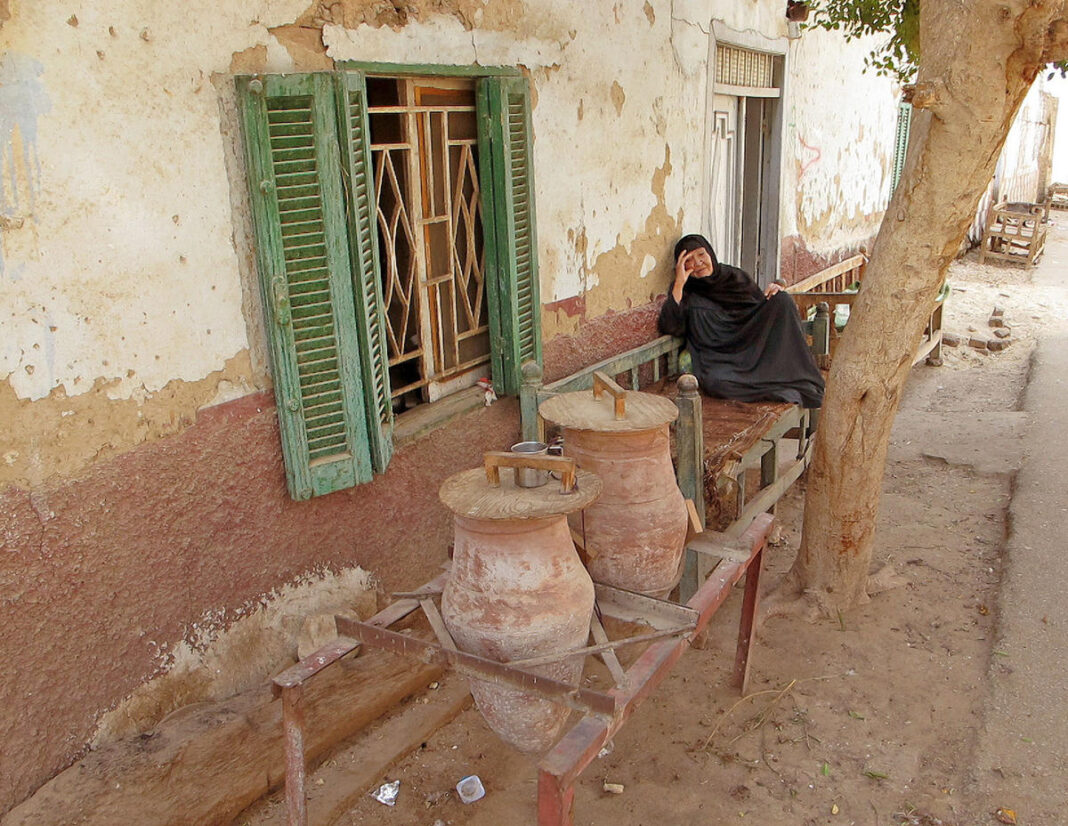

Hassan Fathy was an Egyptian architect, poet and visisionary who worked to revive vernacular architecture for the Egyptian people. His vision is relevant for much of the Middle East and Levante area, Greece and Turkey included. New Gourna was his vision – a novel earthen community commissioned by the Egyptian Department of Antiquities in the sugarcane fields below the concentration of ancient Egyptian tombs. The village was designed and built between 1946 and 1952 to resettle villagers with a history of raiding and pillaging antiquities. Here is the story of New Gourna, an experimental village that can shape the way architects can design our future.

Why was New Gourna built?
In the heart of Egypt’s arid landscape, nestled on the west bank of the Nile, lies a village that defies convention. Its story begins around 1940 when an Egyptian architect with a vision named Hassan Fathy set out to redefine the way we build and live. New Gourna, as it came to be known, was born from a noble purpose – to provide a better life for the people who called it home.

Hassan Fathy, who we have featured over the years, embarked on this ambitious mission to address the dire living conditions of the impoverished residents of Old Gourna. Its inhabitants lived in abject poverty, crammed within mud-brick houses that were falling apart. Instead of living in ramshackle slums, Fathy’s vision was to create a sustainable, self-sufficient, and culturally sensitive community that would uplift the lives of the villagers while preserving their heritage. He was hoping to build them homes they could build and repair themselves. A proud place to call home.
Fathy drew his inspiration from the vaulted Islamic architecture of historic Cairo and the traditional mud-brick houses that could be found all over Egypt, from the Nile valley to the desert oases. The synthesis of these two styles became the foundation of Fathy’s designs, and were his way of protesting against what he saw as an invasive and concrete-heavy wave of modernism influenced by the West. We learn here about one of the problems of concrete.
Why wasn’t New Gourna a success?


Despite the noble intentions, New Gourna faced numerous challenges that ultimately prevented it from realizing its full potential. More than 10 years ago Arwa Aburawa reported here that New Gourna was in shambles. Several factors contributed to its lack of success:
- Limited Resources: Fathy’s commitment to using traditional, locally-sourced materials and techniques meant that the construction process was slow and resource-intensive. This, coupled with a lack of funding, hindered the completion of the entire village. Only parts were ever completed.
- Government Bureaucracy: The Egyptian government didn’t fully support Fathy’s unconventional approach to architecture and urban planning created obstacles. They were more inclined towards modernization and urban development, which didn’t align with Fathy’s vision. This is still true in all parts of the Middle East. While the United Arab Emirates was proud to fund Masdar, a zero energy city near Abu Dhabi, no residents from the region wanted to live there. A great idea that failed to launch.
- Socioeconomic Factors: The future inhabitants of New Gourna were resistant to Fathy’s ideas, as they required them to adapt to a new way of life.
- Maintenance Challenges: New Gourna’s low-tech architecture made from earthen materials requires maintenance, which the villagers struggled to afford and do.
- Incomplete Vision: Some say that Fathy’s ambitious vision for New Gourna was never fully realized. Only a portion of the planned village was constructed before funding dried up and the project was abandoned. Hassan Fathy also used dome ceilings which were linked to spiritual buildings and houses of worship, such as mosques. (Related: 5 beautiful and sustainable mosques). This made the local resist living in such homes.
What can vernacular architects learn from New Gourna?

While New Gourna may not have achieved the success Hassan Fathy initially envisioned, it offers valuable lessons in sustainable architecture and community development:
- Cultural Sensitivity: Fathy’s commitment to preserving the cultural heritage of the villagers by using traditional building materials and techniques is a testament to the importance of respecting and valuing local culture in architectural projects. Every outsider coming to build a new “vision” even if they are from the place and speak the language needs to really listen and understand the needs of the future inhabitants.
- Sustainability: The village’s eco-friendly design showcased the potential for sustainable architecture long before it became a global concern: this was before environmentalists understood the role of the circular economy and the impact of sustainable building. Lessons from New Gourna can be applied to contemporary efforts to create eco-friendly and energy-efficient structures. New Gourna is more relevant than ever especially when crimes against nature are about to be built – see the Neom project in Saudi Arabia.
- Community Involvement: Involving the community in the design and construction process is crucial for the success of any sustainable development project – especially in low-income areas. New Gourna’s struggles highlight the importance of garnering local support and participation. If you look to natural builders like Bill and Athena Steen in Canelo, Arizona, they have recruited a global following and community who come to learn and share natural strawbale building techniques. Or Nadar Khalili, a refugee from Iran who lived in California, working at Cal-Tech. Khalili was an Iranian-born American architect, author, and educator. He is best known for his inventive structures that incorporated a range of atypical building materials to provide shelter in the developing world and emergency contexts. Superadobe homes are potentially the solution for sustainable housing around the world. See how they are used by Palestinians here.
- Resourcefulness: Fathy’s ability to create innovative solutions with limited resources is a testament to human ingenuity. It underscores the importance of finding sustainable, cost-effective solutions to modern urban challenges.
What materials were used in the construction of New Gourna?

Hassan Fathy’s architectural philosophy revolved around using locally-sourced, sustainable materials to build structures that were in harmony with the environment and culture of the region. In the construction of New Gourna, several key materials were employed:
- Mud Bricks: The primary building material in New Gourna was mud bricks, also known as “adobe.” Famously used in Mexico and New Mexico, entire towns can be made from mud bricks as we see in Yemen. These bricks were made from a mixture of clay, sand, and straw, and they were dried in the sun. Mud bricks are not only eco-friendly but also provide excellent insulation against extreme temperatures.
- Palm Wood: Palm wood was used for roof structures and beams. It is a readily available, renewable resource in the Egyptian desert and provided a natural aesthetic to the buildings.
- Stone: In some cases, stone was used for foundations and structural support, providing stability and durability to the buildings.
- Reed: Reed was used for ceilings and as a shading material in the hot desert climate. It allowed for ventilation and reduced the need for energy-intensive cooling systems.
- Natural Pigments: Natural pigments were used to decorate the buildings, adding colorful patterns and designs to the exteriors. If you have ever travelled to Sinai you will see sand and rocks that range from a dark black to pinks, mauves and purples.

Fathy’s choice of materials was not only sustainable but was also rooted in the vernacular architecture of Egypt, ensuring that New Gourna seamlessly blended with its surroundings.
Who was Hassan Fathy?

Hassan Fathy was a visionary Egyptian architect who left an indelible mark on the world of architecture and sustainable design. Born in 1900 in Alexandria, Egypt, Fathy studied architecture in Cairo and later in France, where he was exposed to modernist architectural trends. However, he felt disillusioned by the disconnect between modern architectural practices and the needs of his homeland. You could say it was the time. A lot of new spiritual movements were gaining momentum. There was Rudolf Steiner in Austria and Germany and spiritualists like Viktor Schauberger. working on water.
Fathy’s architectural philosophy was deeply influenced by a reverence for traditional Egyptian architecture, a commitment to social equity, and a concern for the environment. Spanning thousands of years, Egyptian architecture is not one style, but a set of styles differing over time but with some commonalities. He believed that Egypt’s architecture should be accessible to all and that it should be in harmony with its cultural and environmental context.
Throughout his career, Fathy championed the use of local, indigenous materials and construction techniques, advocating for sustainable architecture long before it became a global movement. His most famous work the village of New Gourna, exemplified his dedication to these principles.
Fathy’s legacy extends beyond his built works. He wrote extensively, with his influential book “Architecture for the Poor” (originally published in 1969) outlining his architectural philosophy and principles. His ideas continue to inspire architects and designers worldwide who seek to create sustainable, culturally sensitive, and socially responsible architecture.
What is the status of New Gourna today?

Today, the village of New Gourna is a mixture of both success and stagnation. Many of the original buildings still exist, bearing the architectural and cultural marks of Fathy’s vision. These structures continue to attract architectural enthusiasts, historians, and tourists who come to appreciate the unique blend of tradition and innovation that characterizes the village.
It was open to the public around 2018 and you can visit it on the way to the Memnon Colossi, the Ramesseum or the Hatshepsut Temple. The mosque is easy to see from the end of the main village road. Look for a sign to the Hassan Fathy architecture in New Gourna. Some parts are only open in the mornings, so travel early.
However, New Gourna remains a divided community. Some of the residents have embraced Fathy’s ideas and have maintained their homes in the spirit of his vision, while others have gradually abandoned the traditional mud-brick houses in favor of more modern dwellings. The maintenance and upkeep of the adobe buildings have been a significant challenge for the residents, leading to the decay of some structures.
The Egyptian government has recognized the cultural significance of New Gourna and its potential as a heritage site. Efforts have been made to preserve and restore some of the buildings, but financial and logistical constraints have hindered comprehensive restoration projects.
Despite its challenges, New Gourna continues to serve as a source of inspiration for architects and urban planners worldwide. Back in 2010 the World Monuments Fund expressed support in preserving New Gourna. A PDF report of the site was created by the World Monuments Fund with the support of the Robert W. Wilson Challenge to Conserve our Heritage, and in collaboration with the UNESCO World Heritage Centre and the Luxor Governorate of Egypt. You can get the 2010 report on New Gourna here.