Sonovia’s denim starts with a sustainable, ultrasonic dye

Sonovia has created a process for using less dye and water for sustainable fashion
A Sonovia machine dying fabric in a more sustainable way. Via the use of physics, Sonovia is harnessing the power of ultrasonic cavitation jet-streams to impregnate textiles with color.

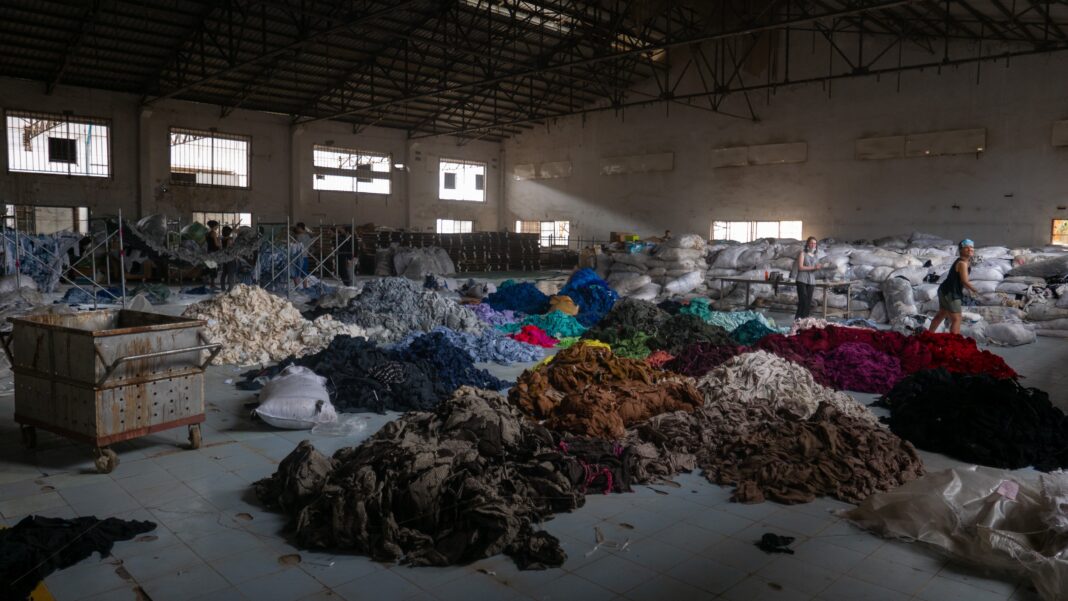
Sonovia is taking the textile industry into the future as we speak, developing the newest way of production in fashion. I spoke with Shay Hershcovich, the co-founder of Sonovia: “It takes eleven-thousand liters of water to produce one pair of jeans,” Shay says. Another problem: the enormous amounts of wastewater dumped due to unsustainable textile production has turned the Jian River in China red from dye.

Shay and the rest of his team at Sonovia are working long and hard to revolutionize the textile industry. By breaking away from outdated methods of dyeing and finishing manufacturing practices, Sonovia aims to create a sustainable future for textile production. According to Sonovia, they claim to “leave the most significant mark on the textile industry since its inception and to enable humanity to enjoy the textiles that surround our lives with a clearer conscience.”

Jian River, China is red from textile dye
The Jian River in China contaminated with red dye via ecohubmap.com

Developed originally at Bar Ilan University outside of Tel Aviv, Sonovia is expanding the new technology of using ultrasound soundwaves to cut down emissions in the textile industry. Via the use of physics, Sonovia is harnessing the power of ultrasonic cavitation jet-streams to impregnate textiles with color. Like “chemistry guns”, they call it, the technology works to generate cavitation bubbles that implode and generate 1,000 meter/sec jet-streams.

Sonovia ultrasonic dye
Sonovia’s ultrasonic dyeing machine

Related: She puts consciousness in her textiles using natural indigo

The machine is called Sonofix, manufactured and supplied by their partners at Bruckner Trockentechnik GmbH. Sonovia affirms this machinery to have breakthrough durability and performance, non-toxic chemistry, and 100% agnostic to fiber type, as well as being cost competitive.

Sonovia textile dye
Leading European textile machinery maker Bruckner partners with Sonovia to cut carbon footprint of clothing production ahead of new European rules. From left, Sonovia CEO Igal Zeitun, Sonovia owner Shuki Herschkovitz, Brückner Textile Technologies owner Axel Pieper. Photo courtesy of Sonovia

In addition, Sonovia has other partners all over the world, including companies all over Asia, and in Germany and Italy. The French Luxury group, Kering, which owns big brands such as Gucci and Saint Laurent even decided to integrate Sonovia’s technology into their production methods for the withseen future.

Sonovia machines and indigo
Sonovia can dye jeans with 90% less waste
Sonovia for better dying using physics
Pictures of Sonovia’s technology

According to a study produced by Made2flow, a company that specializes in testing the environmental impacts the textile industry has, Sonovia’s technology reduces greenhouse gas emissions by 60%, 85% in water use, 99% in polluting wastewater, and 90% in land utilization, compared to the traditional industrial dyeing process of jeans.

Their technology has been tested in labs around the world, including Hohenstein, VisMederi Textyle, Microbe Investigations Switzerland (MIS), and Bureau Veritas.

Sonovia’s products include an innovative and sustainable means of indigo dyeing and odor-controlling technology. The current project D(y)enim, is the indigo dyeing system that uses indigo pigment dispersion to save water and be more eco-friendly.

Related: the secrets of Israel’s holy blue

Unlike the traditional method, D(y)enim only includes 2 dye baths, no redox/oxidation dyeing mechanism, and results in no hydrosulfite waste. There is no need for merceization/scouring prep process before dyeing or need for multiple wash baths after the dyeing baths passage. In their recent study, the production of 1 pair of jeans using their technology saved 9.8% of water, equivalent to 160 days of drinking water per person on average.

In addition, the study concluded that 4% of GHG was saved, equivalent to 12 Km driven by an average private car. And lastly, it saved 1.4% of land use, equivalent to 249 grams of flour produced from equal land use. 

Jeans made with Sonovia indigo
Sonovia has created a process for using less dye and water for sustainable fashion. These are jeans dyed with the Sonovia process

As Sonovia continues to expand internationally, its mission is to serve as the face of sustainable textile production is not bleak. The Future of Sonovia looks propitious, especially as the climate crisis continues to demand change in our society. With the immense research proving Sonovia’s technology massively saves enormous amounts of water, CO2, and land-use, as well as being more cost-effective, companies around the world continue to be inspired to adopt Sonovia’s technology. The company has even been listed in the Tel Aviv stock exchange (TASE: SONO).

Sonovia on the TASE
Ittai Ben Zeev, Joshua Herchcovich, Aaron Garzon, Yaron Yaacobi, Liat Goldhammer, Shay Hershcovich, and Yana Chernyak at TASE’s Listings Unit

To learn more about Sonovia, check out their website. 


Danielle Meyers
Danielle Meyershttp://www.greenprophet.com
Danielle Meyers is an Environmental Science major at the University of Massachusetts Amherst interested in environmental law and policy. She took an interest in studying the environment once she learned about the worsening effects of climate change. Danielle enjoys going on adventures, the beach, shopping, and seeing friends and family. She is reporting from Tel Aviv in the Summer of 2023 to to learn, discover, and inspire change in the community and throughout the Middle East.

Hot this week

How Renewable Energy is Revolutionizing the Way We Power Our World

Solar has become the star of the transition thanks to modular hardware and straightforward installation. It fits dense cities and remote towns alike. Many companies are turning to rooftop arrays and carport systems - and exploring commercial solar installation as a practical way to lock in future savings.

How does one start prepping?

Faced with an extreme winter storm this year, Americans wonder how to be prepared for catastrophe. Miriam has lived through wars in the Middle East - so she's prepared on giving you a guide to prepping.

Fishermen sue tire manufacturers on behalf of the salmon

A federal trial in San Francisco has brought US tire manufacturers, fishing groups, and environmental scientists into court over a chemical most drivers have never heard of — but which scientists say may be silently reshaping aquatic ecosystems.

Listening to Water: Tarek Atoui’s Next Work for Tate Modern

Born in Beirut, Lebanon in 1980 and now living in Paris, Atoui has spent years building instruments that don’t sit comfortably in concert halls. Many of them involve water, glass, and ceramics — materials that react to sound instead of simply producing it.

Leading Through a Dual-Energy Transition: Balancing Decarbonisation with Energy Security

Experience in one area of the energy industry isn't enough to guarantee readiness across all the others. That's where a structured program like an MBA in energy can come in. Today's advanced curricula explore energy economics, finance, policy, and strategic management alongside the technical subjects. And when pursuing an energy MBA online, professionals can skill up and retrain without having to step out of the labor market -- an important perk at a time when skilled professionals are already in short supply.

Topics

How Renewable Energy is Revolutionizing the Way We Power Our World

Solar has become the star of the transition thanks to modular hardware and straightforward installation. It fits dense cities and remote towns alike. Many companies are turning to rooftop arrays and carport systems - and exploring commercial solar installation as a practical way to lock in future savings.

How does one start prepping?

Faced with an extreme winter storm this year, Americans wonder how to be prepared for catastrophe. Miriam has lived through wars in the Middle East - so she's prepared on giving you a guide to prepping.

Fishermen sue tire manufacturers on behalf of the salmon

A federal trial in San Francisco has brought US tire manufacturers, fishing groups, and environmental scientists into court over a chemical most drivers have never heard of — but which scientists say may be silently reshaping aquatic ecosystems.

Listening to Water: Tarek Atoui’s Next Work for Tate Modern

Born in Beirut, Lebanon in 1980 and now living in Paris, Atoui has spent years building instruments that don’t sit comfortably in concert halls. Many of them involve water, glass, and ceramics — materials that react to sound instead of simply producing it.

Leading Through a Dual-Energy Transition: Balancing Decarbonisation with Energy Security

Experience in one area of the energy industry isn't enough to guarantee readiness across all the others. That's where a structured program like an MBA in energy can come in. Today's advanced curricula explore energy economics, finance, policy, and strategic management alongside the technical subjects. And when pursuing an energy MBA online, professionals can skill up and retrain without having to step out of the labor market -- an important perk at a time when skilled professionals are already in short supply.

From Green Energy to Healthy Societies: Why old systems thinking is becoming relevant again

Across the Middle East and North Africa, large investments are being made in green hydrogen, renewable energy, water infrastructure and sustainability. Most of these efforts are discussed in the context of climate change, decarbonization and economic diversification. That framing is important, but it may not capture their full value.

We saw peace – an interreligious encounter deep in our eyes

They came from Israel, Palestine, Jordan, Iraq, Yemen, Morocco, Tunisia, Lebanon, Egypt… There are Sunni Muslims, Shiite Muslims, Jews (Orthodox and Reform), Orthodox Christians, Coptic Christians, Protestant Christians, Druze, Baha'is, a Scientologist.

Can biochar reduce ‘Forever Chemicals’ in food if it’s used in farms?

Biochar is produced by heating organic material in a low-oxygen environment so it does not burn. This process, known as pyrolysis, transforms plant matter into a stable, carbon-rich material.

Related Articles

Popular Categories