

A Soft Day in a Moist Country? If there is a climate for writing, Ireland has that climate. “Soft day” (Lá bog in the Irish language) is a greeting and acknowledgment of the damp mist that drifts down from low clouds onto the fields and forests. On soft days this island’s climate avoids extremes. It is the weather of poetry such as Austin Clarke’s “The Lost Heifer”: “…And her voice coming softly over the meadow/ Was the mist becoming rain…”
Irish weather can also be brutal with monstrous waves and a howling wind that can push north Atlantic spray vertically 600 feet straight up the cliffs of Moher (watch me Wim Hoffing in the cold). The screech of Irish storms became the voice of the Banshee, the legendary faeries who would foretell of death or steal a child as in Yeats poem “The Stolen Child.”
Change is the most persistent feature of Irish weather. Stone-splitting sunshine alternates with wind-driven rain almost hourly on some days, leaving the rainbows and mossy-green this emerald isle is known for.
But then Covid-19 and its lockdowns brought an unfortunate irony. Day after day of sunshine and cloudless blue skies came when Irish people were limited to travelling no further than 3 miles from their homes. Dublin airport went from many tourist flights per day to only enough to carry medical supplies and other essentials. The buzz of the motorway and roar of jet aircraft disappeared into a Wadi Rum desert silence. The deep blue sky was unmarred by cloud or contrail.
Weather Before Contrails
Had such perfect weather ever before visited this damp island? I turned to an unlikely source. The author James Joyce wrote the novel Ulysses to commemorate June 16, 1904. This was the day he and his future-wife Nora Barnacle went on their first date. The book tells the fictional adventures of a thrice-baptized Irish-Jew named Leopold Bloom on his journey around Dublin on that single day. Joyce wrote with such detail that he claimed that if the city should ever be destroyed, it could be rebuilt from his book.
And here it is a perfectly sunny day in Dublin Ireland more than 100 years ago: ”Heavenly weather really. If life was always like that. Cricket weather. Sit around under sunshades. Over after over. Out. They can’t play it here. Duck for six wickets… Heatwave. Won’t last. Always passing, the stream of life, which in the stream of life we trace is dearer than them all.”
Later in the Oxen of the Sun episode of Ulysses, Joyce compares the February 1903 storm that uprooted 3,000 elm trees in Dublin’s Phoenix park to the drought that persisted on June 16, 1904:
“Dignam laid in clay of an apoplexy and after hard drought, please God, rained, a bargeman coming in by water a fifty mile or thereabout with turf saying the seed won’t sprout, fields athirst, very sadcoloured and stunk mightily, the quags and tofts too.
“Hard to breathe and all the young quicks clean consumed without sprinkle this long while back as no man remembered to be without. The rosy buds all gone brown and spread out blobs and on the hills nought but dry flag and faggots that would catch at first fire. All the world saying, for aught they knew, the big wind of last February a year that did havoc the land so pitifully a small thing beside this barrenness.”

Records, annals and tree-rings going back more than 1000 years reveal many Irish droughts including the years 536-550, 1050, 1804, 1887, 1893, 1904-1912.
A 1984 Guinness ad played with the words drought and draught and suggested that young people don’t remember droughts. Ireland has had fewer droughts since the mid-1970s. Could it be that transatlantic travel has made Ireland wetter and that droughts were more common in Leopold Bloom’s Dublin, only 6 months after the Wright Brother’s first flight?
Do Contrails Affect the Weather?
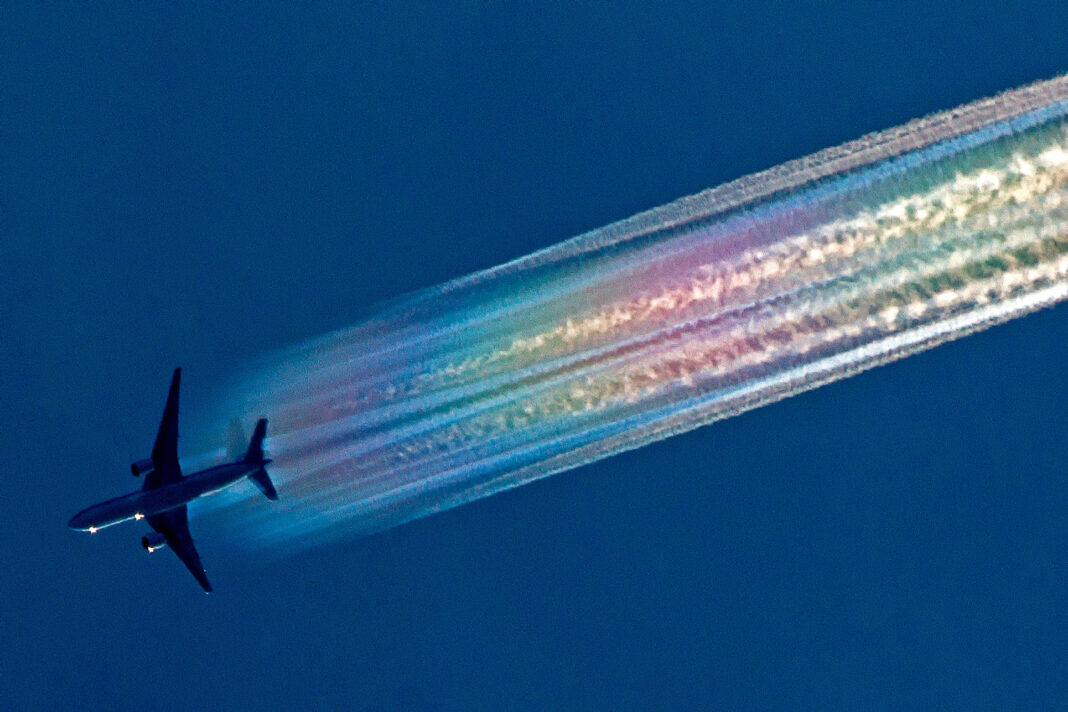
The internet is full of wonderfully silly theories about chemtrails that any crop-duster could debunk after flying barely above corn-detasseling altitude. Contrails don’t contain brain-altering drugs or other subversive substances. They are composed of water ice mixed with carbon dioxide(CO2), soot, nitrogen oxides(NOx) and other pollutants. These pollutants and the jet’s pressure wake can produce the conditions for forming contrails which can become cirrus clouds.
According to scientists at Penn State and the University of Wisconsin-Whitewater, the diurnal (night to day) temperature difference over the US increased by 1.1 degrees celsius during the three-day US flight ban after September 11, 2001. This is higher than had been in the previous 30 years. UW-Whitewater’s lead scientist David Travis told CNN, “I think what we’ve shown are that contrails are capable of affecting temperatures… Which direction, in terms of net heating or cooling, is still up in the air.”
Wouldn’t it be convenient if contrail-generated cirrus clouds reflected away exactly the right amount of sunlight to cool the earth and perfectly balance the heat-trapping effect of its CO2?
In 2011 Ulrike Burkhardt and Bernd Kärcher’s published Global radiative forcing from contrail-induced cloudiness in the international society for optics and photonics. They found the net heating effect from contrail-induced cloudiness and other emissions added to and exceeded the heating effect of CO2!
Eunice Newton Foote first discovered that CO2 and water vapor could trap heat in 1856. But unlike relatively inert CO2, the effects of water are difficult to predict. CO2 is transparent to incoming light and relatively opaque to outgoing longwave infrared energy.
The water vapor and ice in contrails blocks both incoming light and outgoing infrared energy but in different amounts depending on time of day, other cloud cover, season, local climate and other factors. The global reduction in air-traffic during Covid-19 provided opportunities to study these factors. Schumann, Pol, Teoh, Koelle et-al published Air traffic and contrail changes during COVID-19 over Europe: A model study in 2021.

Figure 8 from this study shows average optical thickness of contrails March-August 2019 (a) and the difference 2019-2020 (b). In (a) we see heavy contrail thickness over northwestern Europe. This makes sense because more contrails form where there are many flights and where the stratosphere is relatively cool. In (b) we see a drastic reduction in contrail thickness during the pandemic.

Figure 9 shows radiative forcing (RFnet) in watts per square meter from March-August 2019 and again in 2020. Colors from yellow to red mean there is a net heat input to earth and the blue end of the spectrum means there is a net loss of heat to the earth. Note that the areas of northwestern Europe which had high contrail thickness in 2019 also had a higher (redder) radiative forcing heat balance in 2019.
This and related studies are complex but fascinating to read or to pass along friends and family when they say things like, “Well I was cold when I was up to the lake last weekend so that whole climate change thing is B.S.” People devote their careers to studying climate science and the vast majority of these people are warning us to be careful about uncontrolled experiments with our atmosphere.
Bloomsday 2020
Bloomsday happening tomorrow is a commemoration and celebration of the life of Irish writer James Joyce, observed annually in Dublin and elsewhere on 16 June, the day his 1922 novel Ulysses takes place in 1904, the date of his first intimate encounter with his wife-to-be, Nora Barnacle, and named after its protabloomgonist Leopold Bloom.
In 2020, Covid-19 shortened the Chinese Lunar New Year celebrations. Venice ended Carnival early, Pope Francis gave a blessing to an empty St Peter’s square. The pandemic impacted the Hajj and religious celebrations throughout the world. Ireland cancelled Saint Patrick’s day parades and most Bloomsday celebrations.
But Bloomsday 2020 had something in common with the day Nora Barnacle and James Joyce met in 1904. Ireland’s drought ended after sunset on June 16, 2020 just as described in Ulysses:
“…But by and by, as said, this evening after sundown, the wind sitting in the west, biggish swollen clouds to be seen as the night increased and the weatherwise poring up at them and some sheet lightnings at first and after, past ten of the clock, one great stroke with a long thunder and in a brace of shakes all scamper pellmell within door for the smoking shower, the men making shelter for their straws with a clout or kerchief, womenfolk skipping off with kirtles catched up soon as the pour came.”