
Oldest spun cotton found in Israel

ancient organic cotton fibers under a microscope
Ancient organic cotton fibers under a microscope

Knitting evolved somewhere in the Middle East. And knitting as both a practical skill and creative craft has survived in certain areas of the Middle East and North Africa until the present day. But ancient cotton from the region was not from Egypt as it is today; but was believed to have come from either the Indus Valley, which is modern day Pakistan, or from Africa. Cotton wasn’t made locally in the Middle East. So what happens when ancient microscopic fibers of cotton turn up on an archeology dig in Israel? A look back into how we once lived. 

The oldest sample of cotton known to man in Israel or the Holy Land was found recently, dated to about 7,000 years old, we can interpret that ancient people were skilled in travel, trade and commerce.

The cotton was found by archeologists in the Jordan Vally, home to the River Jordan. The earliest evidence of cotton fibers in the region prior to the present study was dated to several centuries after the Early Bronze age (around 5000-6500 years ago) and comes from the Dhuweila, a site in eastern Jordan.

Although it is impossible to determine whether the cotton at Tel Tsaf, the ancient archeology site in Israel where the cotton was found, was manufactured from domesticated plants, the researchers believe that the early dating of the site means that it is highly probable that the cotton fibers came from the Indus Valley. 

Fibers of data on how we once were

It doesn’t look like much, certainly not a piece of cloth. Just some fibers under a microscope, and this kind of item is usually overlooked by archaeologists, the team explained. It’s hard to separate ancient fibers from the new. But when you look to the ancient microscopic elements at a dig, buried below the surface, images of food and trade and culture emerge that can tell the story of how we once lived.  

“The interesting thing about this ancient evidence of contact over such a great difference is that it comes from fibers, some of them microscopic fragments of ancient thread,” said Prof. Danny Rosenberg from Haifa University, part of the study along with Stanford. “We assume that these cotton threads, which were found together with wool and plant fibers, arrived at the site as part of fabrics or clothes, in other words as ancient textiles.

An ancient site in Israel explores how cotton was used in culture and trade
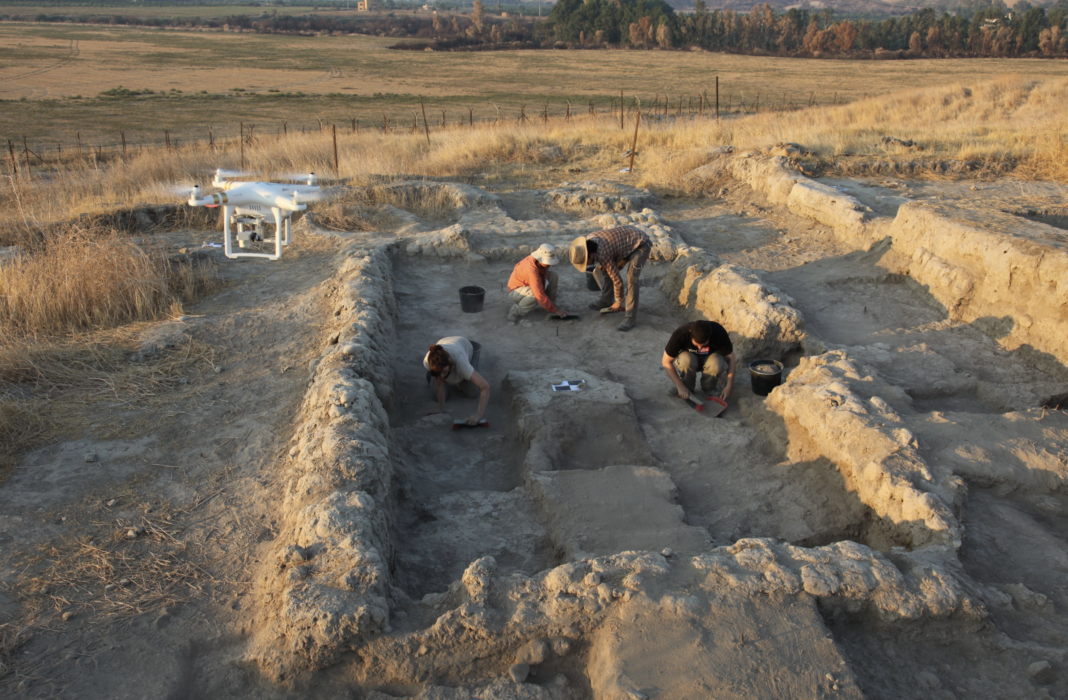
The site Tel Tsaf of the archeology dig in Israel where the ancient cotton fibers were found

Humans were already making textile products tens of thousands of years ago, creating fibers from various plants, such as flax, Rosenberg explained.  However, many fabrics and other organic materials tend to disintegrate rapidly if they are not preserved in dry or inorganic environments. As a result, these fibers are usually not found at sites in the Mediterranean climate zone, and most of the evidence comes from later texts and drawings, or from implements that were evidently used to manufacture textile fibers and products.

The location of where the ancient cotton was found is in a very hot area of Israel not far from the Sea of Galilee and close to the town of Afoula. To be more precise the ancient village was close to Kibbutz Sde Elihayu, where I lived for a year, working and studying. The kibbutz helped change the idea of organic agriculture in Israel, thanks to one of its members Mario Levi who I worked with in the fields for a short time.

Working to understand village dynamics

Back then, the village was called Tel Tsaf village and a home for a community of probably hundreds of people who thrived around a spring. The village thrived for some five hundred years, and one of the mysteries surrounding the site is why it ceased to be inhabited, given that there is no evidence of any distress or lack of resources.

This is one of the areas in which the researchers hope to invest a real effort over the coming years. “This was a period when small agrarian villages were beginning to expand and grow, and when the social structure was becoming more complex, creating the foundation for the later development of the important city-states in the region and facilitating the emergence of important technological and culinary innovations.

“We’re still trying to understand why at such an important junction in human history such a prosperous site simply ceased to exist,” the researchers. 

To the best of the researchers’ knowledge, modern-day cotton comes from four original sources – two in South and Central America; one in the Indus Valley, in modern-day Pakistan, where there is evidence of the use of cotton dating back some 6,000 years; and lastly in Africa, where the evidence concerning
the use of cotton dates back to the first century CE.

Studies of ancient DNA have shown that cotton was domesticated independently and separately in these regions. Although it is impossible to determine whether the cotton at Tel Tsaf was manufactured from domesticated plants, the researchers believe that the early dating of the site means that it is
highly probable that the cotton fibers came from the Indus Valley, rather than from a source
in Africa second old-world candidate.




Karin Kloosterman
Karin Kloostermanhttp://www.greenprophet.com
Karin Kloosterman is an award-winning journalist, innovation strategist, and founder of Green Prophet, one of the Middle East’s pioneering sustainability platforms. She has ranked in the Top 10 of Verizon innovation competitions, participated in NASA-linked challenges, and spoken worldwide on climate, food security, and future resilience. With an IoT technology patent, features in Canada’s National Post, and leadership inside teams building next-generation agricultural and planetary systems — including Mars-farming concepts — Karin operates at the intersection of storytelling, science, and systems change. She doesn’t report on the future – she helps design it. Reach out directly to [email protected]

Hot this week

How Renewable Energy is Revolutionizing the Way We Power Our World

Solar has become the star of the transition thanks to modular hardware and straightforward installation. It fits dense cities and remote towns alike. Many companies are turning to rooftop arrays and carport systems - and exploring commercial solar installation as a practical way to lock in future savings.

How does one start prepping?

Faced with an extreme winter storm this year, Americans wonder how to be prepared for catastrophe. Miriam has lived through wars in the Middle East - so she's prepared on giving you a guide to prepping.

Fishermen sue tire manufacturers on behalf of the salmon

A federal trial in San Francisco has brought US tire manufacturers, fishing groups, and environmental scientists into court over a chemical most drivers have never heard of — but which scientists say may be silently reshaping aquatic ecosystems.

Listening to Water: Tarek Atoui’s Next Work for Tate Modern

Born in Beirut, Lebanon in 1980 and now living in Paris, Atoui has spent years building instruments that don’t sit comfortably in concert halls. Many of them involve water, glass, and ceramics — materials that react to sound instead of simply producing it.

Leading Through a Dual-Energy Transition: Balancing Decarbonisation with Energy Security

Experience in one area of the energy industry isn't enough to guarantee readiness across all the others. That's where a structured program like an MBA in energy can come in. Today's advanced curricula explore energy economics, finance, policy, and strategic management alongside the technical subjects. And when pursuing an energy MBA online, professionals can skill up and retrain without having to step out of the labor market -- an important perk at a time when skilled professionals are already in short supply.

Topics

How Renewable Energy is Revolutionizing the Way We Power Our World

Solar has become the star of the transition thanks to modular hardware and straightforward installation. It fits dense cities and remote towns alike. Many companies are turning to rooftop arrays and carport systems - and exploring commercial solar installation as a practical way to lock in future savings.

How does one start prepping?

Faced with an extreme winter storm this year, Americans wonder how to be prepared for catastrophe. Miriam has lived through wars in the Middle East - so she's prepared on giving you a guide to prepping.

Fishermen sue tire manufacturers on behalf of the salmon

A federal trial in San Francisco has brought US tire manufacturers, fishing groups, and environmental scientists into court over a chemical most drivers have never heard of — but which scientists say may be silently reshaping aquatic ecosystems.

Listening to Water: Tarek Atoui’s Next Work for Tate Modern

Born in Beirut, Lebanon in 1980 and now living in Paris, Atoui has spent years building instruments that don’t sit comfortably in concert halls. Many of them involve water, glass, and ceramics — materials that react to sound instead of simply producing it.

Leading Through a Dual-Energy Transition: Balancing Decarbonisation with Energy Security

Experience in one area of the energy industry isn't enough to guarantee readiness across all the others. That's where a structured program like an MBA in energy can come in. Today's advanced curricula explore energy economics, finance, policy, and strategic management alongside the technical subjects. And when pursuing an energy MBA online, professionals can skill up and retrain without having to step out of the labor market -- an important perk at a time when skilled professionals are already in short supply.

From Green Energy to Healthy Societies: Why old systems thinking is becoming relevant again

Across the Middle East and North Africa, large investments are being made in green hydrogen, renewable energy, water infrastructure and sustainability. Most of these efforts are discussed in the context of climate change, decarbonization and economic diversification. That framing is important, but it may not capture their full value.

We saw peace – an interreligious encounter deep in our eyes

They came from Israel, Palestine, Jordan, Iraq, Yemen, Morocco, Tunisia, Lebanon, Egypt… There are Sunni Muslims, Shiite Muslims, Jews (Orthodox and Reform), Orthodox Christians, Coptic Christians, Protestant Christians, Druze, Baha'is, a Scientologist.

Can biochar reduce ‘Forever Chemicals’ in food if it’s used in farms?

Biochar is produced by heating organic material in a low-oxygen environment so it does not burn. This process, known as pyrolysis, transforms plant matter into a stable, carbon-rich material.

Related Articles

Popular Categories