Solar panels driving opium trade in Afghanistan

opium solar panels Afghanistan

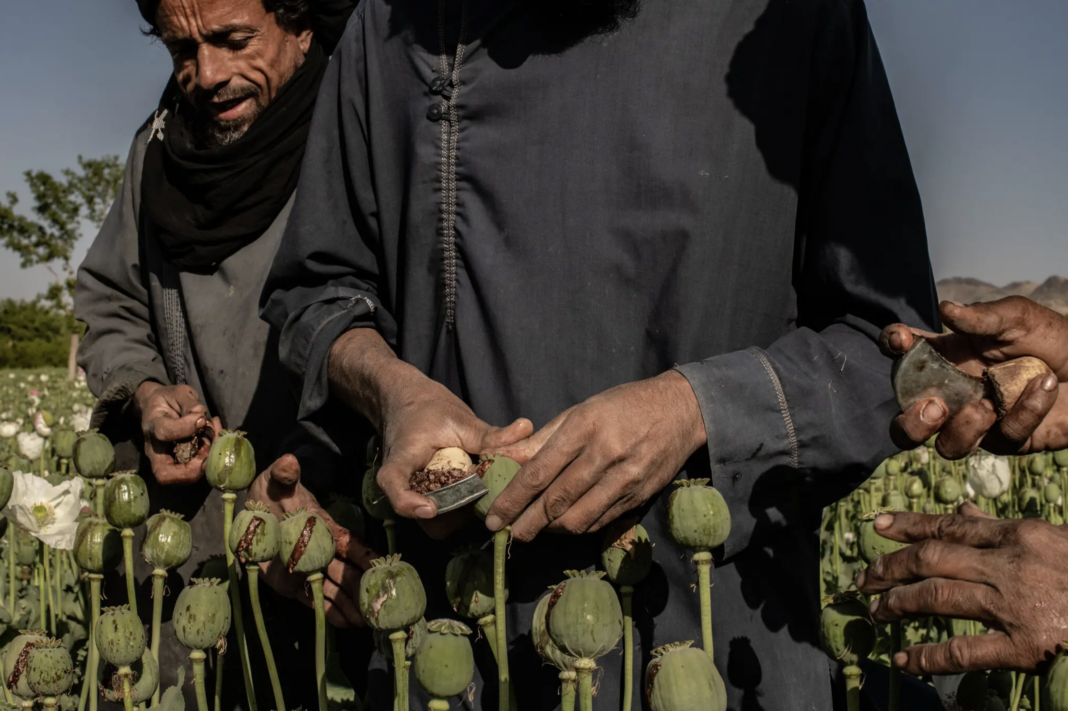
The Taliban walks between hypocrisy and holiness while trying to figure out how to profit from poppies and not damage its local economy. Image via the NY Times. 

Off-grid solar panels that provide electricity to water pumps in lost and forlorn areas in Afghanistan have led to an opium bounty. The solar pumps that are stand alone and not connected to an official electricity supply have allowed Afghans to dig deeper. The idea started around 2014 and bumper crops have appeared since.

In response the Taliban which both profits and denounces opium when it suits them, have started dismantling solar arrays so opium crops dry out

Still, more and more Afghans are investing several hundred dollars a year for seeds and equipment hoping to make a ballpark $5000 profit. According to the United Nations Office on Drugs and Crime, Afghanistan produced 83 percent of the world’s opium from 2015 to 2020. In short, if you use heroin, you fund terror.

The solar-powered electric pumps also allow farmers to grow all manners of crops such as wheat, pomegranates and garden plots in a critical time when dozens of millions of Afghans face extreme food insecurity.

oppy fields from space see the solar panels
Poppy fields from above in Afghanistan. See the solar panels?

While the various Afghan governments over the years have pledged to stamp out opium production and drug trafficking they are unable to forgo the billions of dollars of profits. Opium feeds and fuels the Taliban

“We’ve stood by on the sidelines and, unfortunately, allowed the Taliban to become probably the largest funded non-designated terrorist organization on the globe,” said a US official with knowledge of Afghanistan’s drug trade.

men working with poppies for opium
Men working in the poppy fields, New York Times

“The US and international partners have continued to pull out and not addressed poppy cultivation,” the official said on condition of anonymity. “What you’re going to find is that it has exploded.”

Now after 20 years and the Taliban back in power they announced April 3 that poppy cultivation is outlawed and violators will be punished under Shariah law.

The Taliban had enforced an effective ban on poppy cultivation in 2001, just before a US-led international military intervention toppled the regime. From 2002 to 2021, the US government spent almost $9 billion on counternarcotics as it fought Taliban insurgents in Afghanistan.

Taliban bans opium production for their benefit

The opium business earned Afghanistan about $1.8 billion to $2.7 billion last year, according to the United Nations with sales accounting for up to 14% of its GDP.   

According to a European Union-funded research project by David Mansfield opium farmers now rely on at least 67,000 solar powered water reservoirs. He has studied illegal economies and rural livelihoods in Afghanistan for the last two decades.

“It’s too bad for Afghans because poppy is the wealth of the Afghan people,” Shah Agha, 35, a poppy farmer from the Zari District of Kandahar, told the NY Times in a recent article.

“I think they banned it for their own benefit because most of the smugglers and Taliban commanders have tons of opium, and they might want to increase the prices,” Mr. Agha added.

Vice reported from the field about a month ago and noticed that despite the ban, it was harvest as usual.

With pictures in the Vice article of kids playing with bags of opium in the fields it’s easy to imagine the toll of addiction in Afghanistan in all ages abd walks of life. And it’s not only there.:Iran also faces drug addiction from illicit drugs such as heroin

Karin Kloosterman
Karin Kloostermanhttp://www.greenprophet.com
Karin Kloosterman is an award-winning journalist, innovation strategist, and founder of Green Prophet, one of the Middle East’s pioneering sustainability platforms. She has ranked in the Top 10 of Verizon innovation competitions, participated in NASA-linked challenges, and spoken worldwide on climate, food security, and future resilience. With an IoT technology patent, features in Canada’s National Post, and leadership inside teams building next-generation agricultural and planetary systems — including Mars-farming concepts — Karin operates at the intersection of storytelling, science, and systems change. She doesn’t report on the future – she helps design it. Reach out directly to [email protected]

TRENDING

Turning Your Energy Consultancy into an LLC: 4 Legal Steps for Founders in Texas

If you are starting a renewable energy business in Texas, learn how to start an LLC by the books.

Astro uses AI to help procure land for renewable energy

For oil-rich, environmentally vigilant Gulf states, Astro isn’t just another startup story. It is a blueprint for accelerating an energy transition that is now existential, not optional.

How Renewable Energy is Revolutionizing the Way We Power Our World

Solar has become the star of the transition thanks to modular hardware and straightforward installation. It fits dense cities and remote towns alike. Many companies are turning to rooftop arrays and carport systems - and exploring commercial solar installation as a practical way to lock in future savings.

Leading Through a Dual-Energy Transition: Balancing Decarbonisation with Energy Security

Experience in one area of the energy industry isn't enough to guarantee readiness across all the others. That's where a structured program like an MBA in energy can come in. Today's advanced curricula explore energy economics, finance, policy, and strategic management alongside the technical subjects. And when pursuing an energy MBA online, professionals can skill up and retrain without having to step out of the labor market -- an important perk at a time when skilled professionals are already in short supply.

M2PV Capital Targets the American Southwest as Its Launchpad for Off-Grid EV Growth

In the American Southwest, electric vehicles face extreme heat, long travel distances, and limited grid access that expose the real infrastructure gaps behind the EV transition. M2PV Capital is building off-grid charging and power systems designed to operate independently in the region’s most demanding conditions.

Turning Your Energy Consultancy into an LLC: 4 Legal Steps for Founders in Texas

If you are starting a renewable energy business in Texas, learn how to start an LLC by the books.

Tracking the Impacts of a Hydroelectric Dam Along the Tigris River

For the next two months, I'll be taking a break from my usual Green Prophet posts to report on a transnational environmental issue: the Ilısu Dam currently under construction in Turkey, and the ways it will transform life along the Tigris River.

6 Payment Processors With the Fastest Onboarding for SMBs

Get your SMB up and running fast with these 6 payment processors. Compare the quickest onboarding options to start accepting customer payments without delay.

Qatar’s climate hypocrisy rides the London Underground

Qatar remains a master of doublethink—burning gas by the megaton while selling “sustainability” to a world desperate for clean air. Wake up from your slumber people.

How Quality of Hire Shapes Modern Recruitment

A 2024 survey by Deloitte found that 76% of talent leaders now consider long-term retention and workforce contribution among their most important hiring success metrics—far surpassing time-to-fill or cost-per-hire. As the expectations for new hires deepen, companies must also confront the inherent challenges in redefining and accurately measuring hiring quality.

8 Team-Building Exercises to Start the Week Off 

Team building to change the world! The best renewable energy companies are ones that function.

Thank you, LinkedIn — and what your Jobs on the Rise report means for sustainable careers

While “green jobs” aren’t always labeled as such, many of the fastest-growing roles are directly enabling the energy transition, climate resilience, and lower-carbon systems: Number one on their list is Artificial Intelligence engineers. But what does that mean? Vibe coding Claude? 

Somali pirates steal oil tankers

The pirates often stage their heists out of Somalia, a lawless country, with a weak central government that is grappling with a violent Islamist insurgency. Using speedboats that swarm the targets, the machine-gun-toting pirates take control of merchant ships and then hold the vessels, crew and cargo for ransom.

Related Articles

Popular Categories