
Renewables made up more than half of all new energy sources in 2019

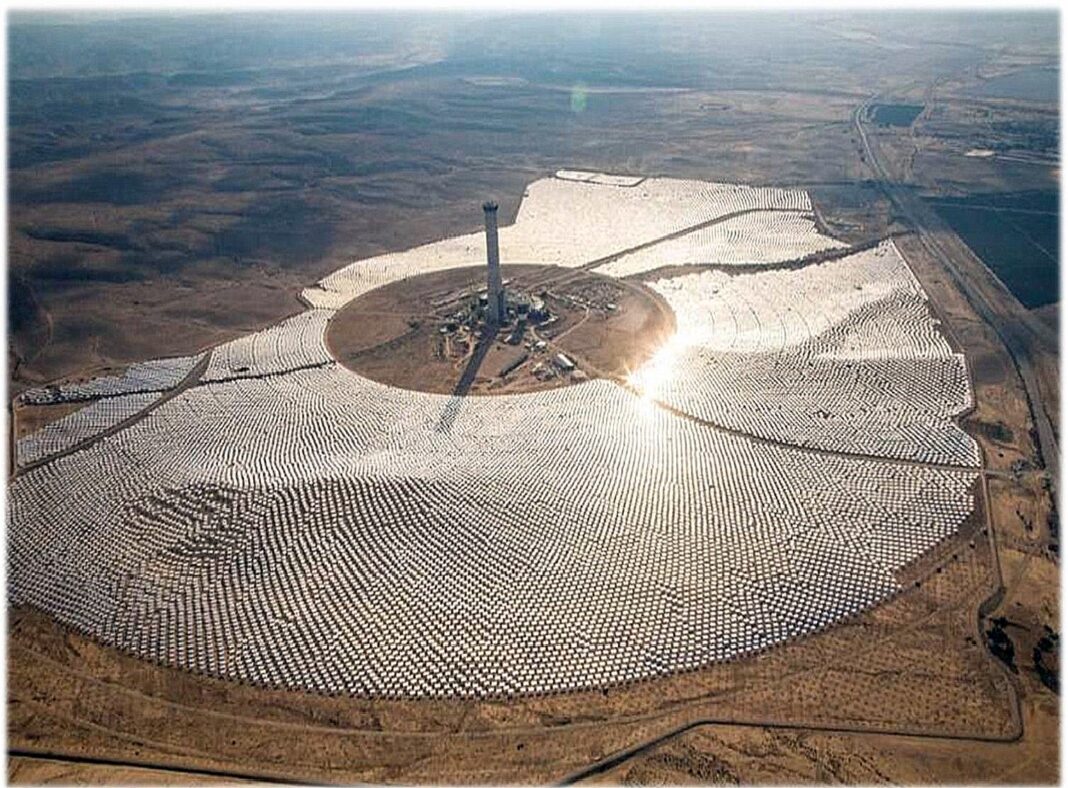
solar energy field in ramat hanegev

Let’s keep this up post-corona and anything the world might throw at us. Renewables keep economies and communities resilient. A solar energy field in Israel called Ashalim.

The renewable energy sector added 176 gigawatts (GW) of generating capacity globally in 2019, marginally lower than the (revised) 179 GW added in 2018. However, new renewable power accounted for 72 per cent of all power expansion last year, according to new data released by the International Renewable Energy Agency (IRENA).

IRENA’s annual Renewable Capacity Statistics 2020 shows that renewables expanded by 7.6 per cent last year with Asia dominating growth and accounting for 54 per cent of total additions. While expansion of renewables slowed last year, total renewable power growth outpaced fossil fuel growth by a factor of 2.6, continuing the dominance of renewables in power expansion first established in 2012. Solar and wind contributed 90 per cent of total renewable capacity added in 2019.

“Renewable energy is a cost-effective source of new power that insulates power markets and consumers from volatility, supports economic stability and stimulates sustainable growth,” said IRENA Director-General Francesco La Camera. “With renewable additions providing the majority of new capacity last year, it is clear that many countries and regions recognise the degree to which the energy transition can deliver positive outcomes.

2020 starts the decade of action

“While the trajectory is positive, more is required to put global energy on a path with sustainable development and climate mitigation – both of which offer significant economic benefits,” continued Mr. La Camera. “At this challenging time, we are reminded of the importance of building resilience into our economies. In what must be the decade of action, enabling policies are needed to increase investments and accelerate renewables adoption.”

Renewables accounted for at least 70 per cent of total capacity expansion in almost all regions in 2019, other than in Africa and the Middle East, where they represented 52 per cent and 26 per cent of net additions respectively. The additions took the renewable share of all global power capacity to 34.7 per cent, up from 33.3 per cent at the end of 2018.

Non-renewable capacity expansion globally followed long-term trends in 2019, with net growth in Asia, the Middle East and Africa, and net decommissioning in Europe and North America.

Solar added 98 GW in 2019, 60 percent of which was in Asia. Wind energy expanded by close to 60 GW led by growth in China (26 GW) and the United States (9 GW).

The two technologies now generate 623 GW and 586 GW respectively – close to half of global renewable capacity. Hydropower, bioenergy, geothermal and marine energy displayed modest year on year expansion of 12 GW, 6 GW, 700 MW and 500 MW respectively.

Asia was responsible for over half of new installations despite expanding at a slightly slower pace than in 2018. Growth in Europe and North America increased year on year. Africa added 2 GW of renewable capacity in 2019, half of the 4 GW it installed in 2018. A new organization called the Clean Gold Energy Alliance aims to make every new mine renewably powered by 2030. Green Prophet and the mining company Loncor – LN (TSE) in a JV with the world’s #2 gold company Barrick Gold TSE: ABX) is making that happen. More here on renewables needed in mining. And how renewables and the mining industry could save Africa.

Highlights by technology:

  • Hydropower: Growth was unusually low in 2019, possibly because some large projects missed their expected completion dates. China and Brazil accounted for most of the expansion, each adding more than 4 GW. A good idea in some instances, but expanding operations could lead to the destruction of the Nile. Some consider hydro power to be an interim solution to renewable energy.
  • Wind energy: Wind performed particularly well in 2019, expanding by nearly 60 GW. China and the United States continued to dominate with increases of 26 GW and 9 GW respectively.
  • Solar energy: Asia continued to dominate global solar capacity expansion with a 56 GW increase, but this was lower than in 2018. Other major increases were in the United States, Australia, Spain, Ukraine and Germany.
  • Bioenergy: Expansion of bioenergy capacity remained modest in 2019. China accounted for half of all new capacity (+3.3 GW). Germany, Italy, Japan and Turkey also saw expansion. This is also known as biogas. IT’s taking energy from organic sources like methane.
  • Geothermal energy: Geothermal power capacity grew by 682 MW in 2019, slightly more than in 2018. Again, Turkey led with an expansion of 232 MW, followed by Indonesia (+185 MW) and Kenya (+160 MW). Companies like Ormat, lead the way.  Their shares are up on the stock market ORA (TLV). 
  • Off-grid electricity: Off-grid capacity grew by 160 MW (+2%) to reach 8.6 GW in 2019. In 2019, off-grid solar PV increased by 112 MW and hydropower grew by 31 MW, compared to growth of only 17 MW for bioenergy.

Download the IRENA white paper report here.

Karin Kloosterman
Karin Kloostermanhttp://www.greenprophet.com
Karin Kloosterman is an award-winning journalist, innovation strategist, and founder of Green Prophet, one of the Middle East’s pioneering sustainability platforms. She has ranked in the Top 10 of Verizon innovation competitions, participated in NASA-linked challenges, and spoken worldwide on climate, food security, and future resilience. With an IoT technology patent, features in Canada’s National Post, and leadership inside teams building next-generation agricultural and planetary systems — including Mars-farming concepts — Karin operates at the intersection of storytelling, science, and systems change. She doesn’t report on the future – she helps design it. Reach out directly to [email protected]

LEAVE A REPLY

Please enter your comment!
Please enter your name here

TRENDING

Asia Powers Ahead in Global Renewable Boom, But Africa Risks Being Left Behind

Asia continues to dominate global renewable energy growth, accounting for 71% of new capacity added in 2024, while Africa and other developing regions remain far behind despite their potential. Solar and wind lead the charge, comprising 97.5% of additions, with solar alone adding 453 GW. Although global renewables capacity hit a record 582 GW, the world is still off track to meet the COP28 goal of tripling capacity by 2030. Without faster growth and more equitable investment, the energy transition risks deepening the global divide.

Renewable energy jobs increased by nearly 20% globally, but skewed by China

According to IRENA, renewable energy jobs are up by 20% but the lion's share of these jobs originate in Communist China.

The world needs to triple renewable energy capacity to 11.2 TW by 2030 to meet COP28 goal

"Renewables must grow at higher speed and scale. Our new report sheds light on the direction of travel; if we continue with the current growth rate, we will only face failure in reaching the tripling renewables target agreed in the UAE Consensus at COP28, consequently risking the goals of the Paris Agreement and 2030 Agenda for Sustainable Development.”

The world’s renewable electricity capacity hit a record 473 GW in 2023

The world’s renewable electricity capacity hit a record 473 GW in 2023, according to International Renewable Energy Agency (IRENA). And, no Turkey, nuclear energy is not renewable energy.

Geothermal company Ormat expands with $75 M USD loan

Ormat Technologies, a family energy business from Israel, has big plans for geothermal and recovered energy generation and the energy storage market

Qatar’s climate hypocrisy rides the London Underground

Qatar remains a master of doublethink—burning gas by the megaton while selling “sustainability” to a world desperate for clean air. Wake up from your slumber people.

How Quality of Hire Shapes Modern Recruitment

A 2024 survey by Deloitte found that 76% of talent leaders now consider long-term retention and workforce contribution among their most important hiring success metrics—far surpassing time-to-fill or cost-per-hire. As the expectations for new hires deepen, companies must also confront the inherent challenges in redefining and accurately measuring hiring quality.

8 Team-Building Exercises to Start the Week Off 

Team building to change the world! The best renewable energy companies are ones that function.

Thank you, LinkedIn — and what your Jobs on the Rise report means for sustainable careers

While “green jobs” aren’t always labeled as such, many of the fastest-growing roles are directly enabling the energy transition, climate resilience, and lower-carbon systems: Number one on their list is Artificial Intelligence engineers. But what does that mean? Vibe coding Claude? 

Somali pirates steal oil tankers

The pirates often stage their heists out of Somalia, a lawless country, with a weak central government that is grappling with a violent Islamist insurgency. Using speedboats that swarm the targets, the machine-gun-toting pirates take control of merchant ships and then hold the vessels, crew and cargo for ransom.

Leopoldo Alejandro Betancourt López Turned Ocean Plastic Into Profitable Sunglasses

Few fashion accessories carry the environmental burden of sunglasses. Most frames are constructed from petroleum-based plastics and acrylic polymers that linger in landfills for centuries, shedding microplastics into soil and waterways long after they've been discarded. Leopoldo Alejandro Betancourt López, president of the Spanish eyewear brand Hawkers, saw this problem differently than most industry executives.

Why Dr. Tony Jacob Sees Texas Business Egos as Warning Signs

Everything's bigger in Texas. Except business egos.  Dr. Tony Jacob figured...

Israel and America Sign Renewable Energy Cooperation Deal

Other announcements made at the conference include the Timna Renewable Energy Park, which will be a center for R&D, and the AORA Solar Thermal Module at Kibbutz Samar, the world's first commercial hybrid solar gas-turbine power plant that is already nearing completion. Solel Solar Systems announced it was beginning construction of a 50 MW solar field in Lebrija, Spain, and Brightsource Energy made a pre-conference announcement that it had inked the world's largest solar deal to date with Southern California Edison (SCE).

Related Articles

Popular Categories