
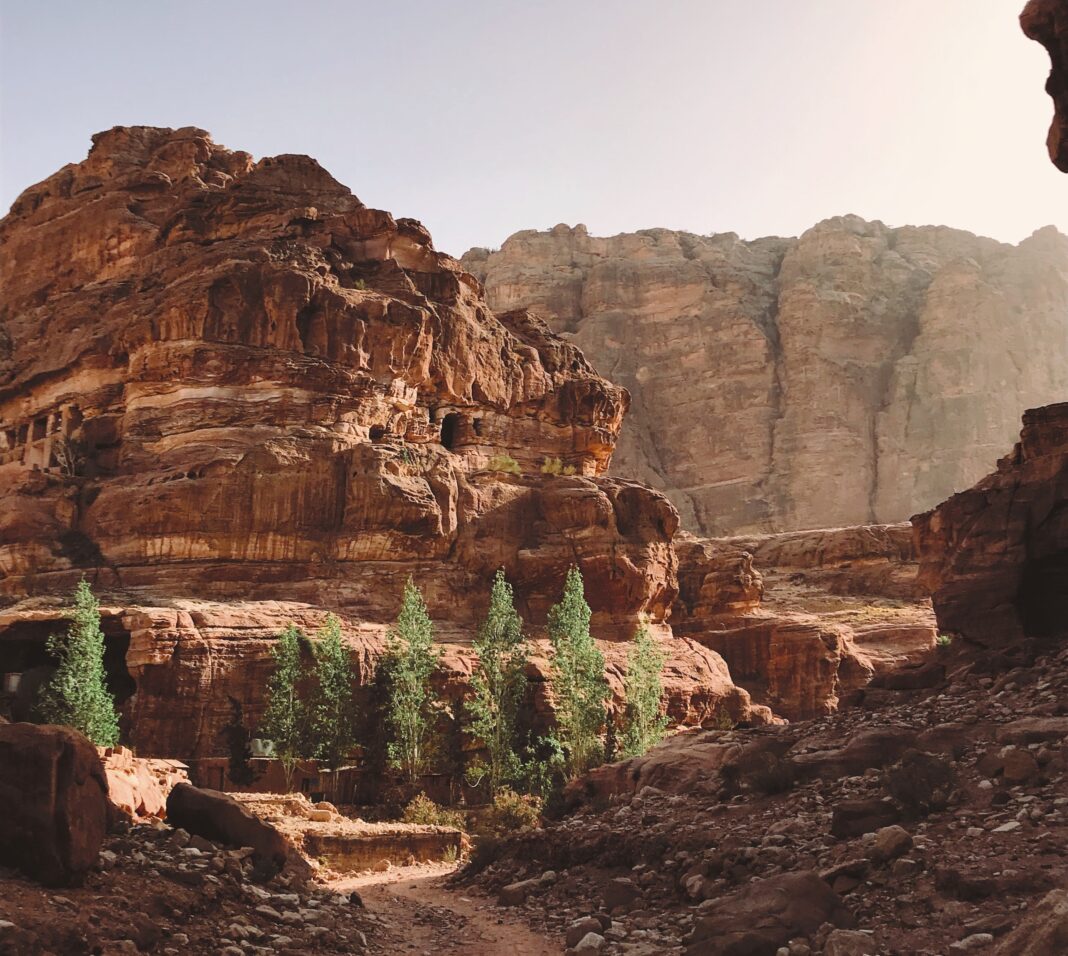


The first people to green the desert? Nabateans who built Petra were like the Mayans of the Middle East. The ancient people were developed in agriculture, spirituality and architecture. Archaeologists dig into how they dealt with drought in Jordan, one of the driest countries on earth.
Water harvesting, flood control and water storage were essential for the survival of the Nabataeans in the arid area of Petra, which is modern day Jordan. One of the driest countries on the planet, the early settlers there had to invent novel ideas to survive. They brought in engineers from afar, Rome probably, and built aqueducts and a water storage system that might be even able to produce drinkable water by today’s standards.
The book, The Petra Siq: Nabataean Hydrology Uncovered, published in 2003 by a Swiss architect and archaeologist Ueli Bellwald dealt with the very complex hydrological (water collection) system of the Nabataean capital, instead of the well-known temples and necropolis. Water collection was an every day and activity and we are grateful that researchers look into the past so we can understand how to survive tomorrow. Green Prophet interviews Bellward to learn more.

The location of Petra was significant and it provided indispensable water supply and flash flood retention systems, explains Bellwald who spent decades studying and writing about the hydraulic network of the Nabataeans.
Without the flash flood system, they wouldn’t last a year
According to Bellwald, who has also lived at Petra itself, the city was built inside a widening of the Wadi Musa, a natural runoff water drainage channel for a surface of 87 square kilometers; he added that without the construction of the highly sophisticated flash flood retention system Petra would not have survived a single winter rainy season.

Due to a geographical and a geological location of Petra there were no springs inside the city area which made thing more difficult for its inhabitants. Because of the geological conditions, all main springs in the area are located on the terraces of actual Wadi Musa, at a height of about 1,300 meters above the sea level, Bellwald explains, noting that the drinking water had to be led down to the city by long aqueducts.
The areas of the tombs and sanctuaries around the city served for collecting and storing water in large cisterns, and that water was used for agricultural purposes, he underlines.
The Nabataeans constructed a complex network of aqueducts and cisterns that is not in use now.
Stay in Petra, in an underground cave with this Bedouin
“If you take the number of drinking water reservoirs fed by the aqueducts and the number of cisterns for the storage of collected runoff water known up to today, you get a total number of more than 200 storage facilities with a capacity of about 40 million liters of water,” Bellwald underlined.
It is obvious that at the beginnings, when the city was established, there was no sufficient local expertise that would meet the requirements of the hydraulic systems to be built.
Just like today they brought in engineers
“I myself discovered a lot of features which did not fulfill their duties and were heavily damaged during their first strain and had to be rebuilt afterwards,” Bellwald noted, adding that very close similarities with other hydraulic installations in Rome and mainly in the Ionian cities, like Pergamon, lead him to the conclusion that the Nabataean authorities employed engineers from abroad and then adopted and further developed the basic expertise.

“For instance the remains of the very first spring water aqueduct which I excavated in the Petra Siq and another section which Graf, Schmid and Bedal [archaeologists specialized in the Nabateans and Petra] excavated in 2004/05 near the Temenos Gate, built in the middle of the 1st century BC, follows closely the model of Aqua Marcia in Rome, whereas the Khubtha North Aqueduct, the actually visible Siq Aqueduct and the Ain Braq Aqueduct follow models from Pergamon, mainly the Kaikos Aqueduct,” Bellwald elaborated.
However, we still don’t know names and biographies of the Nabataean engineers who realized these projects in the ancient times and their life remains a mystery to us.
What is more important for us today is how to utilize their expertise in a region that is overburdened with high natality and lack of water resources. In that regard Bellwald maintains that the Nabataean runoff water collection systems could still nowadays serve as a model for water collection and storage in arid regions.
“There is no agriculture without water, either from natural precipitation like barley fields in Thugra, or from irrigation,” stressed Bellwald, adding that irrigation may tremendously change the appearance of a landscape and may have great, positive impact on the climate.
A center for wine and olive oil
Moreover, in ancient times Petra was a center for wine and olive oil production and wine and olive presses scattered in Petra and its hinterland are the evidence of ancient agriculture.
What the scholar explored were runoff water retention dams with an extended catchment basin and maintenance stairs leading from the wadi (valley) bottom to the top of the dam.
“Experimental archaeological trials I made in the Thugra area showed that with the Nabataean runoff water collection systems you may even get drinkable water,” Bellwald concluded.




[…] In Arabic ‘Maraya’ means mirrors. The building, by designer Florian Boje of Gio Forma, Milan was inspired by the landscape in the same way that the landscape has inspired architecture and art for civilisations from the Nabataeans through to this day. Read here about Nabatean water conservation. […]