

The oldest evidence of food storage rituals has been found by researchers from the University of Haifa and the German Archaeological Institute in Berlin during excavations at the prehistoric site of Tel Tsaf, in Israel. An unusual pottery vessel illuminates how people climbed social statuses fast.
The vessel, which is over 7,000 years old, reveals for the first time the ritual and political significance of large scale food storage in the Ancient Near East.
Tel Tsaf provides first hand evidence of the early connection between food storage on a large scale and the observance of a ritual associated with the successful storage and preservation of agricultural yields,” explains Prof. Danny Rosenberg of the Zinman Institute of Archaeology at the University of Haifa, who heads the research project at Tel Tsaf together with Dr. Florian Klimscha from the German Archaeological Institute in Berlin.
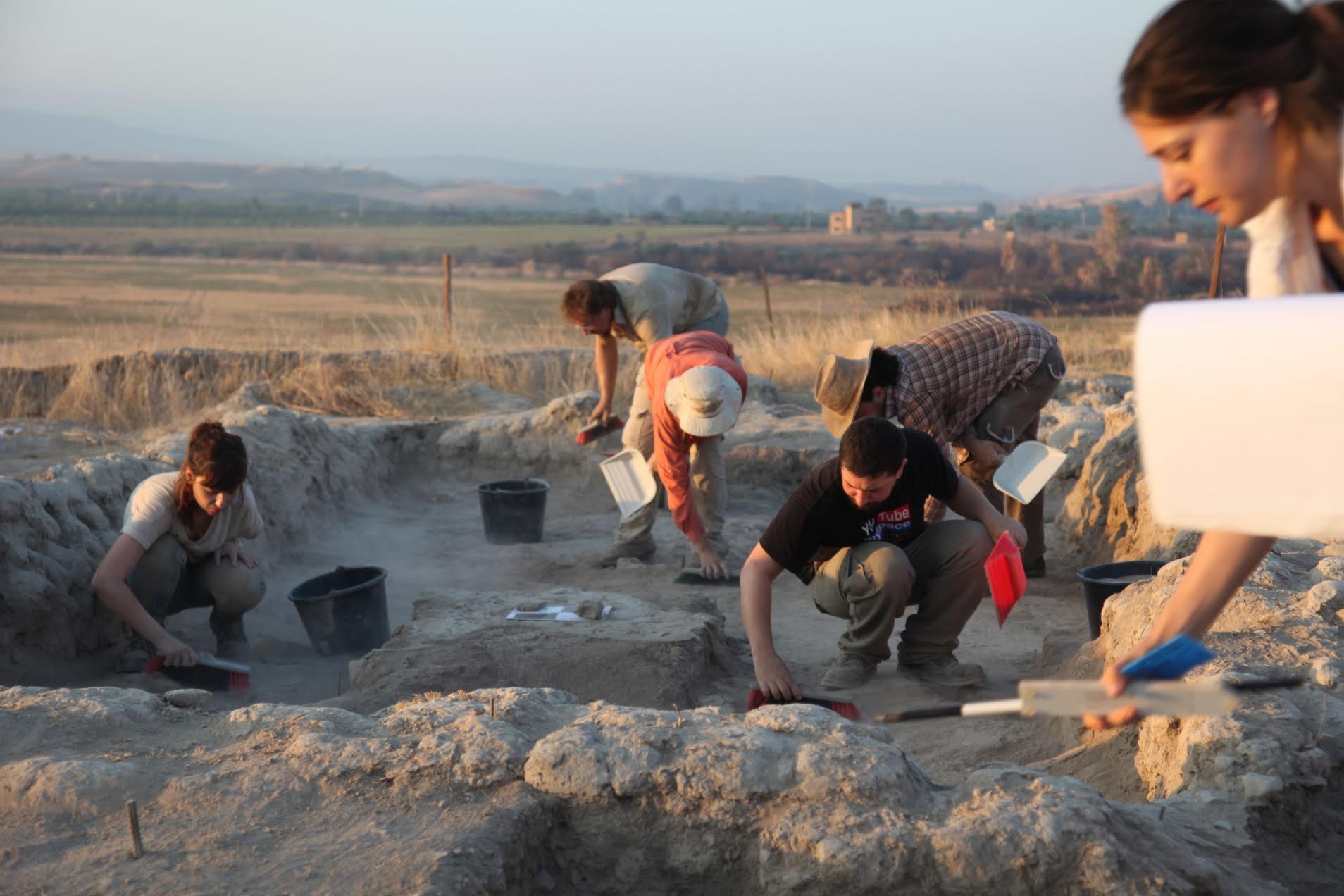
Tel Tsaf archeological site is located in the Jordan Valley, at the Jordan River and Israel’s border with the Kingdom of Jordan. The site was first documented in the late 1940s and has been excavated since the late 1970s, and later in 2004-2007. Since 2013, Rosenberg and Klimscha lead a multidisciplinary project at the site, one that focuses on the site’s economy and its ancient environment, with the assistance of an international team of experts and the use of advanced scientific methods.
Of the unique findings at Tel Tsaf, notable are the numerous silos used for large-scale grain storage, found in the courtyards of the buildings. The silos are evidence of the storage of food on a scale not previously documented at sites from this period. “The wish and ability to store food certainly constitutes an important step in the transition of humans to societies characterized by more complex social organization. It also seems that Tel Tsaf’s location near a major water source such as the Jordan River is no coincidence, considering the site’s potential to accumulate such a large amount of crops,” the researchers noted.
“The significance of storage for development of complex societies is evident by later testimonies from our own region, but even more so from Mesopotamia and Egypt, where complex, pre-state and state level societies emerged and engaged in the intensive storage of food, as an essential condition for the development of a social hierarchy. However, with the exception of Tel Tsaf, we have not yet found evidence of mass food storage in the region from 7,500 – 6,500 years ago in our region.”
Prof. Rosenberg explains that there has been a debate among researchers for many years concerning the early emergence of societies characterized by social and economic elites – a phenomenon that is frequently associated in our region with the Bronze Age. However, no evidence has previously been found showing that large-scale food storage in earlier societies was accompanied by social or ritual acts intended to ensure the successful storage and distribution of produce.
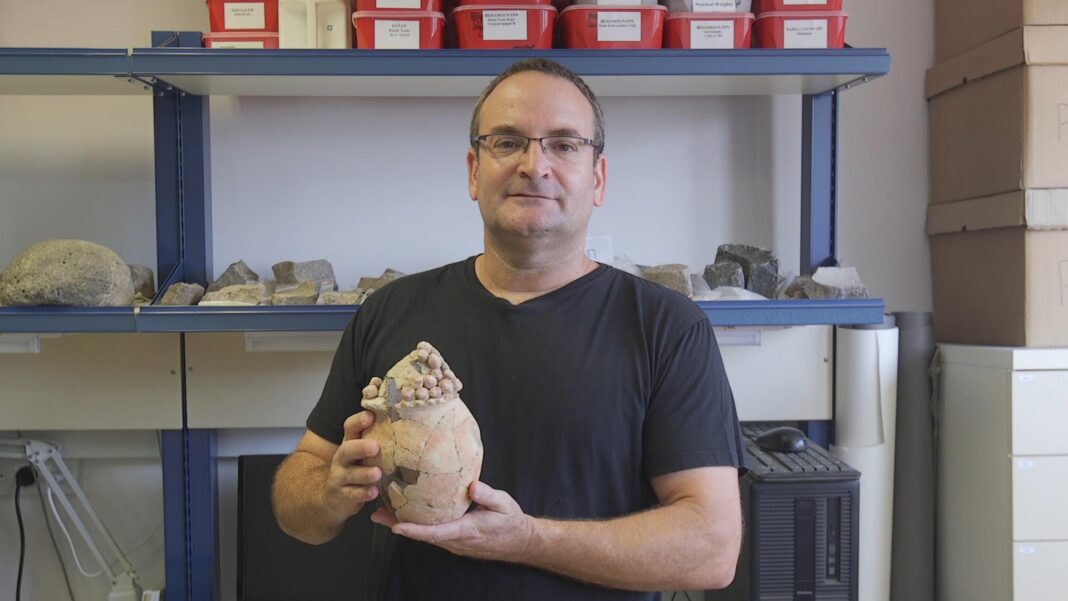
During the excavation season at Tel Tsaf two years ago, researchers found numerous pottery shards in a room situated in the center of a cluster of silos and cooking installations. The fragments appeared to belong to a single vessel. After painstaking work, they managed to reassemble the fragments, and were surprised to find a unique miniature vessel with a height of around 20 centimeters and a small window-like aperture on its side. “All the pottery vessels we are familiar with from this period have an opening on the top, facing up, just like most pots and cups in any modern kitchen. But this vessel is dome shaped, closed on the top, and covered with red-painted clay balls, whose significance is unclear to us,” Prof. Rosenberg notes.
The researchers believe that the vessel is actually a model of the silos themselves: “This vessel is not “functional” and was found in a building that was used for intensive storage, on the floor, in a room surrounded by numerous silos similar to those we are familiar with from archeological and ethnographic records from various parts of the world. We can hypothesize that this vessel was associated in some way with the silos, and particularly with the act of storage. From later evidence, we know that humans created vessels symbolizing larger storage structures, and indeed pottery vessels similar to this one, though larger, appear a few centuries later in our own region, used for secondary burial.
The size and characteristics of this vessel, together with the archeological context in which it was found, reinforce our assumption that this vessel symbolized the silos and was probably used in a ritual setting, perhaps as part of the ceremonies that preceded the placement of grains of wheat and barley in the silos, or their removal from storage,” the researcher explained.
The connection between the growth of food storage capacity and the human cycle of life and death is well known to researchers from various sources, including later findings from the Ancient Near East. “Tel Tsaf offers a glimpse into a unique time capsule, with excellent preservation of organic remains and other archaeological findings that reflect a thriving community practicing long-distance trade. Putting together all these findings, the picture reveals an increasingly strong connection between ritual and intense food storage and consumption.
We believe that the economic prosperity reflected by the astonishing findings from Tel Tsaf was accompanied by notable changes in the way the community of Tel Tsaf organized itself, and by rituals and ceremonies that were practiced in order to ensure that this prosperity will last. The model silo found in Tel Tsaf would seem to be one of the best examples of the connection between the wish to store large amounts of agricultural crops in order to gain social and economic advantage and rituals aimed to sustain and ensure economic prosperity” Rosenberg and Klimscha concluded.