


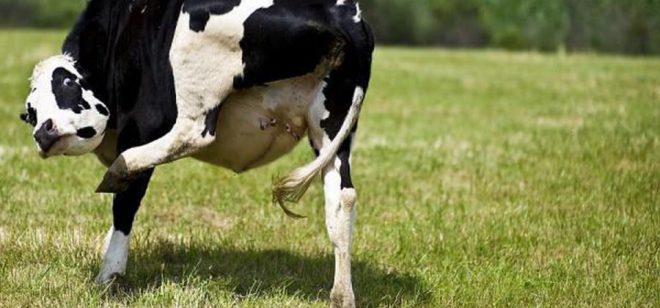
 It’s common knowledge that cows destined for the meat aisle are shot up with antibiotics and fed water and chow dosed with lower levels of the same, intended to promote growth and reduce disease. Turns out this does more damage than just create drug-resistant microbes. A recent study suggests they could also be boosting greenhouse gas emissions (GHG) via a most unsavory delivery vehicle: cow farts.
Cows are notoriously gassy animals. Their farts are laden with methane (CH4), one of the biggest contributors to climate change. Scientists studied the effects of a three-day course of tetracycline on the amount of methane present in cattle manure, finding that waste from cattle dosed with this common antibiotic held 80% more methane than that of untreated cattle. Their report, published online in the Proceedings of the Royal Society B, suggests that the increase links to a spike in methane-producing microorganisms within the digestive tracts of treated animals. Those organisms, called archaea, suppress growth of antibiotic-susceptible bacteria.
According to the US Environmental Protection Agency, the agriculture industry is the world’s primary source of CH4 emissions. In fact, emissions from cud-chewing livestock worldwide (think cattle, buffalo, sheep, goats, and camels) account for about 20% of global-warming-causing GHG. Animal waste and digestion produce both methane and nitrous oxide gas, which have respectively, 23 and 296 times the heat-trapping effect of carbon dioxide.
The Food and Agriculture Organization of the United Nations states that animal agriculture produces 65 percent of the world’s nitrous oxide from human-related sources and 37 percent of the methane. (The emissions result from their normal digestive process, but the emissions are considered human-related because humans raise these animals for food).
The latest findings are the first to link increased GHG emissions to antibiotic use in ranching. The researchers suggest that future studies should test the effect of antibiotics on cow belching, as methane emitted from manure is typically lower than that released from belching.
So what’s the solution?
Last year, a three-month-long study conducted in the dairy barns of America’s Penn State University claimed that feeding dairy cows a methane-inhibiting supplement reduced their methane emission by 30 percent, with no adverse affects on milk production or feed consumption. The supplement is 3NOP, which stands for 3-nitrooxypropanol.
Published in the Proceedings of the National Academy of Sciences, that study explained how 3NOP targets the enzyme methyl-coenzyme M reductase, present in the animal’s rumen. The rumen, or paunch, is the organ responsible for methane production. The inhibitor could potentially be used in other breeds of livestock.
Unfortunately, these remedies may prove problematic for organic farmers. Enter Naturmælk, a Danish organic dairy looking for ways to make its products more climate-friendly. The company is sponsoring development of a natural remedy to cut GHG emissions by feeding animals methane-reducing herbs, as example, alfalfa and oregano.
“Oregano has essential oils with a mild antimicrobial called carvacrol, which can kill some of the bacteria in the cow’s rumen that produce methane,” Kai Grevsen, a senior researcher at Aarhus University who specializes in crop science told National Public Radio program The Salt. “Of course, you can’t kill all the bacteria, or the cow would die.”
The Danish study – which runs through 2019 – builds on earlier research by the lead scientist from the Penn State team, and will include testing on several organic dairy farms. The Danish team will use “Greek oregano,” which has a much higher concentration of burp-busting essential oil than oregano used in earlier research. They expect that this herb-infused feed could cut methane emissions by up to 25 percent.
“A cow loses a lot of energy in releasing all this methane,” explains Grevsen. “By blocking the bacteria, the energy that doesn’t get lost can be used by the cow to produce more milk.”
One anticipated obstacle is economics; cultivating oregano in anticipated volumes is not cheap. In fact, a key part of this study focuses on how to produce the best herb specimens and how best to use them. It is not yet known what oregano will do to the taste of milk.
Denmark is the right place to conduct the tests. The flat nation, surrounded by seas, is maximally vulnerable to climate change. The political climate is right too: the Danish Council on Ethics has floated a food tax based on calculated environmental impact, and although legislation has not been enacted, the Danish market naturally gravitates to sustainable food. Thirty percent of their domestic milk sales is for organic products.
Livestock, natural ecosystems (such as wetlands), and human activities (such as leakage from natural gas systems) all produce methane. It’s lifetime in the atmosphere is much shorter than carbon dioxide (CO2), but CH4 is more efficient at trapping radiation than CO2. According to the US EPA, the comparative impact of CH4 on climate change is more than 25 times greater than CO2 over a 100-year period.
This news might offer incentive to try meatless Mondays, or offer another argument in support of full-bore vegetarianism. And brace yourself for pizza-flavored dairy.


sorry a word was missing from my first sentence above Cows are getting a hugely BAG rap-
I think cows are getting a hugely rap. They are being used as a smokescreen for the Natural gas and Fracking industries which have been off-gassing huge amounts of CH4 ie methane AKA Natural Gas from its thousands of leaky well heads all over the world. Check out episode 6 entitled “Winds of Change” of the Emmy award-winning series about climate change called the years of Living Dangerously. In the movie an expert says that Naural gas is ONLY better than Coal if less than 1% of gas was leaking into the air rather than being captured… In the movie and as turned up n the news recently is the fact that very few wells are managing to keep their natural gas losses to under 1%. Some wells are spewing gas at a rate of 11% to 17 percent losses.
Nature evolved grass-eating four- leggeds to roam free in large herds sweeping into an area, consuming the grasses fertilizing with their manure, and churning the soil with their hooves then move on to give rise to new life…. The symbiotic relationship between ruminants AND the carbon trapping grasses they would feed on is being ignored by those wanting to blame cows for climate change. check out the Savory institutes finding about the usefulness of properly managed ruminants in aid in maintaining the HEALTH of the grasses- which are hugely important CO2 sequestering carbon sink just like trees and other vegetation.
On the USA plains the vast herds of buffalo and deer and caribou which roamed free were replaced by cattle. All of these four legged grass-eating species are all ruminants. Like goats, deer, buffalo, bison, giraffe, moose and elk, cows belch up methane as they move foods from one stomach in their digestion process…