

 Each day, something terrible happens somewhere in this world. Families and communities are torn apart and thrown together in unfamiliar ways. Strangers who had found one another just barely tolerable become fellow humans, grieving needing and helping one another to survive.
“My name is Sidra. I am 12 years old… I have lived here in the Zaatari camp in Jordan for the last year and a half.”
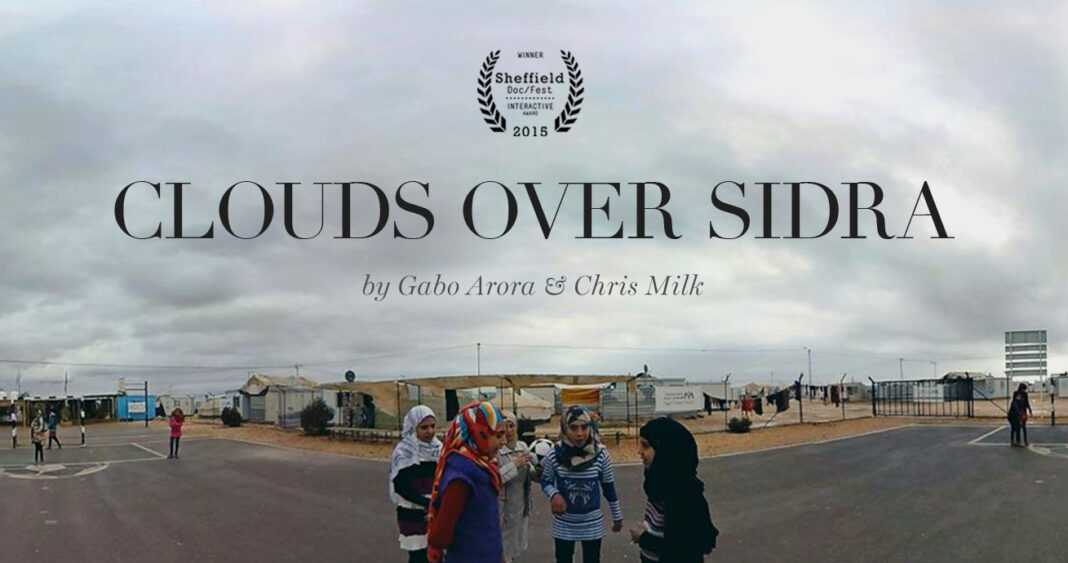
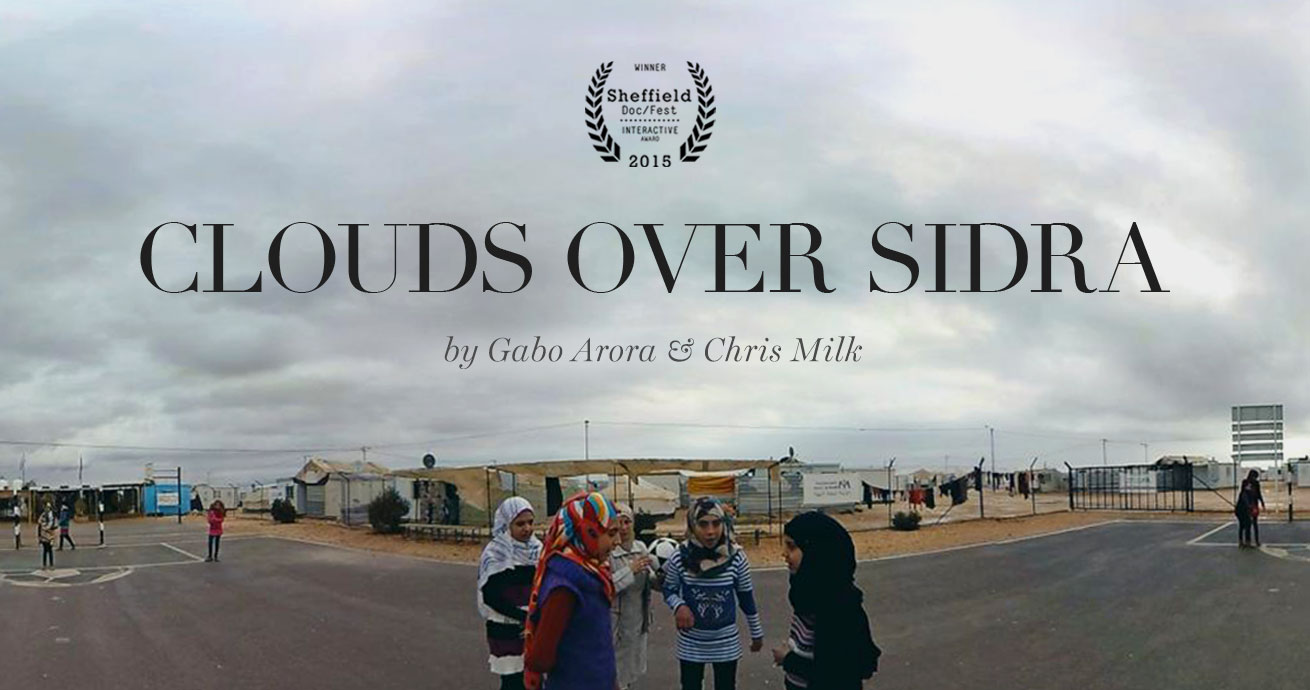
Filmmaker Chris Milk took his empathy machine and virtual reality concept to the Zaatari refugee camp in Jordan. This is where a majority of Syrian refugees have fled to, and a couple of Green Prophet writers have been leading projects to mitigate the suffering. His new virtual reality film can help us imagine standing in their shoes and see and feel more about the lives of these vulnerable people.
Milk is using Virtual Reality (VR) technology to increase our emotional bandwidth beyond what was possible in movies. VR technology has been with us for decades but it has been refined and its cost has dropped dramatically.
Occulus Rift, Google Cardboard and other VR devices will be hot sellers in the coming year. But Chris Milk didn’t wait. He shot “Clouds over Sidra” at Jordan’s Zaatari refugee camp.
[youtube]https://www.youtube.com/watch?v=FFnhMX6oR1Q[/youtube]
This was the first Virtual reality film ever made for the United Nations. Chris explains that unlike film where the viewer is looking through a window frame, this technology takes the viewer through the frame so that they experience what it is like to be in the room with Sidra or sitting next to her in her classroom.
The project was presented to UN dignitaries in Geneva, Switzerland and it did seem to make a difference in their perceptions. Maybe it will for each of us.
Try it yourself by downloading Google Play, VRSE and viewing “Clouds over Sidra” on VRSE, Google Cardboard or other virtual reality devices. If you watch this film on non-VR devices you’ll see it as a distorted 360 degree movie.
The mechanical details of each tragedy are broadcast to the world via live satellite. While survivors are still struggling to breath, observers are consumed with the statistics of disaster.
A category 5 hurricane, a magnitude 7.3 earthquake, the killers were quiet men who kept to themselves. The death toll was 404.
These facts spark our most primitive emotions first because these require the fewest bits of information. We fear that this tragedy might happen to us or we grow angry and seek to punish the real or imagined cause. Our despair grows as these darker motions consume us.
Empathy is a more complex, less primitive and more uniquely human emotion. According to a Princeton and Duke University study entitled, “Brain’s Social Network Implicated in Dehumanizing Others,” by Rick Nauert, MRI scans show that there is a part of the human brain associated with empathy.
But prejudice, racism and socioeconomic status can turn off this empathic part of a person’s brain and enable one associated with disgust. Might this empathy gap explain why people tend to shun war refugees at the same time as they spend millions of dollars per day on wars?
Empathy seems to require more communication bandwidth. Sometimes it requires direct contact with loved-ones in the faraway land or a memories of a time when we ourselves also lived through such a tragedy. Music, photography and visual arts can also trigger empathy. Functional MRI studies have found that literature literally helps us get inside the minds of others by activating the same regions in our brain that tell us the story of who we are.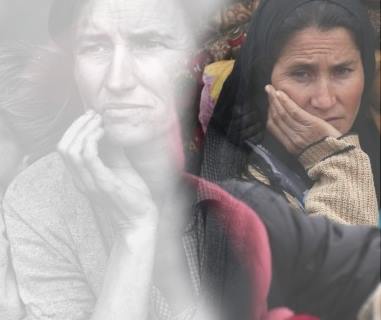
Whatever the cause for the connection, some people are able to feel deeply for the victims of disaster. Their empathy expands to the scale of the disaster. The may lose sleep, grow physically sick or fall into a depression. Or they might feel compelled to do something, anything to try to fix whatever it is that is broken with the world, with the focus on the needs of the victims rather than the punishment of the cause.
 The late film critic Roger Ebert considered empathy to be the most essential quality of a civilization, “We all are born with a certain package. We are who we are: where we were born, who we were born as, how we were raised.
“We’re kind of stuck inside that person, and the purpose of civilization and growth is to be able to reach out and empathize a little bit with other people. And for me, the movies are like a machine that generates empathy. It lets you understand a little bit more about different hopes, aspirations, dreams and fears. It helps us to identify with the people who are sharing this journey with us.”
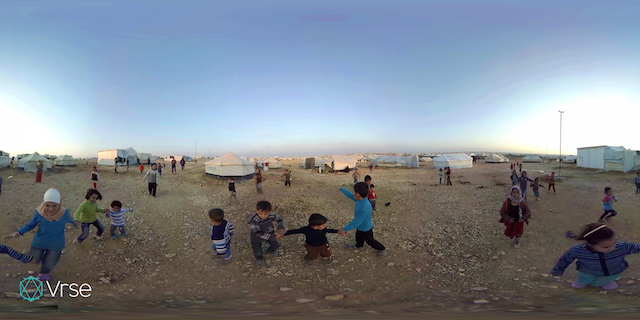
Photos from Chris Milk’s “Clouds over Sidra” at VRSE.
Photo of Migrant mother (1936) by Dorthy Lange.
Photo of Syrian refugee woman(2015) by Washington Post
Thanks also to my Lebanese-American cousin Mud for her thoughtful piece on emotional responses to disasters, Laurie Balbo who works with Studio Syria and Collateral Repair; Gael at Dar al Yasmin for giving my family some non-virtual reality experience with Syrian refugees to help us imagine them not as anonymous faraway strangers, but as human beings.


[…] Each day, something terrible happens somewhere in this world. Families and communities are torn apart and thrown together in unfamiliar ways. Strangers who had found one another just barely tolerable become fellow humans, grieving needing and helping one another to survive. […]
[…] Originally published in Green Prophet Each day, something terrible happens somewhere in this world. Families and communities are torn apart and thrown together in unfamiliar ways. Strangers who had found one another just barely tolerable become fellow humans, grieving needing and helping one another to survive. […]
[…] Real life virtual reality download of how Syrian refugees live Milk is using Virtual Reality (VR) technology to increase our emotional bandwidth beyond what was possible in movies. VR technology has been with us for decades but it has been refined and its cost has dropped dramatically. Occulus Rift, Google … Read more on Green Prophet […]