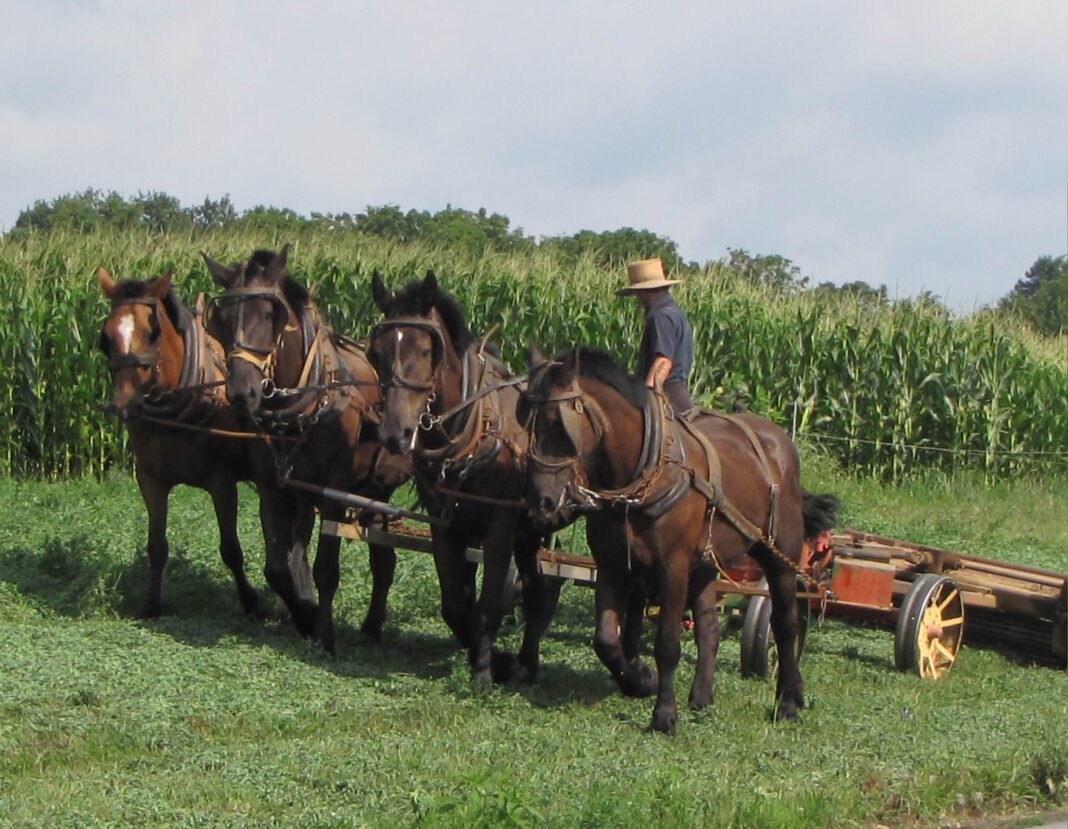
Small scale farming twice as old as we thought

Amish_Farmer

Big agriculture is mainstream in the US, but growing our food has a long history. Until now, researchers believed farming was “invented” some 12,000 years ago in the Cradle of Civilization — Iraq, the Levant, parts of Turkey and Iran — an area that was home to some of the earliest known human civilizations.

A new discovery by an international collaboration of researchers from Tel Aviv University, Harvard University, Bar-Ilan University, and the University of Haifa offers the first evidence that trial plant cultivation began far earlier — some 23,000 years ago.

The study focuses on the discovery of the first weed species at the site of a sedentary human camp on the shore of the Sea of Galilee. It was published in PLOS ONE and led by Prof. Ehud Weiss of Bar-Ilan University in collaboration with Prof. Marcelo Sternberg of the Department of Molecular Biology and Ecology of Plants at TAU’s Faculty of Life Sciences and Prof. Ofer Bar-Yosef of Harvard University, among other colleagues.

“While full-scale agriculture did not develop until much later, our study shows that trial cultivation began far earlier than previously believed, and gives us reason to rethink our ancestors’ capabilities,” said Prof. Sternberg. “Those early ancestors were more clever and more skilled than we knew.”

Evidence among the weeds

Although weeds are considered a threat or nuisance in farming, their presence at the site of the Ohalo II people’s camp revealed the earliest signs of trial plant cultivation — some 11 millennia earlier than conventional ideas about the onset of agriculture.

The plant material was found at the site of the Ohalo II people, who were fisher hunter-gatherers and established a sedentary human camp. The site was unusually well preserved, having been charred, covered by lake sediment, and sealed in low-oxygen conditions — ideal for the preservation of plant material. The researchers examined the weed species for morphological signs of domestic-type cereals and harvesting tools, although their very presence is evidence itself of early farming.

“This uniquely preserved site is one of the best archaeological examples worldwide of the hunter-gatherers’ way of life,” said Prof. Sternberg. “It was possible to recover an extensive amount of information on the site and its inhabitants.”

“Because weeds thrive in cultivated fields and disturbed soils, a significant presence of weeds in archaeobotanical assemblages retrieved from Neolithic sites and settlements of later age is widely considered an indicator of systematic cultivation,” according to the study.

Early gatherers

The site bears the remains of six shelters and a particularly rich assemblage of plants. Upon retrieving and examining approximately 150,000 plant specimens, the researchers determined that early humans there had gathered over 140 species of plants. These included 13 known weeds mixed with edible cereals, such as wild emmer, wild barley, and wild oats.

The researchers found a grinding slab — a stone tool with which cereal starch granules were extracted — as well as a distribution of seeds around this tool, reflecting that the cereal grains were processed for consumption. The large number of cereals showing specific kinds of scars on their seeds indicate the likelihood of those cereals growing in fields, and the presence of sickle blades indicates that these humans deliberately planned the harvest of cereal.

The new study offers evidence that early humans clearly functioned with a basic knowledge of agriculture and, perhaps more importantly, exhibited foresight and extensive agricultural planning far earlier than previously believed.


Karin Kloosterman
Karin Kloostermanhttp://www.greenprophet.com
Karin Kloosterman is an award-winning journalist, innovation strategist, and founder of Green Prophet, one of the Middle East’s pioneering sustainability platforms. She has ranked in the Top 10 of Verizon innovation competitions, participated in NASA-linked challenges, and spoken worldwide on climate, food security, and future resilience. With an IoT technology patent, features in Canada’s National Post, and leadership inside teams building next-generation agricultural and planetary systems — including Mars-farming concepts — Karin operates at the intersection of storytelling, science, and systems change. She doesn’t report on the future – she helps design it. Reach out directly to [email protected]
1 COMMENT

LEAVE A REPLY

Please enter your comment!
Please enter your name here

TRENDING

EU’s CAP reform continues trend of supporting small farmers in hour of need

Despite mounting political opposition, growing scientific criticism and even the retreat of many former industrial supporters like Nestlé and Danone, certain member-states and supermarket chains continue to prop up Nutri-Score. The Commission must therefore remain vigilant to ensure these attempts do not undermine farmers, distort fair competition or compromise the integrity of the single market – particularly as other pressing threats loom on the horizon.

New advances on making aquaponics a valid business

Researchers from a desert country, where food growing is limited due to lack of water, offer a new proof of concept for a new closed loop system called aquaponics that produces more fish and vegetables while using less energy than conventional systems.

Make moss graffiti

Express your green views for all to see - right on the walls of your house, restaurant or office. Moss grafitti is the hottest trend in urban agriculture, after hydroponics and vertical farming.

Saudi greenhouses to feed desert people

With its resilient hybrid tomato rootstocks already available in the market, iyris has proven the commercial viability of their technology in open-field trials.

DoTERRA Plants 500,000 Trees, Sowing Positive Seeds of Change in Hawaii

The KMR initiative is not simply about planting trees. DoTERRA has developed a comprehensive management plan in partnership with the Hawaii State Division of Forestry and Wildlife. This plan aims to reestablish a healthy native forest, ensuring that the reforestation efforts have long-lasting effects.

Qatar’s climate hypocrisy rides the London Underground

Qatar remains a master of doublethink—burning gas by the megaton while selling “sustainability” to a world desperate for clean air. Wake up from your slumber people.

How Quality of Hire Shapes Modern Recruitment

A 2024 survey by Deloitte found that 76% of talent leaders now consider long-term retention and workforce contribution among their most important hiring success metrics—far surpassing time-to-fill or cost-per-hire. As the expectations for new hires deepen, companies must also confront the inherent challenges in redefining and accurately measuring hiring quality.

8 Team-Building Exercises to Start the Week Off 

Team building to change the world! The best renewable energy companies are ones that function.

Thank you, LinkedIn — and what your Jobs on the Rise report means for sustainable careers

While “green jobs” aren’t always labeled as such, many of the fastest-growing roles are directly enabling the energy transition, climate resilience, and lower-carbon systems: Number one on their list is Artificial Intelligence engineers. But what does that mean? Vibe coding Claude? 

Somali pirates steal oil tankers

The pirates often stage their heists out of Somalia, a lawless country, with a weak central government that is grappling with a violent Islamist insurgency. Using speedboats that swarm the targets, the machine-gun-toting pirates take control of merchant ships and then hold the vessels, crew and cargo for ransom.

Leopoldo Alejandro Betancourt López Turned Ocean Plastic Into Profitable Sunglasses

Few fashion accessories carry the environmental burden of sunglasses. Most frames are constructed from petroleum-based plastics and acrylic polymers that linger in landfills for centuries, shedding microplastics into soil and waterways long after they've been discarded. Leopoldo Alejandro Betancourt López, president of the Spanish eyewear brand Hawkers, saw this problem differently than most industry executives.

Why Dr. Tony Jacob Sees Texas Business Egos as Warning Signs

Everything's bigger in Texas. Except business egos.  Dr. Tony Jacob figured...

Israel and America Sign Renewable Energy Cooperation Deal

Other announcements made at the conference include the Timna Renewable Energy Park, which will be a center for R&D, and the AORA Solar Thermal Module at Kibbutz Samar, the world's first commercial hybrid solar gas-turbine power plant that is already nearing completion. Solel Solar Systems announced it was beginning construction of a 50 MW solar field in Lebrija, Spain, and Brightsource Energy made a pre-conference announcement that it had inked the world's largest solar deal to date with Southern California Edison (SCE).

Related Articles

Popular Categories