

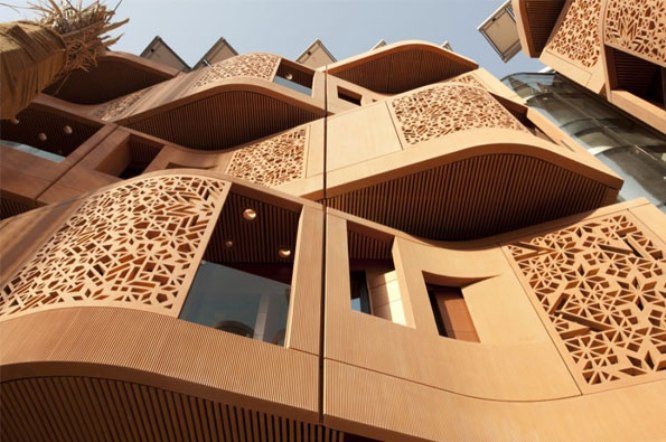
As an intern at Masdar Institute, I’ve witnessed firsthand how real and possible a drastically improved world is. Masdar serves as a real-life experiment of how our sustainable future might look like.
Solar energy generated by a 10-megawatt solar photovoltaic plant as well as panels mounted on the institute’s buildings provide nearly all of the electricity. Many ingenious techniques were used to decreasing the need for energy consumption. Masdar, which is the Arabic word for source, is also the name of the quickly developing sustainable city built with minimal Carbon emissions, and is where the Institute is located in Abu Dhabi, UAE.
The US department of Energy ranked the UAE 6th globally in petroleum production for 2014, and listed 6 Middle Eastern countries in the top 15. With fossil fuels as the lead emitter of greenhouse gases and the biggest contributor to Climate Change, the Arab World will be a key player this December, when the world will turn its eyes towards COP21 negotiations in Paris. (See coverage of COP20)
COP21, the 21st UN Framework Convention on Climate Change Conference of Parties, comes with a long overdue goal; to achieve a legally binding and universal agreement on Climate Change. It is crucial for nations around the world to raise their ambitions and shorten their timelines.
The effects of man-made Climate Change will not spare this region. In fact, according to a report released by the World Bank during COP18 which took place in Doha, Qatar, Climate Change effects in the Arab World will be dire.
The Arab region has the lowest freshwater resource endowment in the world. Climate Change is expected to decrease water runoff further still by 10% by 2050, while demand is projected to increase 60% by 2045 due to increases in population and per capita use. This, along with changing temperatures, will also decrease agricultural production.
Furthermore, more people are moving into urban areas already due to droughts and resources shortage. A recent study mentioned by a National Geographic article says that rural-to-urban migration helped spark the uprising and consecutive war in Syria, which has displaced millions and killed hundreds of thousands of people.
The Arab region is already very vulnerable to wars and security threats. Another report released by the Pentagon affirmed that Climate Change will have immediate threats to national security. This is true all over the world, as the number of climate refugees keep going up, and resources become scarcer.
A 2014 report released by the Intergovernmental Panel on Climate Change (IPCC) states that in order to limit the destructive effects of Climate Change, the world temperature rise will need to be limited to 2 degrees Celsius. The report states that in order to have a likely chance of limiting the increase by that much, we will need to lower global greenhouse gas emissions by 40% -70% compared to 2010 by mid-century, and to near-zero by the end of this century. This is no easy task and will require a “worldwide push over the next 15 years” according to experts appointed by the UN.
These alarming numbers and predictions are not to mention increasing floods, effects on tourism and historical sites, as well as larger gender equality gaps. Three years later since the publishing of this report, we are still short from having concrete action plans to contain these devastating effects, which the IPCC report says is still possible. The only way to avoid the worst is to act big, and act fast.
The scientific evidence is overwhelming: We are running out of time.
This is a guest post by Munira Sibai, an engineering student and environmental advocate who has attended the UN Climate Change negotiations in 2012 in Doha and in 2013 in Warsaw.


While this is a sweet little doom and gloom piece from Munira, there’s nothing substantial about Masdar written here, nor any solutions offered. Is Munira suggesting Masdar is the answer? The same company whose parent, Mubadala, just bought into Spain’s zinc and copper mines? http://www.reuters.com/article/2015/06/29/trafigura-mubadala-idUSL5N0ZF1B620150629
Forget about zinc & copper. They’re after the gold, in Brazil this time. Much environment.
The UAE partnered-up with the ‘right’ guy, and put its hands on his sinking businesses when he crashed. Good for them. Wait a couple of years until Spain pulls off a ‘grexit’, et voila! Smart, if you ask me.
http://www.wsj.com/articles/abu-dhabis-mubadala-takes-ownership-in-gold-firm-aux-1423756551
And you thought buying out football clubs was bad.
From Wikipedia:
“Gold production is associated with contribution to hazardous pollution. The ore, generally containing less than one ppm gold metal, is ground and mixed with sodium cyanide or mercury to react with gold in the ore for gold separation. Cyanide is a highly poisonous chemical, which can kill living creatures when exposed in minute quantities. Many cyanide spills from gold mines have occurred in both developed and developing countries which killed marine life in long stretches of affected rivers. Environmentalists consider these events major environmental disasters. When mercury is used in gold production, minute quantity of mercury compounds reach water bodies, causing heavy metal contamination. Mercury can then enter into the human food chain in the form of methylmercury. Mercury poisoning in humans causes incurable brain function damage and severe retardation.”
—
..but Hey, Masdar city has solar panels.