

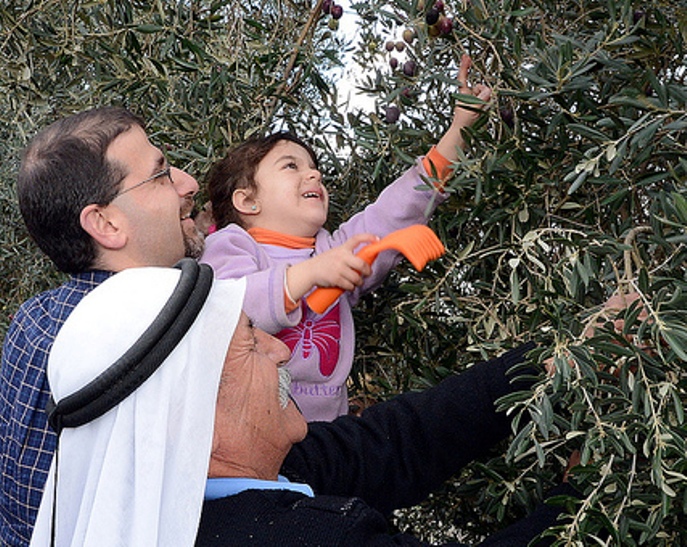
 The olive branch as a symbol of peace is rooted in ancient Greek culture, but the link between the fruit tree and conflict resolution continues today; especially clear in a beautiful little project called Olive Oil without Borders (OOWB) just re-launched in its second edition at a conference held last month in Kufr Rai, in the West Bank.
Subtitled ‘Building Economic Cooperation Among Palestinians and Israelis’, the project began in 2005 to encourage Israeli and Palestinian farmers to share technical experiences about olive cultivation, oil production and quality control. It’s a multiyear initiative to foster cross-border, grassroots economic cooperation and build relationships based on mutual trust, understanding, and shared financial interest among Palestinians and Israelis in the olive oil industry.
Can a micro-scale farming project reverse decades of tribal conflict?
“There is no real border between Israel and Palestine,” Muhammad Hamudi, an olive farmer and oil producer from Asira al-Shamaliya, near the West Bank city of Nablus, told online magazine GOOD. He has worked with OOWB since its start in 2011. “Today the border is here, tomorrow it will be there. The olive oil market has no borders as well. The bridge to the global market is the same bridge for everyone.”
Supported by the NGO Near East Foundation (NEF), the project earned a second round of funding from the US Agency for International Development (USAID) in the amount of $1.2 million, which will benefit 3,000 Palestinians and Israelis working in the business over the next three years. Additional donors include Human Concern International, the United Nations Development Program, and the World Food Program.
Olive oil production and trade have underpinned rural economies in Palestine and Israel for generations; olive trees are woven into the fabric of these societies, with meaning far beyond economic value. Through industry cooperation, OOWB seeks to grow tolerance, indeed friendship, and mutual monetary benefits for the sector.
NEF President Charlie Benjamin told GOOD that the organization approaches its work from “a completely depoliticized perspective.” The focus is on “building economic relationships. We don’t touch the broader issues.” But he does acknowledge that when people collaborate by choice, they grow trust, improve communication, and enhance interaction beyond the limits of the agricultural program.
Ayala Noy, an oil producer from Moshav Zippori in Israel, north of Nazareth, told reporter Assaf Dudai, “It was a very important and empowering experience. Sitting down with a Palestinian farmer who tells me, with tears in his eyes, that his orchard was burned to the ground the previous night by Israeli settlers was very emotional for me. ‘How do you sleep at night?’ he asked me. I told him not very well. That was the biggest challenge for me—being a representative of Israel, dealing with the hard feelings they have toward us.”
“We brought Palestinians to our house, we showed them our mill, and we try to keep in touch by phone,” she added. “I think it gave them a chance to see ‘other’ Israelis. Many of them told me that was their first time to meet an Israeli who is not a soldier, or a settler.”
The feelings are mutual. Sumaya Sawalmeh, another farmer from Asira al-Shamaliya, said, “It was important for me to take part in the project. I came into Israel [and] for the first time in my life…left with positive feelings.” Adel Yaseen, an elderly farmer from the nearby village of Jnaid, agreed, “I made friends from Israel. The project helped us to build relationships and brought us closer.”
The project has improved olive oil production, harvesting and post-harvesting operations. Participants have also been helped in their approach to marketing, all of which has had a positive impact on the economy of 34 olive oil farming communities in Israel and West Bank. Entire families and villages in both Palestine and Israel live off the yearly cycle of the olive trees. NEF estimates that 100,000 Palestinian families work in the olive oil sector, which accounts for more than 10 percent of the state’s GDP.
“This is exactly what should be going on in the region right now—everyone coming together,” Dave Harden, USAID mission director in the Palestinian Authority, told Dudai at an OOWB farmers gathering at an orchard near Nazareth. “They are building stuff together, they’re producing higher quality products, and they’re selling them. What more can you ask for?”
Palestinian farmers have exported 3,600 metric tons of olive oil into Israel since 2013, representing $20 million in new income. Benjamin concluded, “Seventy percent of OOWB participants say they believe economic cooperation helps build additional efforts at reconciliation between the two sides.”
Olive Oil without Borders is now funded to run through 2018. Subpartners include the Peres Center for Peace, the Palestinian Center for Agricultural Research and Development, and Syracuse University’s Maxwell School of Citizenship and Public Affairs.
زيت الزيتون من دون حدود هو مشروع مدته ثلاث سنوات التي تنفذها مؤسسة الشرق الأدنى والممول من الوكالة الأمريكية للتنمية. الفرعي يشمل شركاء مركز بيريز للسلام والمركز الفلسطيني للبحوث الزراعية والتنمية.
שמן זית ללא גבולות הוא פרויקט של שלוש שנים, המיושמת על ידי המזרח הקרוב במימון USAID ושני שותפים בו מרכז פרס לשלום ומרכז פלסטין למחקר ופיתוח חקלאי
Want to learn more about this unique opportunity to promote reconciliation and collaboration between the two groups at a time when the diplomatic process is at a standstill? Visit the NEF website (link here), donations are welcome.
Need some good ideas on how to use olive oil? Check out this story from Green Prophet archives (link here).
Image of olive pickers from the OOWB website.




[…] Olive Oil Without Borders has a recipe for Middle East peace olive oil without borders The olive branch as a symbol of peace is rooted in ancient Greek culture, but the link between the fruit tree and conflict resolution continues today; especially clear in a beautiful little project called Olive Oil without … Read more on Green Prophet […]
[…] Olive Oil Without Borders has a recipe for Middle East peace Additional donors include Human Concern International, the United Nations Development Program, and the World Food Program. Olive oil production and trade have underpinned rural economies in Palestine and Israel for generations; olive trees are woven … Read more on Green Prophet […]