Drones show how pigs get a raw deal in factory farms

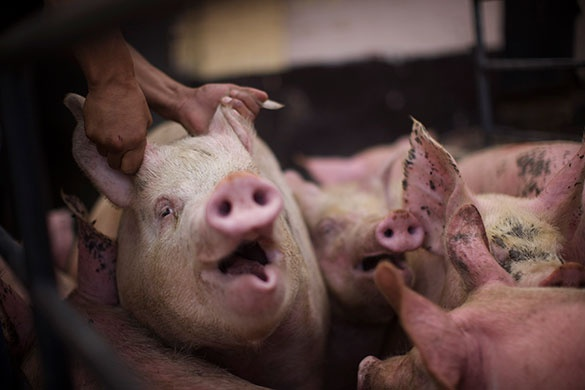
selecting a pig for slaughtering


Animal abuse in the meat processing industry can be particularly disturbing. Whether this involves severe animal abuse in a kosher poultry slaughterhouse;  or cruelty to larger hoofed animals being prodded and shocked with electric devices while being led to their fate, the issue of animal abuse in the commercial meat industry often becomes something not less than shocking, to say the least.

When it involves pigs, which have a similar anatomical structure to human beings (so similar that pig organs have sometimes been used in temporary organ transplants to humans), the issue of animal abuse can be more than just shocking.

One of the most graphic and shocking examples of severe pig abuse was captivated recently on film at a large pork factory farm in the  American state of North Carolina as graphically shown on the video below.

[youtube]https://www.youtube.com/watch?v=ayGJ1YSfDXs[/youtube]

The video, taken by the aid of a small pilotless drone device, shows first what appears to be a large square pond of muddy water. This “pond” in  reality is a large sewage lagoon containing discharges of pig feces and urine. The excrement is pumped into the lagoon from a large number of  long enclosed sheds where thousands of swine are kept in steel enclosures so small the animal cannot even turn around.

When the lagoon becomes too full of its foul smelling mixture, the contents are disposed of in the surrounding countryside by high pressure hoses  that turn the feces-urine mixture into a fine spray. The spray results in all kinds of health problems to people living nearby. Some of these health problems include causing children and adults to suffer from severe asthma and other forms of respiratory diseases. It is said that there are as many as 2,000 of these “farms” located in the U.S. state of North Carolina alone.

Despite some efforts made to ease a pig’s suffering during the slaughtering process, there is no really humane method.

Even “stunning” a pig by using an electric shock device or using a hammer to hit it on the head prior to being slaughtered causes great pain and suffering to the animal. This YouTube clip shows men “humanely” slaughtering a pig. From the looks on their faces, they seem to be enjoying what they are doing.

[youtube]https://www.youtube.com/watch?v=A7uJvjbN968[/youtube]

Although the Middle East does not have such a serious problem concerning pork production, due mainly to Jewish and Muslim dietary  laws, there are enough examples there of animal abuse, including severe abuse of swine at a pig farm in Israel, a country where eating  pork is forbidden by the observant Jewish and Muslim populations.

Pigs are also severely abused and were even slaughtered by the thousands in Egypt during the Swine Flu epidemic a few years back.  Swine are kept in large numbers in Egypt by “Zabaleen”, members of Egypt’s minority Christian population, who not only consume them as food, but use them to help keep the country’s high amounts of organic garbage under control.

One might expect examples of severe animal abuse to not be occurring in sophisticated Western countries like the USA, but it surely is happening.  Most people who purchase the sanitarily packaged pork products being produced at such factory farms are most likely not even be aware of what occurs in these places. Or perhaps people care less about what happens there.

Read more on animal abuse of swine and other animals as a result of the meat processing industry:

Pig Abuse Rampant in Kosher Israel
See Severe Animal Abuse at Israel’s Largest Kosher Poultry Slaughterhouse – Video
Israel’s Cruel Meat Industry Exposed by Watchdog TV Show
Swine Flu harms people and the environment in Egypt

Photo: selecting a pig for slaughtering; The Guardian

Maurice Picow
Maurice Picowhttps://www.greenprophet.com/
Maurice Picow grew up in Oklahoma City, U.S.A., where he received a B.S. Degree in Business Administration. Following graduation, Maurice embarked on a career as a real estate broker before making the decision to move to Israel. After arriving in Israel, he came involved in the insurance agency business and later in the moving and international relocation fields. Maurice became interested in writing news and commentary articles in the late 1990’s, and now writes feature articles for the The Jerusalem Post as well as being a regular contributor to Green Prophet. He has also written a non-fiction study on Islam, a two volume adventure novel, and is completing a romance novel about a forbidden love affair. Writing topics of particular interest for Green Prophet are those dealing with global warming and climate change, as well as clean technology - particularly electric cars.

TRENDING

Renewables hit 5,149 GW in 2025 as the world edges away from oil shocks and fossil-fueled conflict

“In the midst of uncertain time, renewable energy remains consistent and steadfast in its expansion,” said Francesco La Camera, IRENA’s Director-General. “A more decentralised energy system, with a growing share of renewables and more market players, is structurally more resilient.”

What Is Liberty HealthShare, and Should I Learn More?

Health insurance is a regulated financial product. Insurers operate under binding contracts, overseen by state insurance commissioners, that legally obligate them to pay claims meeting policy terms. Policyholders who believe a covered claim was wrongfully denied have legal recourse through state regulatory channels.

Zentera drops “ethical wool” claim after peta exposé into zq-certified farms

The New Zealand Merino Company, now rebranded as Zentera, has quietly removed the phrase “world’s leading ethical wool brand” from its website, a notable change that comes after a disturbing investigation by PETA Asia-Pacific into the company’s ZQ-certified wool supply chain, PETA reports to Green Prophet.

Fresh Fava Bean Soup, A Vegan Springtime Recipe

Somehow vegetables with short seasons excite the imagination and appetite more sharply than produce that’s available all year around. Good Middle Eastern cooks have many recipes for delicate fava beans, and this turmeric-fragrant soup is one.

The future of trucking and freight is electric and hydrogen

For years the freight industry tried to force a...

Nobul’s Regan McGee on Shareholder Value: “Complacency Is the Silent Killer” 

Why the governance framework designed to protect shareholders so...

Should You Invest in the Private Market?

startustartup Unlike public stock exchanges, which offer daily trading, strict...

How to build a 100-year-company

Kongō Gumi is a Japanese construction company, purportedly founded in 578 A.D., making it the world's oldest documented company. What can we learn about building sustainable businesses from them?

From Pilot Plant to Global Stage: How Aduro Clean Technologies’ 2026 Expansion Signals a Turning Point for Chemical Recycling Investors Like Yazan Al Homsi

The company's Next Generation Process (NGP) Pilot Plant in London, Ontario, has officially moved into initial operating campaigns, generating the kind of structured, repeatable data that separates laboratory promise from commercial viability.

How AI Helps SaaS Companies Reduce Repetitive Customer Support Work

SaaS products are designed for large numbers of users with different levels of experience, and also in renewable energy.

Pulling Water from the Air

Faced with water shortage in Amman, Laurie digs up...

Turning Your Energy Consultancy into an LLC: 4 Legal Steps for Founders in Texas

If you are starting a renewable energy business in Texas, learn how to start an LLC by the books.

Tracking the Impacts of a Hydroelectric Dam Along the Tigris River

For the next two months, I'll be taking a break from my usual Green Prophet posts to report on a transnational environmental issue: the Ilısu Dam currently under construction in Turkey, and the ways it will transform life along the Tigris River.

Related Articles

Popular Categories