

 One hundred years ago on the first of September 1914, a bird named Martha died at the Cincinnati Zoo. She was the last of what had once been the most numerous bird in the world – the passenger pigeon. How did this happen? Read more as we attempt to solve this extinction mystery.
A favorite animal
Each night after her bedtime story my daughter would quiz me. “What is your favorite animal?” She would ask, hoping that I would agree that we absolutely must adopt a dog, a cat or a pony. “Dolphin.” I would answer.
The next night I would choose a different animal. It had to be something cute but completely unsuitable as a pet. I moved from cetaceans to insects to endangered species and finally to extinct animals. “Brachiosaurus, woolly mammoth, passenger pigeon.”
That last one piqued my interest. This one didn’t die of an asteroid sixty-five million years ago. This was recent history. John Muir, Charles Darwin, even my own grandparents were alive when these birds flocked over Midwestern American skies. They lived during the enlightenment and the age of scientific discovery. Surely someone must know what caused them to go extinct.
Martha’s big family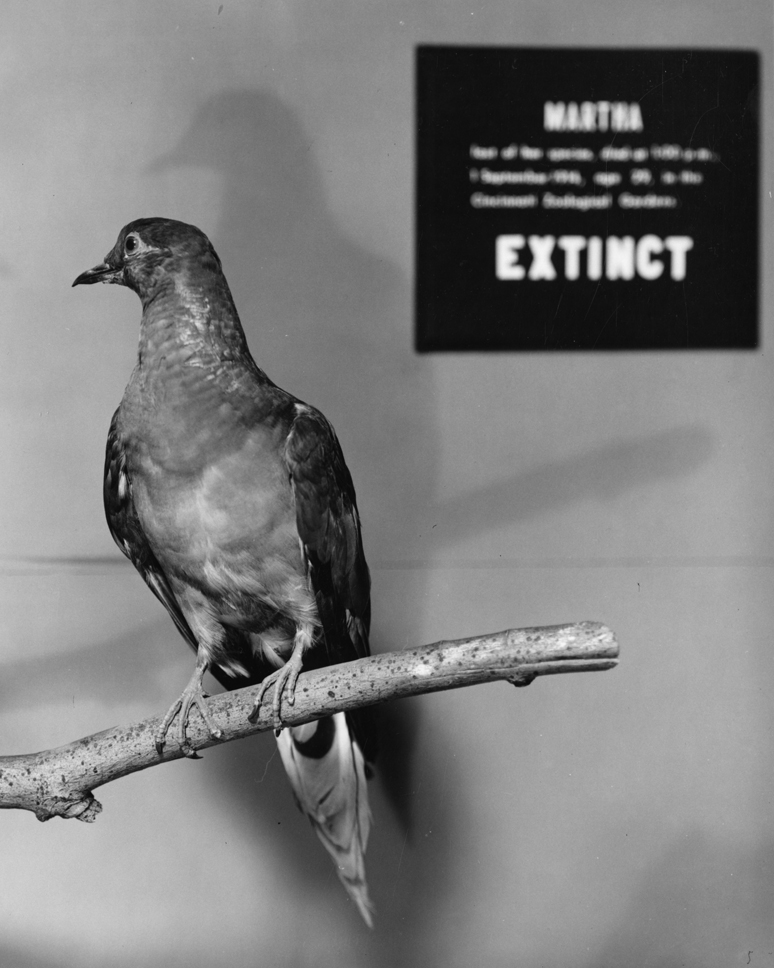
A quick internet search told me that passenger pigeons lived in Eastern North America and were at one time the most populous bird species on earth, numbering as many as five billion.
The famous ornithologist John James Audubon wrote that they had darkened the skies for days as during a total eclipse. Their weight had caused trees to collapse. Naturalist A.W. Schorger wrote that a single nesting site in the state of Wisconsin contained 136 million breeding adults. For comparison, the stockier mourning dove which bears the closest resemblance to passenger pigeons, number only about 250 million worldwide.
A living example
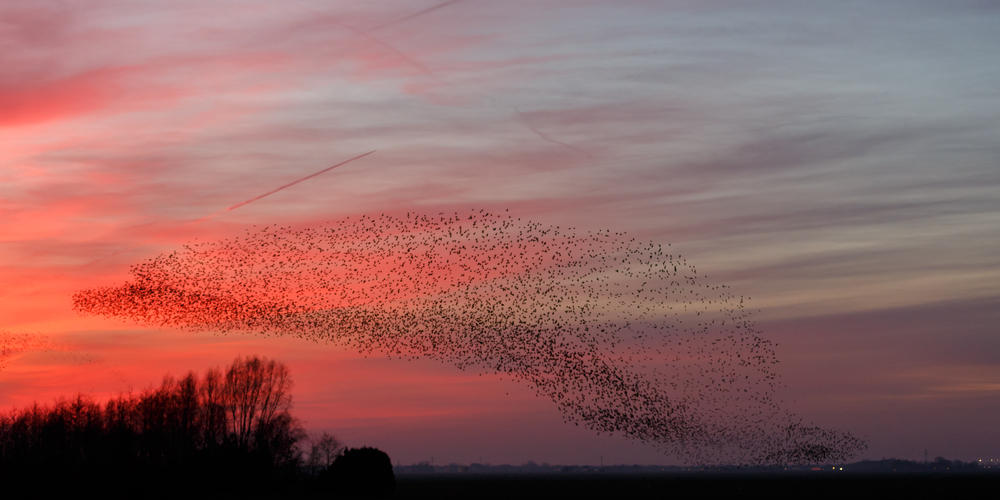
The European starling is North America’s most prolific living bird. It numbers only 200 million. Starlings disappeared from the skies over Jordan and Israel in the 1990s and just as mysteriously returned in recent years. Watch this murmeration of about 100,000 Starlings flying over Istanbul Turkey and imagine their number multiplied by 30,000. That’s what a mile wide, 300 mile long cloud of more than three billion birds would have looked and sounded like as it darkened the skies of southern Ontario for fourteen hours in 1866:
[youtube]https://www.youtube.com/watch?v=8IT9HTXmURM&feature=player_detailpage#t=6[/youtube]
From great multitudes to Zero
Seventy years later, a childless 29 year-old passenger pigeon named Martha, died in an Ohio zoo. She was the last of her kind. If you didn’t feel a chill run down your spine or hear some swear words escape from your lips at that thought, maybe you should read that again.
From five billion to zero over the course of a short human lifetime. What the #*^% happened?! There are people living today who might have seen one in a zoo or standing on a telegraph wire. We have witnesses we even have photographs. But for an extinction that happened after Charles Darwin published “Origin of the Species” and after the world’s first national parks were founded, we know remarkably little.
Why so many?
To discover why the passenger pigeon’s numbers dropped to zero we should first investigate why their numbers rose to such– dare we say, unsustainable numbers. In fact there are relatively few vertebrate species who thrive in such large numbers. During their heyday, more than than one fifth of all birds in North America belonged to this single species. Where were their predators?
The Predators
One theory is that passenger pigeons were an outbreak species with Native Americans as their primary predator. Flocking in such large numbers, they were easy to hunt. Their young could be picked from the ground. Migrating flocks were caught with nets or clubbed from the sky. Native Americans killed just enough to keep their population under control until…
The outbreak
The arrival of Europeans led to the death of millions of Native Americans which led to an explosion in the population of passenger pigeons until– Europeans developed a taste for these birds. They were used as cheap food for slaves.
The collapse
Waves of hungry immigrants soon created a passenger pigeon economy. They used guns and nets. They set trees on fire. They used blinded and tethered “stool pigeons” as bait. A single hunter could take in 5000 birds in a day. Hunters in Michigan collected 7.5 million passenger pigeons in 1869. Their haul increased each year until it peaked at between 10 and 15 million birds in 1878.
Then, following the same pattern as peak whale oil, peak fish and peak oil, their numbers began to collapse. The ecosystems which supported these multitudes were poorly understood and before we knew it we were past the point of no return. Passenger pigeons usually laid only one egg per year and so they were unable to recover their numbers.
A 14-year-old boy shot the last wild passenger pigeon with a BB gun in 1900 and Martha died alone in captivity, one hundred years ago this week.
Of luck and Lyme Disease
Naturalist John Muir once said that if you tug at any little part of nature you find that it’s hitched to the whole universe. We were lucky that passenger pigeons didn’t fill an irreplaceable niche in our food chain. Martha’s family died at a time when industrialization allowed humans to more efficiently produce food. A similar extinction of honeybees or cod would have disastrous economic and social effects today.
Martha’s death did have a human impact. Passenger pigeons fed primarily on tree nuts such as acorns and chestnuts. The four billion chestnut trees which once covered much of eastern North America were been wiped out by an invasive fungus. But enough acorns and other nuts remained to support a large population of deer mice. And deer mice are host to a wood tick which carries Lyme disease. It is possible that MERs or Ebola outbreaks are caused or amplified by similar environmental disasters caused by our “destroy now ask questions later” approach to nature.
Martha’s legacy
Martha’s death taught us that it is possible for humans to have a devastating impact on what seemed to be an inexhaustible natural resource. By revealing this truth, she may have helped spark the environmental movement which saved the American bison, the bald eagle, the grey wolf and numerous other species from a similar fate and led to conservation laws and the national park system.
Photo of starling mumeration by shutterstock
Photo of Martha the last passenger pigeon by Wikipedia





Comments are closed.