

Dream of fresh organic food? Have little land in your town or city but plenty of patience? There is a new city gardening movement called aquaponics or AP. The movement is creating missionaries, new converts and maybe even some gurus, but there are also real people doing it in backyards, parks, basements or a garage near you.
On our mission to find sustainable ways to feed the Middle East, and our planet, and real people leading these movements, Green Prophet heads out to Downsview Park in Toronto, Canada, to meet Even Bell, the founder of WaterFarmers, Toronto’s largest aquaponics farm. The company has also built commercial-scale projects in Oman and Pakistan.
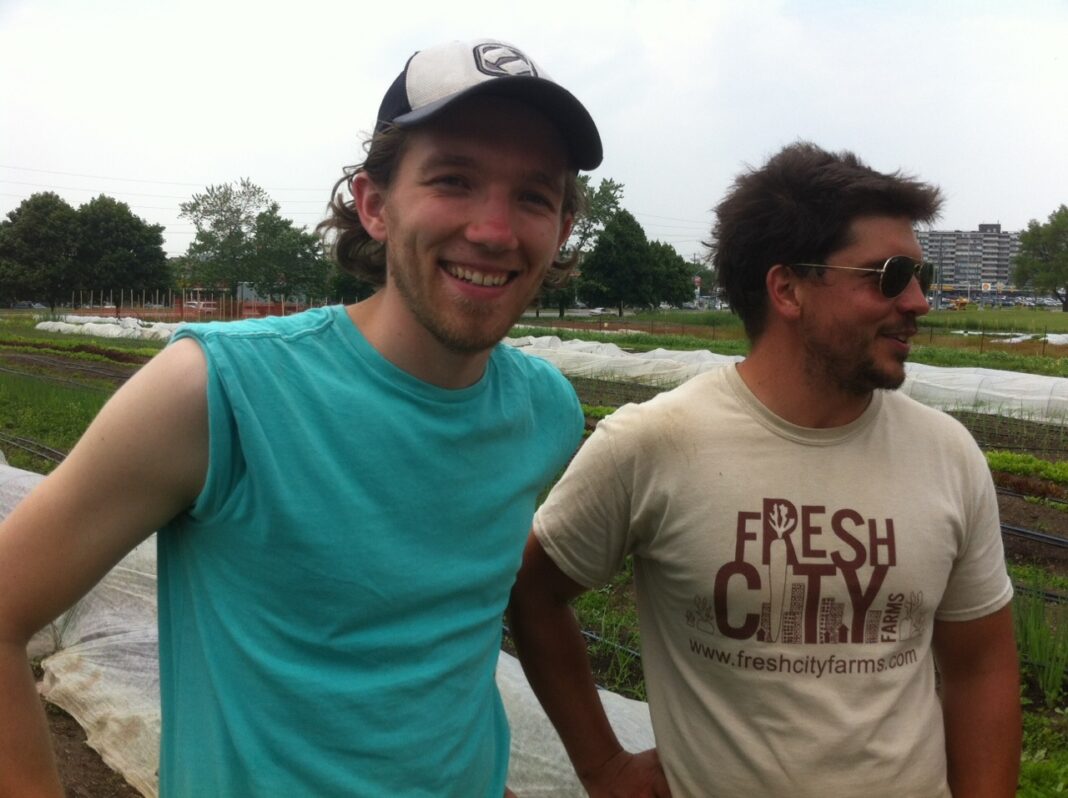
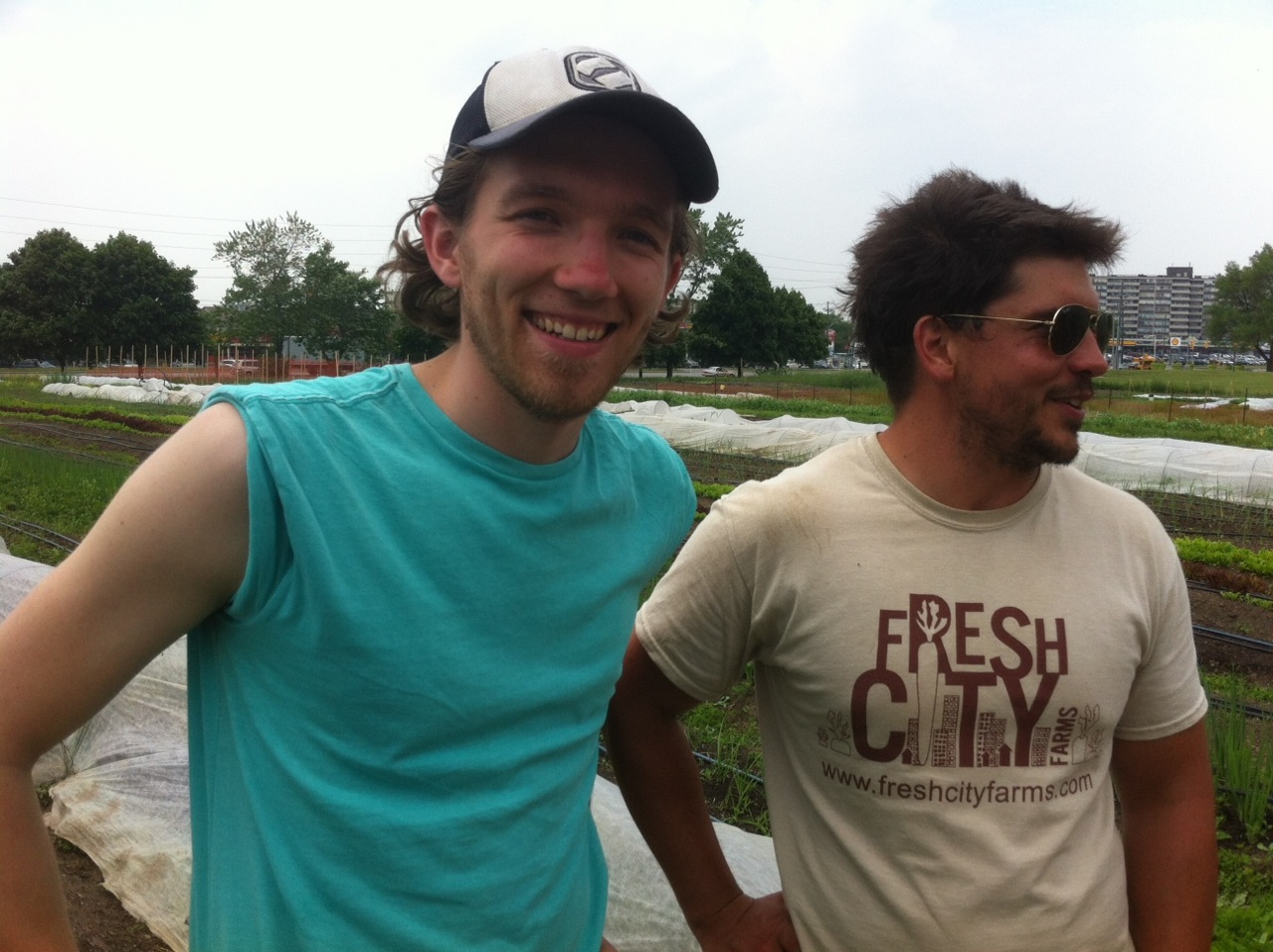
Bell (pictured above left) is a farmer, on water. But he’s not your average hydro guy. Bell, a web analyst by day, moonlights as a fish and vegetable farmer on his spare time.
Some say it’s a perfect system, ecologically balanced: When you couple the fish, and their waste (poo and pee), with a plant system that grows on this waste water, factor in bacteria that helps to break down the fish waste and you get a pretty complete nutrient cycle. Except for the food you need to feed the fish, and some added micronutrients like kelp, you can grow some of the healthiest organic food out there.
WaterFarmers is doing this and helping Toronto eat a little more local and sustainably. Because AP or water farming uses about 90 percent less water than traditional farming it’s also really suited to drought ridden climates like the Middle East and California.
Bell’s farm (he’s a co-founder) is strategically not out in the country, but in the middle of a city where most people have no clue where their food comes from. It is based in a greenhouse run by Fresh City Farms, a CSA. In the above picture you’ll see Fresh City Farms founder Phil Collins, right.
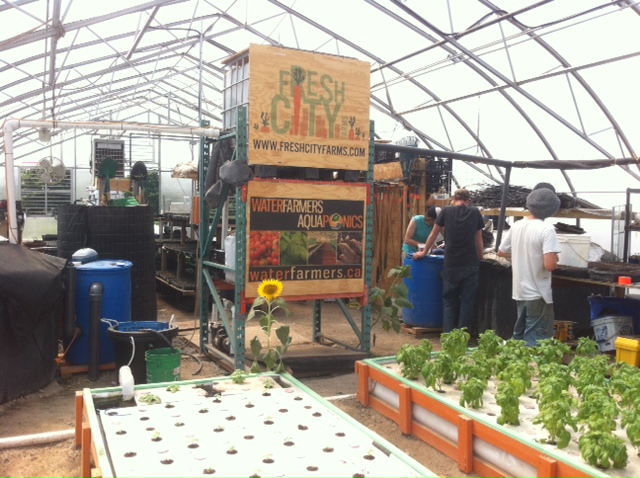
“100% of what we produce is harvested by them,” says Bell, 26, who keeps a personal aquaponics farm at home. “There would be more to show you over there but we just harvested 500 heads of lettuce,” he says pointing to the styrofoam trays floating on a bed of water.
The fish for now are not culled for food, but serve as a nutrient generator for the plants. We meet him as he’s giving a diverse but beautiful crowd of co-op gardeners an overview seminar on aquaponics farming. He’s explaining the minerals and chemicals that need to be added to keep the balance so the fish stay happy, the lettuce leafy and the tomatoes tasty. Later on we meet a summer intern who shows us how the chemicals keep balanced and what to do if they are not.
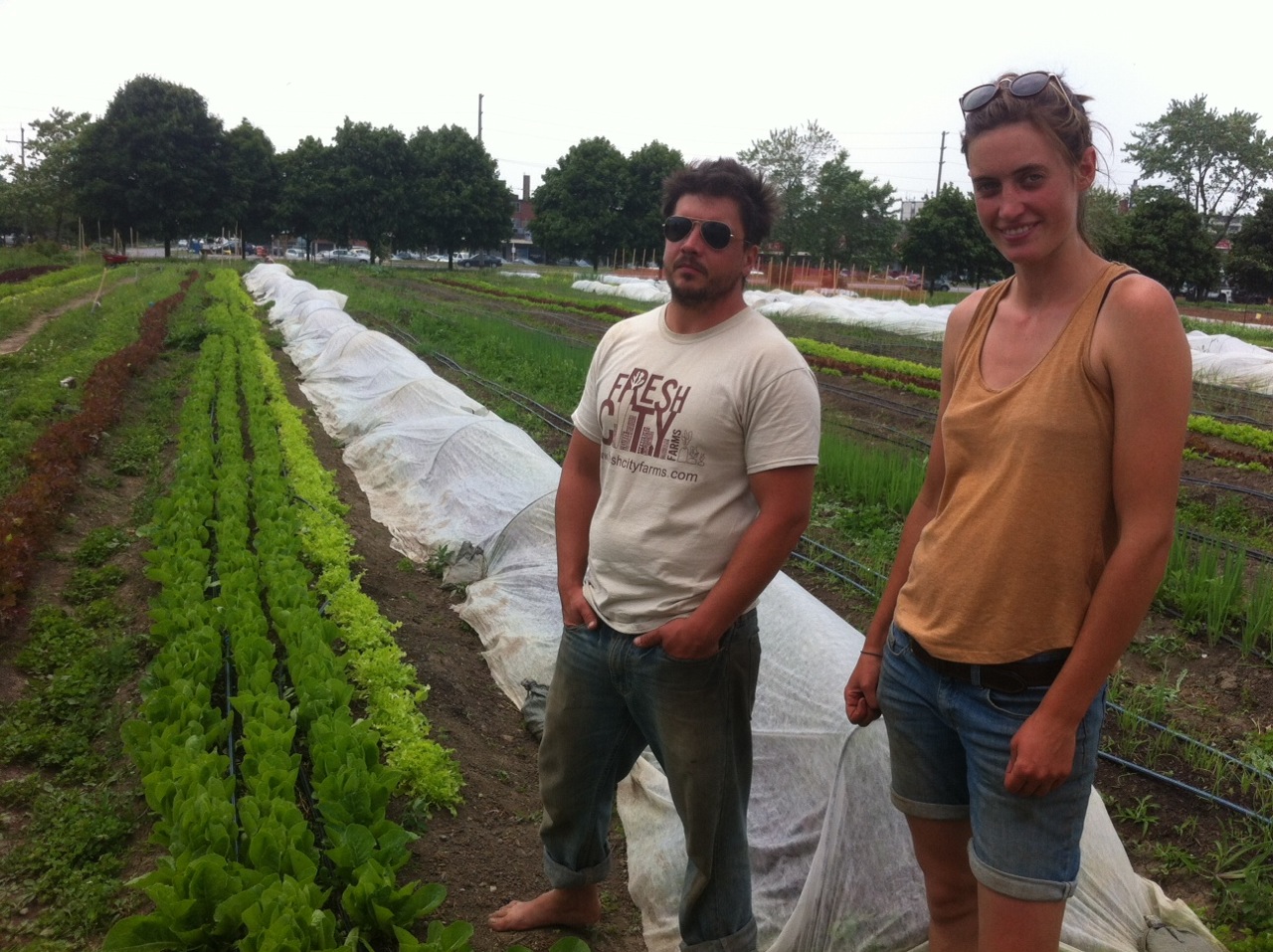
Below is Hannah Hunter, farm manager (right) and Ashley, intern (left).

There may be a lot of interest and people who want to “convert” to aquaponics, an old but “new” method of urban farming, Bell tells Green Prophet, but at the end of the day he asks people who want to set up operations: have you ever farmed before? Had a garden? It is basically just farming, but some extra complexities and responsibilities, he explains while we head to DQ for a much needed ice-cream. The greenhouse feels like it’s about 60 degrees C in there.
Aquaponics farming in Toronto, the way Bell does it at WaterFarmers, may not be for everyone or every climate: the farm needs energy for pumps to pump oxygen to the fish, and it needs heat in the winter.

But “AP is intuitively appealing,” says Bell who handles North American operations for the company. The Toronto farm is a hybrid system with media and deep water beds. It’s made to consume little power and be efficient. This takes lower capital. It’s also not automated. He or an assistant monitors pH, and nitrate and nitrate levels on a daily basis. They have a data collection app, perhaps for automation one day. But for now someone needs to be on hand every day of the week to make sure the fish and plants are doing well. Five hours without power may cause the fish to go belly up.
He shows us the grow beds budding basel that they will cull again, maybe only once more before the herbs become too tired.
The fresh herbs, lettuce, and future tomatoes that are growing, are added to the weekly CSA boxes sent out by Fresh City Farms. The CSA has 1,600 members and most of the food is produced onsite in Downsview Park where they lease land.
If there are gaps in making AP transition to a more common way of farming Bell sees them as technology, supply change, and knowledge exchange as key factors in making it more appealing and widespread. For now, many operations are simply not cost effective, he says.
Bell picked up on the idea of aquaponics while studying economics and statistics at Waterloo University in Kitchener where he joined the UWAQ aquaponics club. His farm just started operating in January but he expects by the end of the year they’ll have produced thousands of kilos of fresh organic food to feed people in Toronto. For now they are using the hearty tilapia fish as a nutrient provider but they might switch to a fish like trout which can tolerate winters better.

So far none of the fish have been eaten, but when they do grow they can be an excellent source of protein – especially for communities where fresh protein is in short supply. Certainly this is not the case in Toronto where a McDonalds can be found on every major street corner.
But in their own way WaterFarmers are planting the seeds of education so more people in this hard-scrabble neighbourhood of North York, fed subsidies and food stamps, may get exposed (even if only in passing)- to an alternate way of living off the land – on water.
::WaterFarmers website; Fresh City Farms
If you would like to learn more about technology solutions for AP farmers, visit flux and sign up to the company beta.




[…] Water Farmers get fresh with aquaponics for food in Toronto … find sustainable ways to feed the Middle East, and our planet, and real people leading these movements, Green Prophet heads out to Downsview Park in Toronto, Canada, to meet Even Bell, the founder of WaterFarmers, Toronto's largest aquaponics farm. Read more on Green Prophet […]
“mission to find sustainable ways to feed the Middle East …” Actually this may soon hit much closer to home. Surprisingly none of the influential politicians seems yet to have understood that when e.g. energy prices go up, then transport-dependent agricultural produce will have to be farmed or harvested ever closer to the areas of final consumption. AND the energy and resources need to be driven down that are being used or else crop failures, even relative starvation will be the end result. Instead I see investments going to e.g. crazy biofuel programs which will go into exactly the opposite direction.