Tunisia’s phosphate town is dying over our addiction to phosphorus

Redeyef phosphate mining

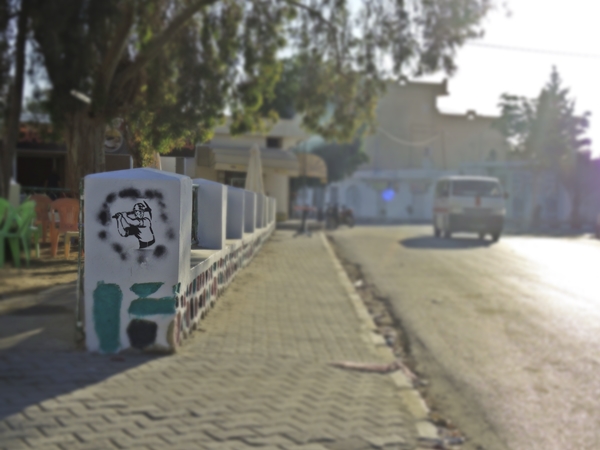
Today Redeyef, Tunisia, is quite a scene: it’s a decrepit French colonial houses are surrounded by mountains of black phosphate sand, radioactive water lakes and its inhabitants, the vast majority unemployed, walk around with yellowish brown toothy smiles.

The main sounds are that of shuddering chains transporting phosphate, and sirens marking the beginning and end of working hours. The average life expectancy here is 60 years, as lung and colonic cancer, leukemia, kidney stones, rheumatism and tooth loss chip away at people’s lives.

Phosphate is a perverse affair for Redeyef: it has become the life and death of its people.

Phosphate is used in agriculture as fertilizer, and animal feed, but in dishwasher detergent, in soft drinks, and also as flame retardants and to treat water in water softeners. It is used to make cereal, produce chicken, make cheese, and to make ice cream, pudding, canned and fresh vegetables. It’s virtually everywhere unless you produce your own organic food. We can imagine its economic value.

The region of Gafsa in Tunisia is found in one of the largest phosphate basins in the world where Compagnie des phosphates de Gafsa (CPG), the fifth largest phosphate producer in the world, produces 8 million tons per year.

Redeyef, a community in the region of Gafsa, finds itself battling daily with the side effects of phosphate production.
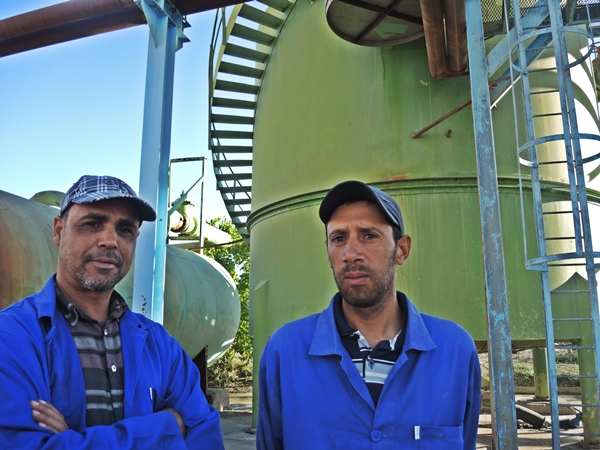
phosphate Miners in Redeyef, tunisua

Green Prophet meets Abed, father of four children, and soon two more, has worked in the water treatment sector for six years. He explains that the principle phosphate related activity in Redeyef is the “humid treatment”,  that is washing, of phosphate which is bought here from all over the region by train.

This practice is highly polluting for two reasons: first the open sky black phosphate sand mountains, of which Redeyef is increasingly seeing itself surrounded by, blows in the desert winds entering into the homes, crops, mouths and lungs of its inhabitants.

Second, the water used to wash the phosphate is expelled into artificial lakes which infiltrates into the groundwater. This water, once used to water crops and drink, is now highly toxic, containing elevated concentrations of radioactive metals such as uranium and cadmium.

For years Redeyef has demanded to see some benefits from CPG’s activities. “All the money and richness goes to the capital and the state does nothing for the inhabitants of Redeyef. We are a forgotten town and region. Our land is sterile, our water is contaminated and we are sick, we have no hospitals to meet the demand of high cancer rates and our own citizens have to clean the streets. Who’s fault is this?” Abed asks.

Phosphate has become the death of self-sufficiency. With limited self-employment alternatives, phosphate has become the only other alternative for local employment- which CPG has not been able to fulfill.

In 2008 stifled protests and social movements erupted as CPG’s rigged employment procedures angered prospective workers, who have had enough of seeing political favoritism destroy the glimmers of hope for those who studied and sacrificed years of work to become more “employable”.

Redeyef, was the inedited site where those who had enough of Ben Ali’s regime began protesting. The “Jasmine revolution” in Tunisia, which snowballed into the so called Arab spring, began in Redeyef. Abed emphasizes “ the Tunisian revolution began here- it was a phosphate revolution before being a jasmine revolution.”

One could say that phosphate gave life to democracy in Tunisia.

Today the situation has not changed. Production halted for two months earlier this year because of protests, chefs promote for favoritism and not merit, the health of citizens is deteriorating, and unemployment rates are still amongst the highest in Tunisia. When talking about the future for Redeyef and Tunisia, Abed has little hope. He tells Green Prophet:  “I think there will be worse protests in the future because there is high unemployment and phosphate is the only source of income for the region.”


Linda Pappagallo
Linda Pappagallohttps://www.greenprophet.com/
Linda's love for nature started when at the age of eight she discovered, with her dog, a magical river in the valley of a mountainous region in Lebanon. For four years Linda and her dog explored along the river, until one day she saw construction scrapers pushing rock boulders down the valley to make way for new construction sites. The rubble came crashing into the river destroying her little paradise, and her pathetic reaction was to shout at the mechanic monsters. Of course that was not enough to stop the destructive processes. As she continued to observe severe environmental degradation across the different places she lived in the Middle East and Africa, these terrible images remained impressed in her mind. However, environmental issues where not her first love. Her initial academic and career choices veered towards sustainable economic development, with particular interest in savings led microfinance schemes. Nevertheless, through experience, she soon realized a seemingly obvious but undervalued concept. While humans can somewhat defend themselves from the greed of other humans, nature cannot. Also nature, the environment, is the main “system” that humans depend on, not economics. These conclusions changed her path and she is now studying a Masters in International Affairs with a concentration in Energy and the Environment in New York. Her interests lie on ecosystems management: that is how to preserve the integrity of an Ecosystem while allowing for sustainable economic development, in particular in the Middle East and Africa.

TRENDING

Peak Phosphorus Fuels the World’s Growing Bellyache

Whisked away down the toilet and into our waterways,...

Turning Your Energy Consultancy into an LLC: 4 Legal Steps for Founders in Texas

If you are starting a renewable energy business in Texas, learn how to start an LLC by the books.

Tracking the Impacts of a Hydroelectric Dam Along the Tigris River

For the next two months, I'll be taking a break from my usual Green Prophet posts to report on a transnational environmental issue: the Ilısu Dam currently under construction in Turkey, and the ways it will transform life along the Tigris River.

6 Payment Processors With the Fastest Onboarding for SMBs

Get your SMB up and running fast with these 6 payment processors. Compare the quickest onboarding options to start accepting customer payments without delay.

Qatar’s climate hypocrisy rides the London Underground

Qatar remains a master of doublethink—burning gas by the megaton while selling “sustainability” to a world desperate for clean air. Wake up from your slumber people.

How Quality of Hire Shapes Modern Recruitment

A 2024 survey by Deloitte found that 76% of talent leaders now consider long-term retention and workforce contribution among their most important hiring success metrics—far surpassing time-to-fill or cost-per-hire. As the expectations for new hires deepen, companies must also confront the inherent challenges in redefining and accurately measuring hiring quality.

8 Team-Building Exercises to Start the Week Off 

Team building to change the world! The best renewable energy companies are ones that function.

Thank you, LinkedIn — and what your Jobs on the Rise report means for sustainable careers

While “green jobs” aren’t always labeled as such, many of the fastest-growing roles are directly enabling the energy transition, climate resilience, and lower-carbon systems: Number one on their list is Artificial Intelligence engineers. But what does that mean? Vibe coding Claude? 

Somali pirates steal oil tankers

The pirates often stage their heists out of Somalia, a lawless country, with a weak central government that is grappling with a violent Islamist insurgency. Using speedboats that swarm the targets, the machine-gun-toting pirates take control of merchant ships and then hold the vessels, crew and cargo for ransom.

Related Articles

Popular Categories