
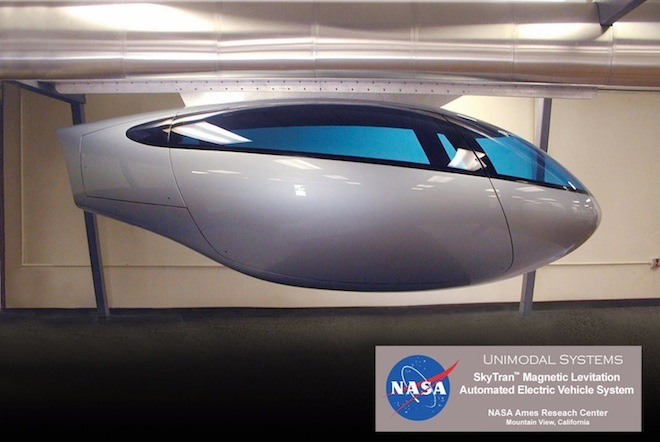
skyTran’s magnetic sky pods to be tested in obscure Israeli city

skyTran, hover cars, NASA, Israeli Aerospace Industry, IAI, maglev, magnetic levitating technology, sky pods, personal rapid transit, PRT, Israel, Lod, Tel Aviv, sky cars, Magnetic levitation technology enthusiasts around the world are waiting to see what will happen in Israel, where skyTran has teamed up with Israel Aerospace Industry (IAI) to prove the viability of their Hover Car personal rapid transit (PRT) system. The levitating sky cars will be tested in Lod, a run-down industrial city south of Tel Aviv.

The possibility of installing ‘hovering cars’ in Tel Aviv has been on the table for a while. The idea is that because they are elevated, they can reduce congestion in over-crowded cities.

A 1,640 foot elevated test loop will be installed on IAI’s campus in Lod. Each of the cars can hold two people and will travel up to 45 mph. In reality, if the test proves successful, they will travel at much greater speeds.

skyTran, hover cars, NASA, Israeli Aerospace Industry, IAI, maglev, magnetic levitating technology, sky pods, personal rapid transit, PRT, Israel, Lod, Tel Aviv, sky cars,

Users merely need to call up the pods, which arrive very quickly and deliver the user to their destination. In this way, people are not restricted to the sometimes rigid schedules of other forms of transportation.

And hey, they can be above the city looking down, which is more like adventure. The pods operate by magnetic levitation or maglev on what the BBC most accurately describes as a “monorail-type track.”

Related: skyTran – world’s first levitating transit system heads to Tel Aviv

It sounds crazy, it sounds ambitious, but this is real. skyTran has been developing this technology under the watchful guidance of NASA for some time.

skyTran, hover cars, NASA, Israeli Aerospace Industry, IAI, maglev, magnetic levitating technology, sky pods, personal rapid transit, PRT, Israel, Lod, Tel Aviv, sky cars,

Towards the end of next year, 2015, the test loop should be complete and then the technology has to be tested. I’m sure details of what this entail will emerge over the coming weeks and months. And then, if it is successful, which its investors think it will be, Tel Aviv residents will be the first guinea pigs.

India, California and France are chomping at the bits as well. And really, any overpopulated city or country will be watching carefully, because technology like this could be a game changer. But it won’t come cheap at $80 million.

Maybe the $10 cardboard bike from Israel is a better idea?

:: BBC

Tafline Laylin
Tafline Laylinhttp://www.greenprophet.com
As a tour leader who led “eco-friendly” camping trips throughout North America, Tafline soon realized that she was instead leaving behind a trail of gas fumes, plastic bottles and Pringles. In fact, wherever she traveled – whether it was Viet Nam or South Africa or England – it became clear how inefficiently the mandate to re-think our consumer culture is reaching the general public. Born in Iran, raised in South Africa and the United States, she currently splits her time between Africa and the Middle East. Tafline can be reached at tafline (at) greenprophet (dot) com.

TRENDING

What a martian ice age left behind tells us about our future

We have heard that peak climate change might be...

Perseverance Rover Uncovers Ancient Martian Chemistry — And Raises the Question: Could This Hint at Past Life?

On Earth, similar mineral–organic interactions can be biological or abiotic. In Jezero Crater, the long geological timescales suggest the reduced vivianite and sulfides may have formed without biology — but organic compounds could still have driven the chemistry.

The Satellite That Sees Earth Breathe: How NISAR Could Transform Sustainability From Space

Critically, NISAR’s data will be publicly available. That means not only scientists and governments, but also nonprofits, local planners, and startups can build tools and services using the data.

Why Is the Martian Night Sky So Bright? New NASA Video Sheds Light on the Red Planet’s Glow

Another factor is sunlight scattering at high altitudes. Even though the Sun sets on Mars just as it does on Earth, light continues to scatter off the high-altitude dust, keeping the sky bright for hours. This is why astronauts may one day be able to navigate or work during the “night” without artificial lighting—at least in the early evening.

China’s solar great wall to power Beijing – captured by NASA

China has become the world's leading producer of solar energy. This desert plant will power all of Beijing.

Nobul’s Regan McGee on Shareholder Value: “Complacency Is the Silent Killer” 

Why the governance framework designed to protect shareholders so...

Should You Invest in the Private Market?

startustartup Unlike public stock exchanges, which offer daily trading, strict...

How to build a 100-year-company

Kongō Gumi is a Japanese construction company, purportedly founded in 578 A.D., making it the world's oldest documented company. What can we learn about building sustainable businesses from them?

From Pilot Plant to Global Stage: How Aduro Clean Technologies’ 2026 Expansion Signals a Turning Point for Chemical Recycling Investors Like Yazan Al Homsi

The company's Next Generation Process (NGP) Pilot Plant in London, Ontario, has officially moved into initial operating campaigns, generating the kind of structured, repeatable data that separates laboratory promise from commercial viability.

How AI Helps SaaS Companies Reduce Repetitive Customer Support Work

SaaS products are designed for large numbers of users with different levels of experience, and also in renewable energy.

Pulling Water from the Air

Faced with water shortage in Amman, Laurie digs up...

Turning Your Energy Consultancy into an LLC: 4 Legal Steps for Founders in Texas

If you are starting a renewable energy business in Texas, learn how to start an LLC by the books.

Tracking the Impacts of a Hydroelectric Dam Along the Tigris River

For the next two months, I'll be taking a break from my usual Green Prophet posts to report on a transnational environmental issue: the Ilısu Dam currently under construction in Turkey, and the ways it will transform life along the Tigris River.

Related Articles

Popular Categories