Egypt’s environmental suicide by coal

solar panels

Egypt’s ongoing energy issues, compounded by its current political and economic problems, appear to be going from bad to worse. This is especially so since its natural gas revenues were dramatically curtailed following numerous sabotage attacks on its Sinai gas pipeline to Israel and Jordan.

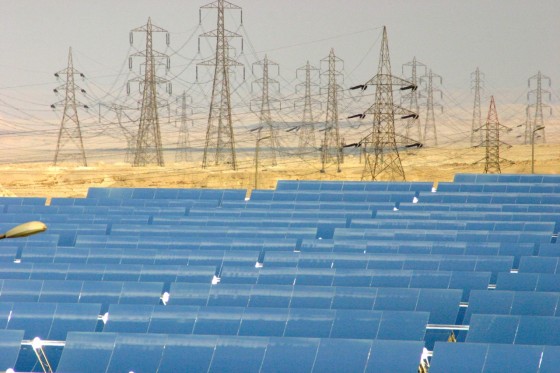
Egypt once held great promise as becoming a leader in solar energy production (see photo) in the  in the Middle East and North Africa MENA region.  The  World Bank, which has been helping to provide financing for MENA region renewable energy projects , has mentioned that Egypt and other MENA countries are located in a region  that is very susceptible to the ravages of climate change.
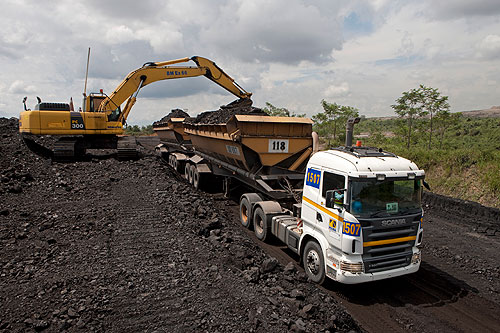
loading a coal hauler In order to provide at least a partial solution to the country’s increasing energy needs, Egypt’s government is now turning to importing large shipments of coal  through its Safaga Red Sea Port, according to an article published in the Saudi Gazette.

The Gazette article quoted comments by Ali Reda, head of the Tourism Investment Authority in the Red Sea, who,  said in a press statement: “Coal will be detrimental to tourism in the Red Sea. Coal and coal hauling (see photo above) will pollute the environment, harm people’s health, and destroy marine life; especially coral reefs.”  He added that bringing in thousands of tons of coal by truck will also harm the country’s roadways and cause numerous road accidents.

This fear was also voiced by  Ahmed Droubi, coordinator of the Egyptians Against Coal movement, who said that bringing in 8 million tons of coal a year would require 250,000 to 500,000 trucks on Egyptian roads, causing significant damage  to its road infrastructure.

Despite efforts made by Egyptian government cabinet officials to curtail the use of coal by “abiding to precautionary measures recommended by the World Health Organization and enforcing those measures on all  facilities that manufacture, import, transport, store, or use coal,”the government seems to be turning a “blind eye” to increasing the country’s use of this polluting energy source.

Turning to coal has resulted  from a significant cut in natural gas supplies to major factories; especially cement factories. Egypt’s energy supplies have also come partially from hydroelectric power generated from its Aswan Dam facility in southern Egypt. This energy source could be curtailed significantly if Ethiopia embarks on its plan  to build a giant dam on its section of the Nile River.

Regarding the environmental impact of coal, the organization Egyptians Against Coal (EAC) say that the use of it  “affects the brain, the nerves, the lungs, and the blood. Research proved that inhaling coal dust causes redox reactions and increases chances of lung cancer, blood viscosity, and narrowed blood vessels.”

Due to the continued political turbulance present in Egypt, it may be naive to expect it to turn to renewable energy.  Solar energy and wind power could help by providing even a small percentage of the country’s total energy needs. In a joint statement issued by several environmental  groups, representatives said that  Egypt needs to pursue other forms of energy production, including use of waste products (garbage, etc) to generate energy. “In Germany, 61% of energy used in the cement industry is generated from waste. In the Netherlands, the percentage rose to 98% in 2009.”

The statement added that several developing countries are also working on long-term plans to discard polluting sources of energy. Egypt’s mounting garbage problem, especially in major cities like Cairo and Alexandria, could become an energy source of its own; and not just food for  pigs and income for ragpickers.

Maybe this idea will one day  become reality; resulting in less use of polluting fuels like coal.

Read more on Egypt’s energy issues:

The Dam that May Damn Egypt’s Future

Jumpstarting Solar Power in the MENA Region

Will Israel’s Natural Gas Tap Flow to Turkey?

Photo of Egyptian solar panels: Tarir Institute for Middle East Policy

Maurice Picow
Maurice Picowhttps://www.greenprophet.com/
Maurice Picow grew up in Oklahoma City, U.S.A., where he received a B.S. Degree in Business Administration. Following graduation, Maurice embarked on a career as a real estate broker before making the decision to move to Israel. After arriving in Israel, he came involved in the insurance agency business and later in the moving and international relocation fields. Maurice became interested in writing news and commentary articles in the late 1990’s, and now writes feature articles for the The Jerusalem Post as well as being a regular contributor to Green Prophet. He has also written a non-fiction study on Islam, a two volume adventure novel, and is completing a romance novel about a forbidden love affair. Writing topics of particular interest for Green Prophet are those dealing with global warming and climate change, as well as clean technology - particularly electric cars.

Read More

TRENDING

Ethiopians are Looking to Somaliland for Red Sea Access as Global Powers Move In

Somaliland, for its part, has operated as a de facto independent state since 1991. It has its own government, elections, currency, and security forces. It’s often described as one of the more stable and democratic political systems in the region, despite never being formally recognized internationally. 

Egypt building nuclear power

Egypt is building a nuclear energy plant, expected to go online in 2026 when countries like Germany have shut down all its domestic nuclear power. The El Dabaa Nuclear Power Plant is the first nuclear power plant planned for Egypt and will be located at El Dabaa, Matrouh Governorate, Egypt, about 320 kilometers northwest of Cairo. 

More investments of 1.2 GW in Benban solar, Egypt

Egypt’s Ministry of Electricity and Renewable Energy, the Egyptian Electricity Transmission Company, and a consortium comprising Infinity Power and Hassan Allam Utilities Energy Platform signed an agreement to jointly develop solar power projects at Benban Solar, one of the world's largest solar energy parks in Egypt.

Benban solar in Egypt and the companies that make the energy shine

Benban isn’t a single solar plant at all, but a collection of 41 facilities, each developed by different companies but connected through shared infrastructure. This structure is what makes Benban unique: dozens of developers working like nodes in a vast energy network, each feeding electricity into shared substations and Egypt’s national grid.

Undercover divers find fatal flaws in Egypt’s dive boat industry

German magazine stern and broadcaster RTL have confirmed what Green Prophet has reported for months — the sinking of Egypt’s Sea Story dive yacht in November 2024, which killed 11 people, was no freak accident. Their undercover investigation reveals the captain had no licence, the operator lacked legal authorisation, and the vessel had serious stability flaws. A wider probe of 17 Red Sea liveaboard boats found every one had dangerous safety deficiencies, echoing Green Prophet’s earlier coverage of Egypt’s dive tourism safety crisis.

Yerukim Forms a New Green Economy Where the Money is Really Green

The Yerukim members who pick up the recyclables get to keep the monetary reward, the public earns "green" bills that can be used in shops, and business owners get to be associated with environmentalism.

Choosing Riyadh over Dubai? What Investors Should Know

Saudi Arabia is deploying capital at unmatched scale to catalyze tourism and advanced industry while rewiring its power-and-water backbone. The investable frontier is widening—especially in renewables, grid storage, water efficiency/desal retrofits, and hospitality operating platforms. Prudent investors will insist on phased delivery, enforceable KPIs (energy, water, biodiversity), and RHQ/zone compliance—while pricing political-economy and reputational risks alongside growth upside.

Sell your cooking oil for biodiesel money

Want to make money on old french fry oil? Sell it.

Qatar Alternative Energy Summit Pairs Investors And Innovators

Alternative energy investors and innovators can meet n' greet in Doha, Qatar March 16 and 17.

Here’s How To Implement The Four Pillars Of Employee Engagement

If you throw a party for your work team and they are vegans, don't make it a barbecue. Know the sustainability values of your team to boost moral and retain good people.

Locals From Rishon Fight IKEA

Big Box stores are a pretty new concept in Israel, and thank God that not every Israeli city wants them in their backyard. A word from someone who has see the beautiful farmland around her hometown Newmarket, Ontario stripped and converted into vulgar strip malls of big box shops: they have no place in a healthy and sustainable town or city.

The Jewish National Fund Meets An Inconvenient Truth

According to the JNF, it has transformed thousands of acres of barren land into green forests in Israel. They state that each person emits about 23 tons of carbon per year, estimating that each tree planted can absorb one ton of carbon in its lifetime. That's a whole lot of trees you'd need to be planting. Could so many fit in Israel?

How to quiet noise from construction in your office

Streets need to be resurfaced in New York but the humming and grinding noise is unsettling. Noise is environmental pollution. 

Popular Categories