Morocco’s Berbers take on Africa’s richest silver mine – and the king

Movement on the road '96, africa's richest silver mine, berbers, moroccan silver mine, king of morocco, berber activists, environmental activism, water issues, water management, pollution

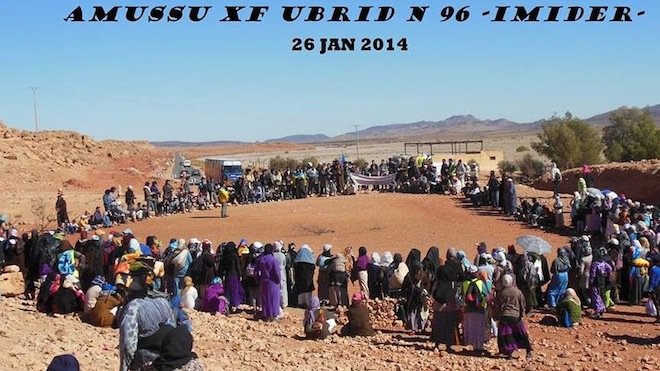
Africa’s largest silver mine has been operating in the Atlas mountains since 1969, but the Berber people living in the surrounding villages remain among the most poverty-stricken people in Morocco. Now Movement on the Road ’96 are living in an “occupation” camp to protest a silver mine’s water use and pollution. They are also fighting for a fair share in the nation’s resource .
Since August, 2011, the group of activists from Imider, who call themselves Movement on the Road ’96have been living in an occupation camp on Mount Alebban in order to protest the mine’s polluting practices.

While Africa’s resources are historically usurped by international companies, the Imiter Mettalurgic Company operating the silver mine is mostly owned by Morocco’s royal family, according to the New York Times. Which makes the lack of a sufficient “trickle down” effect perhaps more egregious.

“The king forgot about us. He tours the country helping people, and he never comes to this region,” one woman told the New York Times: “He is our father, and he has forgotten about his children.”

The group claims that the mine has used up more than their fair share of water, depleting aquifers that the agricultural communities in the area use for their terraced crops.

Read here about how the Berber’s had a perfect water use system in place.

Backed in part by the Free Academy in Rome (LAR), the Movement on the Road ’96 also claims that the toxic byproduct of the mining process, including cyanide and mercury used to treat the ore, has caused disease, killed livestock and exacerbated desertification.

“…even small plots at the foot of the mountain seem doomed to due to the shortage of water and poisons from the mine,” according to LAR.
Movement on the road '96, africa's richest silver mine, berbers, moroccan silver mine, king of morocco, berber activists, environmental activism, water issues, water management, pollution

Morocco’s Berbers are historically independent, organized and resilient, and once enjoyed a deeply entrenched system of water management that has been disrupted by international groups in recent years. The mine is said to have taken up to 66 percent of the water allocated in a special system to each village.

In 2011, some of the villagers from Imider climbed the mountain to cut off water supply to the mine. This resulted in a 40 percent capacity loss in 2012 and a 30 percent loss 2013.

Meanwhile, Farid Hamdaoui, a mine manager, denied allegations that they are improperly disposing waste, and says that the mine recycles 62 percent of the water they use.

The group, which takes its name from a 1996 uprising that the government violently suppressed, is demanding that local employees should make up 75 percent of the total workforce. Independent commentators say this is impossible, and the company accuses the group’s organizers of turning down offers for a feasible employment ratio.

Hamdaoui insists that the mine spends $1 million a year on the local communities, but LAR says that since operations began in 1969, very few infrastructural improvements have taken place.

“At Imider there are no schools (except a small garrison basic), there is no electricity in most homes, the internet [or] even kiosks with newspapers, while the nearest hospital is located 200 km away (Ouarzazate).”
:: New York Times

Tafline Laylin
Tafline Laylinhttp://www.greenprophet.com
As a tour leader who led “eco-friendly” camping trips throughout North America, Tafline soon realized that she was instead leaving behind a trail of gas fumes, plastic bottles and Pringles. In fact, wherever she traveled – whether it was Viet Nam or South Africa or England – it became clear how inefficiently the mandate to re-think our consumer culture is reaching the general public. Born in Iran, raised in South Africa and the United States, she currently splits her time between Africa and the Middle East. Tafline can be reached at tafline (at) greenprophet (dot) com.

TRENDING

Travel Morocco with teens at the Kasbah du Toubkal’s magical mountain retreat

Walking well-trodden mountain pathways, eating fresh local food, and learning about the transformative work embedded in the Kasbah’s approach to tourism has now been imparted to our children. We hope, in turn, these experiences will serve to inform their contributions in the world as they continue to grow. Don’t wait, Morocco is on everyone’s bucket list. Growth and change are inevitable. 

Arab agricultural land is on the brink

Across the Arab world, croplands face a perfect storm of stressors. Excessive fertilizers and pesticides erode soil ecology. Poor drainage and over-irrigation drive salinization, leaving fields crusted with salt. Rising temperatures, dwindling groundwater, and more frequent sand-and-dust storms—all amplified by climate change—compound the crisis.

This stunning ancient citadel in the Sahara Desert Has a mysterious past

Today, the Rock Round Palace stands as a historical site, a reminder of the diverse cultural heritage that once thrived in the region. Videos circulating on Youtube suggest that anyone off the street can wander inside and around the citadel suggesting it's not being protected well for future generations.

BMW partners with mineral miner SK tes to recycle electric batteries

BMW launched a pan-European partnership with SK tes, a company that can mine valuable minerals such as cobalt, nickel and lithium from used batteries before returning them to the value chain to make new batteries.

Morocco loses half its wheat crop this year from drought

A prolonged drought in Morocco is causing serious problems...

Turning Your Energy Consultancy into an LLC: 4 Legal Steps for Founders in Texas

If you are starting a renewable energy business in Texas, learn how to start an LLC by the books.

Tracking the Impacts of a Hydroelectric Dam Along the Tigris River

For the next two months, I'll be taking a break from my usual Green Prophet posts to report on a transnational environmental issue: the Ilısu Dam currently under construction in Turkey, and the ways it will transform life along the Tigris River.

6 Payment Processors With the Fastest Onboarding for SMBs

Get your SMB up and running fast with these 6 payment processors. Compare the quickest onboarding options to start accepting customer payments without delay.

Qatar’s climate hypocrisy rides the London Underground

Qatar remains a master of doublethink—burning gas by the megaton while selling “sustainability” to a world desperate for clean air. Wake up from your slumber people.

How Quality of Hire Shapes Modern Recruitment

A 2024 survey by Deloitte found that 76% of talent leaders now consider long-term retention and workforce contribution among their most important hiring success metrics—far surpassing time-to-fill or cost-per-hire. As the expectations for new hires deepen, companies must also confront the inherent challenges in redefining and accurately measuring hiring quality.

8 Team-Building Exercises to Start the Week Off 

Team building to change the world! The best renewable energy companies are ones that function.

Thank you, LinkedIn — and what your Jobs on the Rise report means for sustainable careers

While “green jobs” aren’t always labeled as such, many of the fastest-growing roles are directly enabling the energy transition, climate resilience, and lower-carbon systems: Number one on their list is Artificial Intelligence engineers. But what does that mean? Vibe coding Claude? 

Somali pirates steal oil tankers

The pirates often stage their heists out of Somalia, a lawless country, with a weak central government that is grappling with a violent Islamist insurgency. Using speedboats that swarm the targets, the machine-gun-toting pirates take control of merchant ships and then hold the vessels, crew and cargo for ransom.

Related Articles

Popular Categories