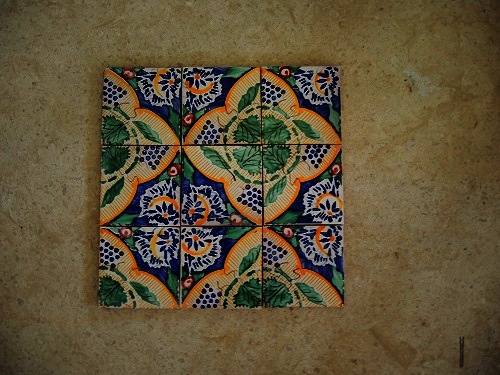
Tunisia’s handmade tiles risk disappearing forever

Tunisian Handmade Tiles

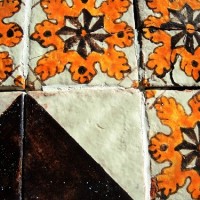
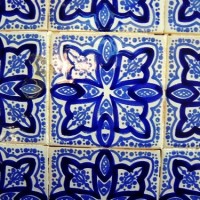
The history of handmade tiles in Tunisia is fascinating. Green Prophet digs deep between the tiles of a rundown factory in Roman Neapolis, Nabeul, a historic tile making center in Tunisia, to discover what fragments remain of this disappearing art.

Although handmade decorated tiles were used in some early mosques, it was only in the 1600’s, with the final great exodus of Andalusian Muslims to Tunisia, that the application of enamel techniques  revived the fading ceramic centers around the country.

Originally tiles were  produced for utilitarian, rather than decorative purposes.
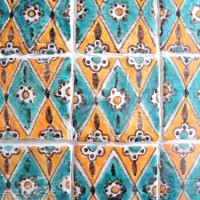
Ceramic tiles acquired important decorative purposes and were highly influenced by Ottoman and Andalusian motifs which culminated around the same time. In 1574, following the Turkish victory over the Hafsids, Ottoman tastes took over the Tunisian home as Tunisians reoriented themselves eastward.

In 1609, the final expulsion of Muslims from Spain, which saw more than 80,000 refugees settle in Tunisia, brought with it Andalusian tile making techniques which were readily adopted by Tunisian tile makers .
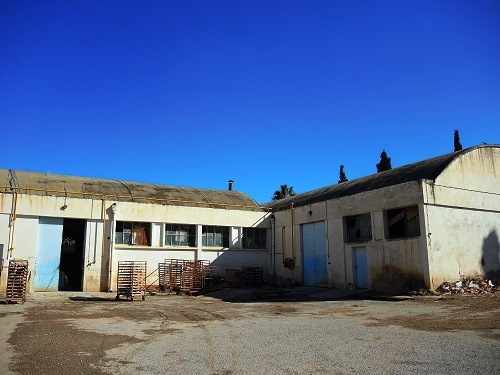
Tunisian Handmade Tiles workshop Nabeul

In 2003 Nabeul, counted more than 350 workshops and factories, with tile production being the largest employment sector in the area. Following the 2011 revolution, many workshops are closing down and, apart from industrially and serially made tiles destined for tourists, workshops  which produce handmade tiles with traditional motifs are becoming rarer by the year.
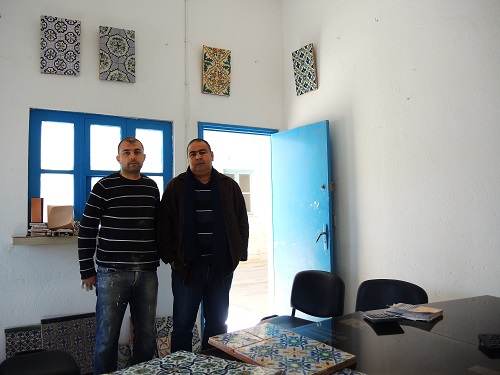
Tunisian Handmade Tiles workshop owners

“La maison des Arts”, is one of the remaining ateliers where Zobaier, “Technical Director” and Noomen, “Business Director” make ends meet primarily driven by passion. According to Zobaier “Passion is the ingredient which is largely missing in today’s generation, which have not grown up next to their parents working in the workshops, but in front of books at school.”

In fact, of the 6 employees employed at La maison des Arts, 4 of them grew up watching their parents work in the tile making business, and so with them grew the passion for this craftsmanship.

Even though artisans are paid twice the minimum wage in Tunisia, and manual labor is highly sought after, it is hard to find young workers willing to work in this sector, as Zobaier reiterates “it is challenging to work long hours painting hundreds of tiles by hand, without having the passion for it.”

Nevertheless post revolution has seen an increase of 20% in exports for this workshop, but when I asked Noomen about the future of the handmade tiles industry, I was immediately told frankly “for us to do well, Tunisia has to sort its politics first.”

As he points out “our year zero is now 2011, of course production was higher before the revolution, but now there are good prospects if the domestic economic environment allows us to expand.”

If the handmade tile making industry in Tunisia is still afloat, it is largely thanks to the  Algerian, Japanese and American clients. Tunisian clients, are increasingly preferring to import modern tiles rather than traditional tiles.

The process in making handmade tiles is as follows:
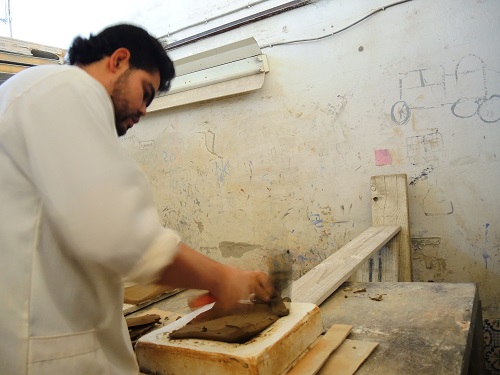
Tunisian Handmade Tiles process 1

1. Clay from Tabarka is imported to Nabeul which is worked into stamps by the skillful gestures of a young Tunisian worker, depending on the model, each tile costs between  3 dinar (3 USD) and 5 dinars (5 USD) .
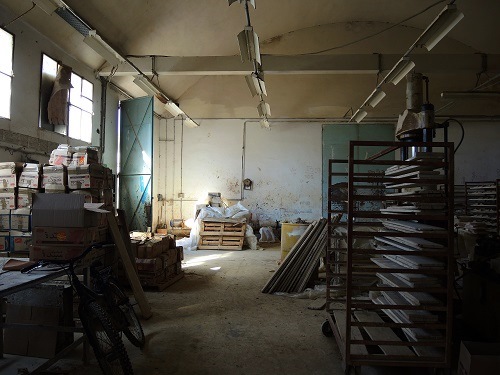
Tunisian Handmade Tiles drying

2. The clay tiles are then left to dry in the sun and subsequently placed in a kiln at 1300 degrees Celsius for 8 hours.
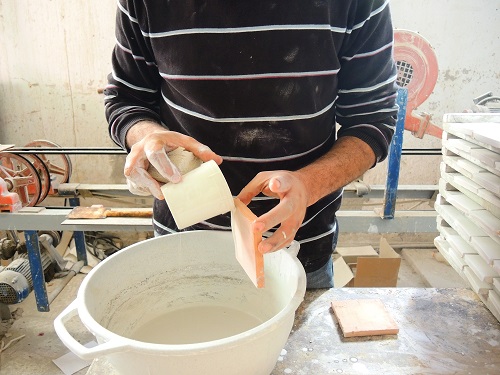
Tunisian Handmade Tiles process2

3. Each square tile is then covered with a special base layer of white , each “atelier” or family has its own secret enamel recipe. Zobaier learned this enamel recipe from his father, renown for its luminescent white.
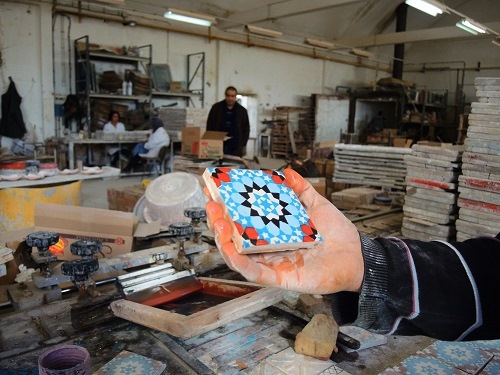
Tunisian Handmade Tiles process 3

4. A tile can be either “stamped” with various colors using screen printing techniques…
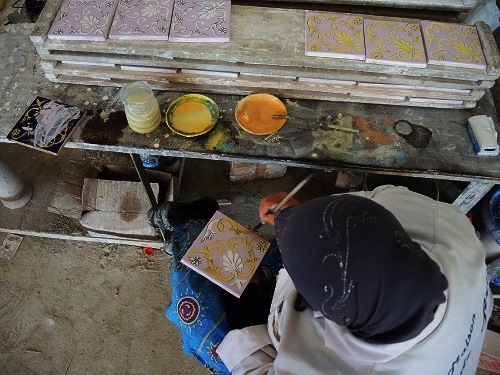
Tunisian Handmade Tiles process 4Hand painted with black guidelines…..

Tunisian Handmade Tiles process 4 or hand painted free-form, which requires the greatest skill.
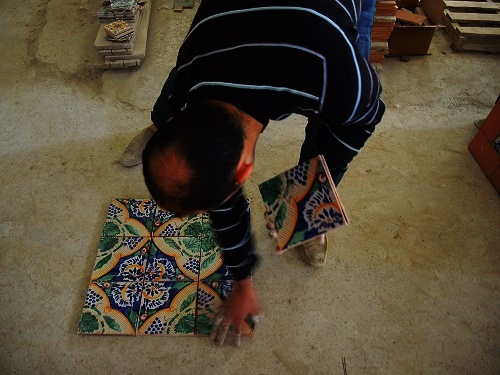
Tunisian Handmade Tiles feuille de rasins

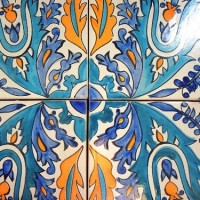
Zobaier’s favorite tile motif is “les feuilles de raisins” , it is the most ancient Tunisian motif, and requires the most skill to paint

More on the tiles in the MENA region:

Claesson Koivisto Rune Gives Moroccan Tiles a Lean Scandinavian Touch

Blatt Chaya Revives Traditional Floor Tile Making in Lebanon

Images of Handmade Tiles taken by Linda Pappagallo for GreenProphet

Linda Pappagallo
Linda Pappagallohttps://www.greenprophet.com/
Linda's love for nature started when at the age of eight she discovered, with her dog, a magical river in the valley of a mountainous region in Lebanon. For four years Linda and her dog explored along the river, until one day she saw construction scrapers pushing rock boulders down the valley to make way for new construction sites. The rubble came crashing into the river destroying her little paradise, and her pathetic reaction was to shout at the mechanic monsters. Of course that was not enough to stop the destructive processes. As she continued to observe severe environmental degradation across the different places she lived in the Middle East and Africa, these terrible images remained impressed in her mind. However, environmental issues where not her first love. Her initial academic and career choices veered towards sustainable economic development, with particular interest in savings led microfinance schemes. Nevertheless, through experience, she soon realized a seemingly obvious but undervalued concept. While humans can somewhat defend themselves from the greed of other humans, nature cannot. Also nature, the environment, is the main “system” that humans depend on, not economics. These conclusions changed her path and she is now studying a Masters in International Affairs with a concentration in Energy and the Environment in New York. Her interests lie on ecosystems management: that is how to preserve the integrity of an Ecosystem while allowing for sustainable economic development, in particular in the Middle East and Africa.
1 COMMENT

Comments are closed.

TRENDING

Avocado Green Mattress gets eco award, a first in the US

Avocado is a leader in organic mattresses in the United States.

Sustainable Flooring Options Guide

Sustainable flooring is a critical component of environmentally conscious living. By choosing eco-friendly options, consumers can contribute to a healthier planet. From recycled timber to bamboo and resilient floors, each sustainable flooring type has its advantages and considerations.

How to Make Your Property Landscaping More Eco-Friendly 

New landscaping tips, like xeroscaping to up your eco

Invasive species of the Mediterranean Sea

The Med region is changing as hundreds of new species invade. Can you imagine floating in Cefalu with killer jellyfish?

6 Tips on How to Spend Less on Utilities

Be green in more ways than one. Save money on utilities. Here's how.

Turning Your Energy Consultancy into an LLC: 4 Legal Steps for Founders in Texas

If you are starting a renewable energy business in Texas, learn how to start an LLC by the books.

Tracking the Impacts of a Hydroelectric Dam Along the Tigris River

For the next two months, I'll be taking a break from my usual Green Prophet posts to report on a transnational environmental issue: the Ilısu Dam currently under construction in Turkey, and the ways it will transform life along the Tigris River.

6 Payment Processors With the Fastest Onboarding for SMBs

Get your SMB up and running fast with these 6 payment processors. Compare the quickest onboarding options to start accepting customer payments without delay.

Qatar’s climate hypocrisy rides the London Underground

Qatar remains a master of doublethink—burning gas by the megaton while selling “sustainability” to a world desperate for clean air. Wake up from your slumber people.

How Quality of Hire Shapes Modern Recruitment

A 2024 survey by Deloitte found that 76% of talent leaders now consider long-term retention and workforce contribution among their most important hiring success metrics—far surpassing time-to-fill or cost-per-hire. As the expectations for new hires deepen, companies must also confront the inherent challenges in redefining and accurately measuring hiring quality.

8 Team-Building Exercises to Start the Week Off 

Team building to change the world! The best renewable energy companies are ones that function.

Thank you, LinkedIn — and what your Jobs on the Rise report means for sustainable careers

While “green jobs” aren’t always labeled as such, many of the fastest-growing roles are directly enabling the energy transition, climate resilience, and lower-carbon systems: Number one on their list is Artificial Intelligence engineers. But what does that mean? Vibe coding Claude? 

Somali pirates steal oil tankers

The pirates often stage their heists out of Somalia, a lawless country, with a weak central government that is grappling with a violent Islamist insurgency. Using speedboats that swarm the targets, the machine-gun-toting pirates take control of merchant ships and then hold the vessels, crew and cargo for ransom.

Related Articles

Popular Categories