

How low can you grow wasn’t the motto of yesterday’s Agrivest conference and startup contest in Tel Aviv, but it could work for Rootility. The non-GMO solution wowed local and international guests at an event that brought out decision makers and investors from some of the world’s biggest seed and food companies.
 Rootility, from Israel, pitched its root-growing platform to people from Bayer, Syngenta, PepsiCo and Monsanto and more, as world leaders all agree that new solutions are sought for feeding the world’s population living within a climate in question.
Like the trait amplification seed company Kaiima (just funded with $65 million), Rootility is working in this space – a non-GMO biotech solution to enlarge a plant’s root structure. It can work for a broad range of plants including tomatoes and melons. Larger roots, presumably help the plants access more water, nutrients and real estate, resulting in a greater crop yield by at least dozens of percents, reports the company’s CEO.
They were one of a dozen of new agritech companies from Israel spotlighted.
 There was Eden Shield, a company that I’ve interviewed in the past: Eden Shield uses natural extracts present in desert plants to fend off plant predators, reducing the need for using conventional pesticides. A bonus, says its CEO, is that pests’ defences never get accustomed to the off-putting fragrances Eden Shield is able to create. It actually works more like a “nose plug” confusing the pest so it can’t smell the plant crop it wants to eat.
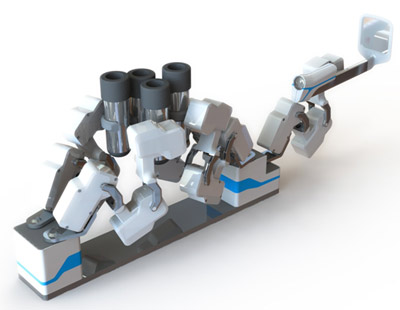 MiRobot looked pretty neat. It’s a robotic system (left) to fully automate milking, made for a developed world where “no one wants to be farmers, and even fewer people want to milk cows,” says its presenting CEO.
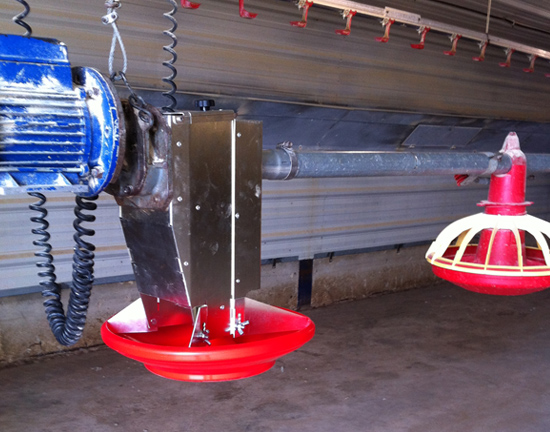
Metabolic Robots showed us an interesting add on for poultry farmers –– a box that helps regulate feed so that chickens are fed according to activity levels, age and size. Industrial chickens get pretty stressed out waiting for the food to drop, resulting in high rates of mortality due to fighting.
The solution (pictured below), is able to save about 6 percent in feed costs, and prevent poultry mortality by about 30 percent, its CEO said.
We love the ability of sending information to the cloud so that for the first time, the poultry industry will know more about the health and habits of its chickens. The solution, its CEO says, can also predict disease.
EggDetect is another add-on solution for existing infrastructure in conventional chicken hatcheries: they can separate male chicks from the females before the eggs hatch and do this in a non-invasive way. The solution could save chicks from the shredder, well, the culling of new-born male chicks, at least if your chicks are born in this German state. It can’t save embryonic chicks though as the solution only works to detect males about a week before they hatch.
The system can also detect at Day O the fertility status of the egg. Some 20 percent of all eggs that go in the hatchery are not fertile and will never become viable. Why bother warming and turning them for a week? Tests that exist today can only determine egg viability one week after it’s been in the hatchery.
I didn’t get to see all the presentations, only about two-thirds, but out of those I did see Catalyst Agtech was my favorite. The company is not selling us a blue skies solution, but a way to make do with conventional agricultural problems.
Pesticide use in conventional agriculture is here to stay, at least for a while. And until other alternative solutions like aquaponics are more broadly applied, pesticides will continued to be used for high yield crops.
Catalyst Agtech is able to detonate much of the damage that the widely used pesticide atrazine can do if left to linger in the water table. Before atrazine leaches through the soil into our water, the company’s solution catalyzes the breaking down of its toxic elements within 150 hours, the company claims.
Atrazine, made by Syngenta, is the most widely used herbicide in the United States. It is banned by the EU because of the groundwater contamination issues.
One caveat here is that if atrazine can be “greened” before it reaches the water table, it might make its use more widespread than it is today. Could that be a problem?
Over all the event was an impressive one. Big corporations like Syngenta, Monsanto (which has bought the Israeli agritech companies Beeologics and Rosetta Green), PepsiCo and Bayer sent high level representatives who were featured to speak, somewhat frankly, about what kinds of potential they saw in Israel and about how startups can start to think about doing big business with billion dollar companies.
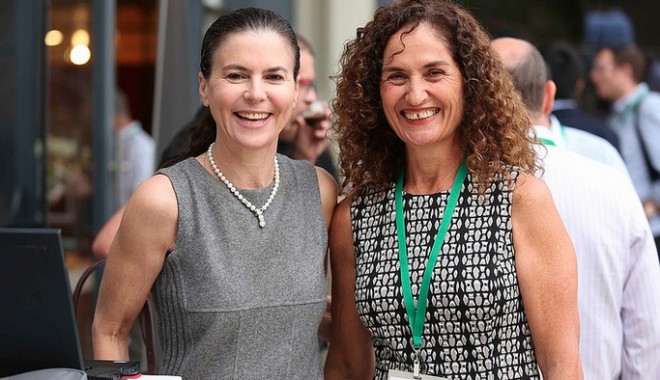
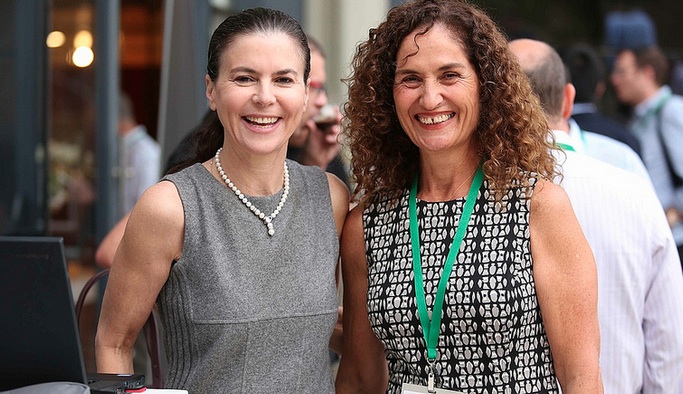
I briefly spoke with Nitza Kardish, the CEO of Trendlines Agritech (pictured top right with Ofra Strauss from the Strauss Group). Trendlines and Mofet put on the event.
She told me that not all the startup companies in the Israeli agritech scene are looking for the Big Exit, like in traditional Internet high-tech start ups in Israel. And some of them sell their products directly to the farmer.
Kardish told Haaretz in a previous interview: “Our vision is to create and build companies that will improve the human condition. What amazed us when we began searching for the ideas to develop is that there is lots of knowledge in the research realm, but no one knew how much of it is applicable and can be commercialized.”
Working in a lab on something which could be the next big thing in agtech? Contact Trendlines, Mofet or Green Soil, a VC dedicated to the agtech space.
So if you missed this year’s event startups and investors, let’s hope Agrivest is on a roll. Learn more here. What might enticing for some executives is the chance to get your galoshes wet: the organizers included a three-day field trip around the conference, where about 20 international visitors are currently going cross-country seeing some Israeli inventions in the field and in the cowshed.




[…] Too new stars at Israel’s AgriVest agricultural conference included Rootility, which has a root-growing platform that substantially increases crop yields. Also EggDetect, which ensures incubation of only fertile eggs and prevents unnecessary production of male chicks. http://www.greenprophet.com/2013/12/rootility-wins-agrivest-agtech-event-in-israel/ […]
[…] winner was Rootility, whose founders came up with the genius idea to focus on breeding methods to produce stronger root […]
Sand Creek Farm in Cameron, TX, USA will be hosting the Texas Commercial Aquaponics and Solar Greenhouse Training Course from January 13th to 17th, 2014. For more information or to enroll, visit http://www.sandcreekfarm.net/aquaponics
[…] Read the full article on Green Prophet. […]
[…] Israeli companies at AgriVest. Too new stars at Israel’s AgriVest agricultural conference included Rootility, which has a root-growing platform that substantially increases crop yields. […]